Showing posts with label #worldrefugeeday. Show all posts

Friday, June 19, 2020

Act of faith, hope and love

This year, we share with you our beautiful prayer for and with refugees. We called this prayer as "Act of faith, hope and love". We invite you to join us to pray for all of those who leave everything behind to escape war, persecution or terror. 

Print prayer: HERE

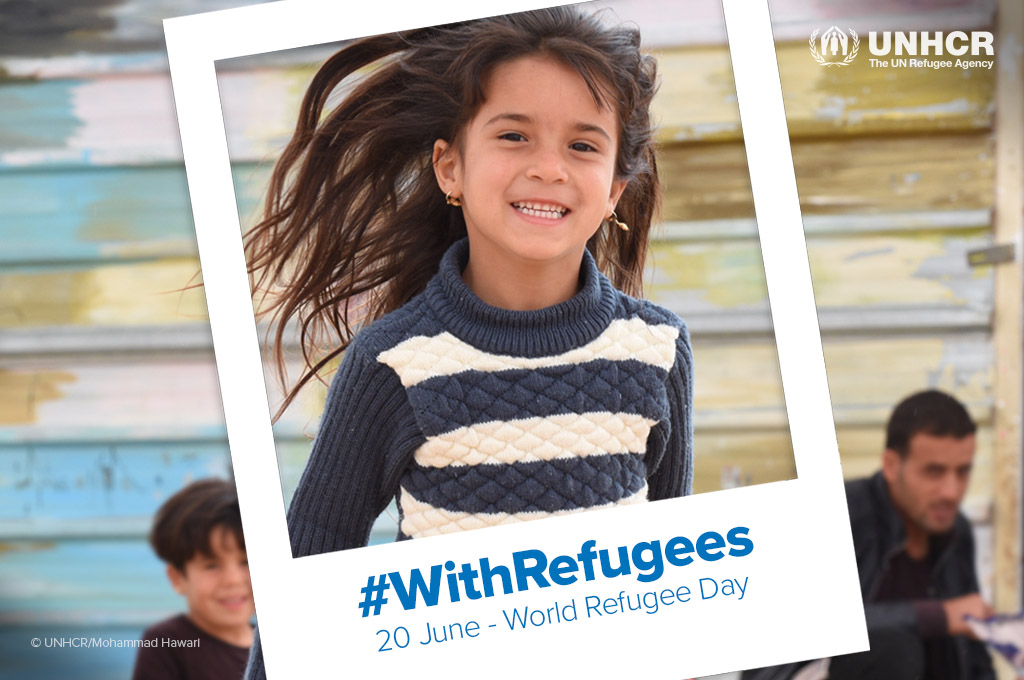
United Nations aim to remind the world that everyone, including refugees, can contribute to society and Every Action Counts in the effort to create a more just, inclusive, and equal world.  The COVID-19 pandemic and the recent anti-racism protests have shown us how desperately we need to fight for a more inclusive and equal world: a world where no one is left behind. It has never been clearer that all of us have a role to play in order to bring about change. Everyone can make a difference. This is at the heart of UNHCR’s World Refugee Day campaign. 


Act of Faith, Hope and Love

God of the life,
We believe in your infinite goodness
and your love gave rise to all creation.
Jesus Christ, Incarnate Word,
we believe that you teach us the way to welcome,
protect, promote and integrate every human being,
especially people in vulnerable situations.
Ruah, Spirit of Community,
you bring us together to work for justice and peace,
we believe that we all have a place in your loving heart.

We hope in you, God of life,
we wait on the promise that your people contain,
our migrant, immigrant and refugee sisters and brothers
are the living memory of a new heaven and a new earth.
We actively look forward to building your Kingdom,
we put our hope in the dynamism of your Incarnation in history
and in the call that you make to us every morning
to be a presence of compassion, freedom and mercy.

God, grace with us,
from your immense charity and your justice,
we firmly recognize that human dignity knows no borders.
We love that we are in your
human condition, courage, bread, promise and spring.
Thanks for showing us that at your table
we all have a place.

Amen
  

© A prayer resource by Congregational Justice, Peace and Integrity of Creation Office. A ministry of the Sisters of Charity of the Incarnate Word [World Refugee Day 2020] Free Resource

Friday, May 31, 2019

Prayer for World Refugee Day

Adonai,
Lord and Master,

Many are the journeys your people have taken:
Abraham’s journey led from fear to understanding;
Moses’ journey led from bondage to liberty;
the disciples’ journey led from death to new life.

Even today, your people journey— 
immigrants and refugees,
pilgrims and nomads,
searching for hope,
searching for opportunity,
searching for peace,
searching for you.

Lord, I know that I too am called to journey.
Yet too many times,
I have heard your call,
and my feet have remained unmoved.

Continue to call me
beyond my comfort and into encounter.
And when I meet a companion on the road,
may we find you in each other’s embrace.
Let us share the journey.

Amen

source: Share the Journey #sharejourney 

Pope’s message for 2019 World Day of Migrants and Refugees

Dear Brothers and Sisters,

Faith assures us that in a mysterious way the Kingdom of God is already present here on earth (cf. Gaudium et Spes, 39). Yet in our own time, we are saddened to see the obstacles and opposition it encounters. Violent conflicts and all-out wars continue to tear humanity apart; injustices and discrimination follow one upon the other; economic and social imbalances on a local or global scale prove difficult to overcome. And above all it is the poorest of the poor and the most disadvantaged who pay the price.

The most economically advanced societies are witnessing a growing trend towards extreme individualism which, combined with a utilitarian mentality and reinforced by the media, is producing a “globalization of indifference”. In this scenario, migrants, refugees, displaced persons and victims of trafficking have become emblems of exclusion. In addition to the hardships that their condition entails, they are often looked down upon and considered the source of all society’s ills. That attitude is an alarm bell warning of the moral decline we will face if we continue to give ground to the throw-away culture. In fact, if it continues, anyone who does not fall within the accepted norms of physical, mental and social well-being is at risk of marginalization and exclusion.

For this reason, the presence of migrants and refugees – and of vulnerable people in general – is an invitation to recover some of those essential dimensions of our Christian existence and our humanity that risk being overlooked in a prosperous society. That is why it is not just about migrants. When we show concern for them, we also show concern for ourselves, for everyone; in taking care of them, we all grow; in listening to them, we also give voice to a part of ourselves that we may keep hidden because it is not well regarded nowadays.

“Take courage, it is I, do not be afraid!” (Mt 14:27). It is not just about migrants: it is also about our fears. The signs of meanness we see around us heighten “our fear of ‘the other’, the unknown, the marginalized, the foreigner... We see this today in particular, faced with the arrival of migrants and refugees knocking on our door in search of protection, security and a better future. To some extent, the fear is legitimate, also because the preparation for this encounter is lacking” (Homily in Sacrofano, 15 February 2019). But the problem is not that we have doubts and fears. The problem is when they condition our way of thinking and acting to the point of making us intolerant, closed and perhaps even – without realizing it – racist. In this way, fear deprives us of the desire and the ability to encounter the other, the person different from myself; it deprives me of an opportunity to encounter the Lord (cf. Homily at Mass for the World Day of Migrants and Refugees, 14 January 2018).

“For if you love those who love you, what recompense will you have? Do not the tax collectors do the same?” (Mt 5:46). It is not just about migrants: it is about charity. Through works of charity, we demonstrate our faith (cf. Jas 2:18). And the highest form of charity is that shown to those unable to reciprocate and perhaps even to thank us in return. “It is also about the face we want to give to our society and about the value of each human life... The progress of our peoples... depends above all on our openness to being touched and moved by those who knock at our door. Their faces shatter and debunk all those false idols that can take over and enslave our lives; idols that promise an illusory and momentary happiness blind to the lives and sufferings of others” (Address at the Diocesan Caritas of Rabat, 30 March 2019).

“But a Samaritan traveller who came upon him was moved with compassion at the sight” (Lk 10:33). It is not just about migrants: it is about our humanity. Compassion motivated that Samaritan – for the Jews, a foreigner – not to pass by. Compassion is a feeling that cannot be explained on a purely rational level. Compassion strikes the most sensitive chords of our humanity, releasing a vibrant urge to “be a neighbour” to all those whom we see in difficulty. As Jesus himself teaches us (cf. Mt9:35-36; 14:13-14; 15:32-37), being compassionate means recognizing the suffering of the other and taking immediate action to soothe, heal and save. To be compassionate means to make room for that tenderness which today’s society so often asks us to repress. “Opening ourselves to others does not lead to impoverishment, but rather enrichment, because it enables us to be more human: to recognize ourselves as participants in a greater collectivity and to understand our life as a gift for others; to see as the goal, not our own interests, but rather the good of humanity” (Address at the Heydar Aliyev Mosque in Baku, 2 October 2016).

“See that you do not despise one of these little ones, for I say to you that their angels in heaven always look upon the face of my heavenly Father” (Mt 18:10). It is not just about migrants: it is a question of seeing that no one is excluded. Today’s world is increasingly becoming more elitist and cruel towards the excluded. Developing countries continue to be drained of their best natural and human resources for the benefit of a few privileged markets. Wars only affect some regions of the world, yet weapons of war are produced and sold in other regions which are then unwilling to take in the refugees produced by these conflicts. Those who pay the price are always the little ones, the poor, the most vulnerable, who are prevented from sitting at the table and are left with the “crumbs” of the banquet (cf. Lk 16:19-21). “The Church which ‘goes forth’... can move forward, boldly take the initiative, go out to others, seek those who have fallen away, stand at the crossroads and welcome the outcast” (Evangelii Gaudium, 24). A development that excludes makes the rich richer and the poor poorer. A real development, on the other hand, seeks to include all the world’s men and women, to promote their integral growth, and to show concern for coming generations.

“Whoever wishes to be great among you will be your servant; whoever wishes to be first among you will be the slave of all” (Mk10:43-44). It is not just about migrants: it is about putting the last in first place. Jesus Christ asks us not to yield to the logic of the world, which justifies injustice to others for my own gain or that of my group. “Me first, and then the others!” Instead, the true motto of the Christian is, “The last shall be first!” “An individualistic spirit is fertile soil for the growth of that kind of indifference towards our neighbours which leads to viewing them in purely economic terms, to a lack of concern for their humanity, and ultimately to feelings of fear and cynicism. Are these not the attitudes we often adopt towards the poor, the marginalized and the ‘least’ of society? And how many of these ‘least’ do we have in our societies! Among them I think primarily of migrants, with their burden of hardship and suffering, as they seek daily, often in desperation, a place to live in peace and dignity” (Address to the Diplomatic Corps, 11 January 2016). In the logic of the Gospel, the last come first, and we must put ourselves at their service.

“I came so that they might have life and have it more abundantly” (Jn 10:10). It is not just about migrants: it is about the whole person, about all people. In Jesus’ words, we encounter the very heart of his mission: to see that all receive the gift of life in its fullness, according to the will of the Father. In every political activity, in every programme, in every pastoral action we must always put the person at the centre, in his or her many aspects, including the spiritual dimension. And this applies to all people, whose fundamental equality must be recognized. Consequently, “development cannot be restricted to economic growth alone. To be authentic, it must be well-rounded; it must foster the development of each man and of the whole man” (SAINT PAUL VI, Populorum Progressio, 14).

“So then you are no longer strangers and sojourners, but you are fellow citizens with the holy ones and members of the household of God” (Eph 2:19). It is not just about migrants: it is about building the city of God and man. In our time, which can also be called the era of migration, many innocent people fall victim to the “great deception” of limitless technological and consumerist development (cf. Laudato Si’, 34). As a result, they undertake a journey towards a “paradise” that inevitably betrays their expectations. Their presence, at times uncomfortable, helps to debunk the myth of a progress that benefits a few while built on the exploitation of many. “We ourselves need to see, and then to enable others to see, that migrants and refugees do not only represent a problem to be solved, but are brothers and sisters to be welcomed, respected and loved. They are an occasion that Providence gives us to help build a more just society, a more perfect democracy, a more united country, a more fraternal world and a more open and evangelical Christian community” (Message for the 2014 World Day of Migrants and Refugees).

Dear brothers and sisters, our response to the challenges posed by contemporary migration can be summed up in four verbs: welcome, protect, promote and integrate. Yet these verbs do not apply only to migrants and refugees. They describe the Church’s mission to all those living in the existential peripheries, who need to be welcomed, protected, promoted and integrated. If we put those four verbs into practice, we will help build the city of God and man. We will promote the integral human development of all people. We will also help the world community to come closer to the goals of sustainable development that it has set for itself and that, lacking such an approach, will prove difficult to achieve.

In a word, it is not only the cause of migrants that is at stake; it is not just about them, but about all of us, and about the present and future of the human family. Migrants, especially those who are most vulnerable, help us to read the “signs of the times”. Through them, the Lord is calling us to conversion, to be set free from exclusivity, indifference and the throw-away culture. Through them, the Lord invites us to embrace fully our Christian life and to contribute, each according to his or her proper vocation, to the building up of a world that is more and more in accord with God’s plan.

In expressing this prayerful hope, and through the intercession of the Virgin Mary, Our Lady of the Way, I invoke God’s abundant blessings upon all the world’s migrants and refugees and upon all those who accompany them on their journey.

From the Vatican, 27 May 2019

FRANCIS

2019 World Refugee Day Action Ideas

Thursday, June 20th ─ and the entire month of June ─ we come together to celebrate the courage and resilience of refugees and their contributions to U.S. communities. We also raise our voices in opposition to the U.S. government’s decision to turn its back on refugees, through reducing resettlement in the United States and expanding policies that keep families apart.
While the United States was once a leader in protecting refugees, the current administration has dismantled our refugee resettlement program by 75%. But the need has never been greater, as the world is currently grappling with the worst refugee crisis in history. As refugees and friends of refugees, we are calling on the administration to preserve and expand refugee resettlement in the United States and enact policies that help refugees rebuild their lives.
Top 4 Ways to Protect Refugees and Restore the U.S. Resettlement Program
  1. Start by Sharing the Message on Social Media: Starting June 1 and every day thereafter, send a message of support on social media. Sample tweets available here. Sample graphics are available herebit.ly/WRDGraphics2019.Sample videos on welcoming refugees are linked, as well as a longer form video for screening at events. Follow @WeAreAllUSA on Twitter and "like" We Are All America on Facebook for more. Please use #WRD2019 in all postings.
  2. Host or Attend a Local World Refugee Day Event: Even small events, multiplied across the country, send a powerful message to the Trump administration and Congress that welcoming refugees and immigrants matters. Host a local World Refugee Day event or attend an event already being planned. We Are All America has a map where you can register your event, or find out what is going on in your area. Our partners Church World Service suggest a Journey Sabbath to dedicate a worship service to refugees. You can also link up with I Am An Immigrant actions. More resources are available here.
  3. Call Congress - National Call-in Day June 20th: Click here for information on calling Congress, and share with your networks for our massive call-in day June 20th, World Refugee Day. Sample script and click-to-call tool available here.
  4. Support Local Refugees Welcome Resolutions: Ask your state & local policymakers to pass Refugees Welcome resolutions in June. Click here for a sample resolution. Visit contactingcongress.org/local and usa.gov/elected-officials for contact information. Tweet at your governor and state legislators. Don’t forget #WRD2019!

Tuesday, May 28, 2019

Support Refugees and Prevent Trafficking

Image result for with refugees
U.S. Catholic Sisters Against Human Trafficking (USCSAHT) invites you to join us in honoring refugees. On June 20, World Refugee Day, we commemorate the strength, courage, and resilience of refugees. Today, an unprecedented 68.5 million people around the world have been forced from home. Among them are nearly 25.4 million refugees, over half of whom are under the age of 18.1 Every 15 minutes a family is forced to flee their homeland.
We know that there is a strong link between forced migration and human trafficking. Men, women, and children are made vulnerable to human trafficking by the mass displacement caused by violence, extreme poverty, humanitarian crises, climate change, natural disasters, and conflict. Impoverished, vulnerable families are targeted by traffickers who promise to provide education and opportunity only to exploit them through forced labor, sexual exploitation, enslavement, or organ theft.
Stand in solidarity #WithRefugees and #StopRefugeeTrafficking on World Refugee Day, Thursday, June 20, 2019. Join us in calling our Representative and Senators and urging them to support two pro-refugee bills:

  1. H.R.2146 / S.1088 GRACE Act
  2. H.R. 2214 / S.1123 NO BAN Act
Visit our website to learn about our 2019 World Refugee Campaign and discover more ways that you can support refugees on June 20 and throughout year. You’ll find backgrounders, resources for prayer, stories of trafficked immigrants and  asylum seekers, sample social media posts and more.
If you would prefer to download and print the 2019 World Refugee Toolkit, you’ll find a PDF file HERE.
Join us and Stand in Solidarity #WithRefugees and #StopRefugeeTrafficking on World Refugee Day, Thursday, June 20! 

Wednesday, June 13, 2018

Prayer for Refugees

Prayer of Pope Francis for Refugees 

Merciful God,
we pray to you for all the men, women and children 
who have died after leaving their homelands 
in search of a better life. 

Though many of their graves bear no name, 
to you each one is known, loved and cherished.
May we never forget them, 
but honor their sacrifice with deeds more than words.
 
We entrust to you all those who have made this journey, 
enduring fear, uncertainty and humiliation, 
in order to reach a place of safety and hope.

Just as you never abandoned your Son 
as he was brought to a safe place by Mary and Joseph, 
so now be close to these, your sons and daughters, 
through our tenderness and protection.

In caring for them may we seek a world 
where none are forced to leave their home 
and where all can live in freedom, dignity and peace.

Merciful God and Parent of all, 
wake us from the slumber of indifference, 
open our eyes to their suffering, 
and free us from the insensitivity 
born of worldly comfort and self-centredness.

Inspire us, as nations, communities and individuals, 
to see that those who come to our shores 
are our brothers and sisters.

May we share with them 
the blessings we have received from your hand, 
and recognize that together, as one human family, 
we are all migrants, 
journeying in hope to you, our true home, 
where every tear will be wiped away, 
where we will be at peace and safe in your embrace.

Amen 

20 Action Points for Refugees and Immigrants

Image result for pope francis refugeesFrom the beginning of his pontificate, using persuasive words and deeds, Pope Francis has urged the Church to accompany all people who are compelled to leave their country. In 2017, he established the Migrants and Refugees Section (M&R) to help him implement this pastoral objective. While M&R forms part of the new Dicastery for Promoting Integral Human Development under the direction of Cardinal Peter Turkson, the Section is personally guided by the Holy Father for the time being. Concerned with immediate humanitarian needs as well as long-term integral human development, the M&R Section focuses on the legal and policy frameworks which govern migration; on understanding the structural causes of forced displacement; and on achieving beneficial changes in the long run. 

Image result for refugees welcomeMigration has four possible stages. Migrants may be leaving their place of origin; in transit; arriving, with its subsequent process of integration; and perhaps choosing or obliged to return to their former homeland. In each of these stages, what is happening and why it is happening are of great interest. The Church encourages the Catholic faithful and everyone of good will to respond personally and communally to the material and spiritual needs of asylum seekers, refugees, migrants, internally displaced persons and victims of human trafficking.

Pope Francis knows what asylum-seekers, migrants and refugees need. We should welcome and protect them, he says, we should promote and integrate them. To do all this, here are some resources you can use in your community or parish … plus some policies to advocate in your country and at the U.N. level.

20 Pastoral Action Items:

Depending where you live, you may find refugees and migrants arriving, leaving, passing through, settling, and even returning to their place of origin. This is your chance to get personally involved in practical and spiritual ways. Lend them a hand and become their neighbor.

DOWNLOAD HERE


20 Government Action Items:
What about the laws and policies which govern human mobility in your own country and all over the world? Take these policy proposals up in your dialogue with your government and international organizations as they prepare the new Global Compacts on Migrants and on Refugees in 2018.

DOWNLOAD HERE

Full Packet
And you can also download the full packet of all the above information, including Pope Francis' message for World Day of Peace on Migrants and Refugees. This booklet presents three documents which provide the teaching, reflections and pastoral guidance of Pope Francis regarding the various issues concerning migrants and refugees. 

Tuesday, June 12, 2018

World Refugee Day and Human Trafficking

On World Refugee Day, June 20, we take time to remember the strength, courage, and resilience of the millions forced to flee their homes by violence of every kind. Today, more than 50 million people are displaced by war and violence, some 33.3 million in their own country and 16.7 million as refugees, mostly in neighboring countries. Every 15 minutes a family is forced to flee their homeland.

The US Catholic Sisters Against Human Trafficking Advocacy Working Group has prepared a Toolkit for World Refugee Day, highlighting the connection between the plight of refugees and their vulnerability to human trafficking.  Men, women, and children are made vulnerable to human trafficking by the mass displacement caused by violence, extreme poverty, humanitarian crises, natural disasters, and conflict. Impoverished, vulnerable people are targeted by traffickers who promise to provide education and opportunity only to exploit them through forced labor, sexual exploitation, enslavement, or organ theft.

We invite you to take action on June 20, World Refugee Day to #StopRefugeeTrafficking.

1) We are asking you to make calls to your senators asking the senators to support the bipartisan bill, S. 1580. Here is a sample script, talking points, and a link to the bill. https://bit.ly/2Jmg51T

Call your Senators and ask them to co-sponsor the bi-partisan S. 1580, “Protecting Girls’ Access to Education in Vulnerable Settings Act.”  You can find your Senators’ contact information here. Alternatively you can call the United States Capitol switchboard at (202) 224-3121. A switchboard operator will connect you directly with the Senate office.

Suggested Script: 
I’m your constituent from [CITY/TOWN] and as a person of faith [and a Catholic sister], on World Refugee Day I urge you to do all that you can to protect and support refugees and to ensure that our country fulfills its legal and moral obligation to welcome refugees.

Today, more than 22 million people have been forced to flee their countries to escape violence, persecution, or natural disasters. More than half of these refugees are children. Refugee children, especially girls, are vulnerable to human trafficking, early marriage, and forced labor. Providing opportunities for education is one way to reduce their risk of being trafficked.

You can support refugee children by co-sponsoring the bi-partisan S. 1580“Protecting Girls’ Access to Education in Vulnerable Settings Act.” This bill will help to ensure that refugee children, especially girls, have access to education that will strengthen and empower them. 

2)  View the World Refugee day Campaign materials on the USCSAHT website for additional action items.

3)  Resources to help you plan to #StopRefugeeTrafficking:

4)  Additional resources from our friends and colleagues: