
Sister María Luisa Velez CCVI found inspiration to create a space of care, growth, and hope, from the sacred pages of the Gospel to the most fragile streets affected by poverty. Here we share a brief chronicle of her journey. It's a story of how the gospel of love guides each step, from the seed of the idea to the flourishing of a shared mission. The story of the Santa Fe Shelter reminds us that even in the most challenging times, the light of the Gospel can guide the way and ignite solidarity.
A Passionate Love
By Miriam Bannon CCVI
Back in 1969, when Sister María Luisa was a junior sister working as a teacher at the Miguel Angel Institute, Sister Lourdes Nava invited her to a course at ITES on liberation theology. This course broadened her horizons. If her heart had burned with the changes of Vatican II before, in the way of living and acting in the Church, now it burned even more with hope for social justice. Later in 1985, the congregation offered María Luisa another opportunity to take a five-month course in missiology in Brazil. There, she had the pleasure of meeting 40 people from different countries who all shared the same longing: to be an open and committed church. Juan Luis Segundo, Pablo Richards, Gustavo Gutiérrez, Salvador Beocio, and others were her teachers, and they spoke to her about the role of laypeople, religious sisters, and brothers inserted in the peripheries.
Encounter with the Word of God in Peripheral Communities
These courses, along with some workshops at MACC in San Antonio, led our Sister María Luisa, after finishing her period in congregational leadership from 1984 to 1990, to take a sabbatical year in South America with the purpose of learning about the experiences of CEBs (Base Ecclesial Communities) in the peripheries. For this, Sister María Luisa contacted congregations in Chile, Brazil, Peru, Bolivia, Ecuador, Colombia, Nicaragua, El Salvador, Honduras, and Guatemala. Wherever she went, she tried to stay with communities in peripheral populations. In these communities, she met the CEBs where they talked about life. They talked about a nearby God, living among them, fighting for justice. They shared about the struggles to earn money to live each day. Sister María Luisa became more and more convinced that this was what it meant to be a church. She recalls that in Chile, for example, she met a priest named Mariano Puga. Father Mariano chose to live in poverty and in the periphery. Although he was an architect before becoming a priest, he worked eight hours a day as a wall painter, and in the evening, after finishing his work, he celebrated mass with all the people in the neighborhood. After mass and fellowship, at the end of the day, between 10:00 and 11:00 p.m., he prayed together with his small community. When Sister María Luisa arrived, Father Mariano went to sleep on a bunk bed to give María Luisa his small room, which only had a bed, a chair, and a suitcase.
Completing her sabbatical year, María Luisa returned to Mexico completely convinced that the only way to make a change is through the Word of God in a peripheral neighborhood.
 Base Ecclesial Communities in the Parish of La Asunción, Santa Fe
In 1991, María Luisa established a mixed community of sisters and lay missionaries who wanted to serve in the Parish of La Asunción, Santa Fe, CDMX. After a year of arriving, the community looked for a house in the Ampliación el Pirul neighborhood in the Santa Fe ravine. There, María Luisa and I began teaching popular Bible classes in different homes. Sister María Luisa dreamed of transmitting the type of Church she had experienced in Latin America. She based her Bible classes on the writings of Carlos Mesters, Carlos Bravo, Gustavo Gutiérrez, and Leonardo Boff, among others, following Javier Saravia's methodology. She ensured that it was a participatory, open, and ecumenical reflection.
What she had experienced in the Bible study ignited the hearts in the group, and over time led the participants to form two CEB groups. These communities, by praying and seeing reality in the light of the Word of God, came to the conclusion that it was important to do something for the community. At that time, there was a lot of garbage in the streets of Santa Fe. They started a first project around garbage, making the decision to separate the garbage, but after a few months, it overwhelmed them because there was too much garbage, and they stopped separating it.
The second initiative of the base communities was about food. Through Sister María Teresa Valdez, they met the owners of Verde Valle (a company that sells seeds). They spoke with the owners and managed to buy the seeds with a 25% discount. The communities opened a store selling basic products - beans, rice, lentils, etc. Of the 25% discount, the communities only took 5% to pay for transportation and something for the person selling. This allowed people to buy with a 20% discount off the cost. They did very well in sales at first because the products were of quality. But then, after five months, Bodega Aurrera opened its store and started selling cheaper products, but not of the same quality. Sadly, the CEBs realized that it was no longer convenient to sell because people were buying from the other store.
The communities thought again about what they could do. The idea of a daycare center emerged among them because they saw it as a great need. Sister María Luisa recalls stories of moms who, because they had to go to work, turned off the gas and lights and left their children locked up. Other times they left the children with the grandmothers, but when the children grew up and started running around, the grandmothers couldn't keep up. Since the parish was sectored, the CEBs decided to conduct a survey in each of the nine zones to see what people thought about childcare while moms worked. It was unanimous. All the surveyed families agreed that a daycare center was necessary.
After confirming that it was indeed a necessity, Sister María Luisa surveyed the members of the CEBs who wanted to work in a daycare center and encouraged them to prepare. About 15 people said yes and chose to take a six-month course in popular education in childcare and preschool education. After finishing the course, Sister María Luisa insisted a lot, emphasizing that it was very important to continue studying because the daycare center had to be incorporated into the SEP (Secretary of Public Education). In addition, Sister María Luisa committed to accompany them in the search for donations to continue studying.
Their motivation always came from the Word of God, now embodied in their hearts, hands, and feet. While they prepared, they looked for a house for rent to start the daycare center. Thank God, they were lucky to find a spacious house on Paso Ancho Street, #149, in Colonia Ampliación La Mexicana, and there they started the daycare center, under the direction of Mrs. Lourdes Cruz, on October 1, 1995. They named it Estancia Infantil Vasco de Quiroga in honor of the founder of the Santa Fe Hospital Village.
They remained in the house on Paso Ancho for several years during which the communities began to think about establishing themselves as a private assistance institution so that the daycare center would stay in Santa Fe and no one could take it away. After consulting with the communities, Sister María Luisa integrated a board of trustees.
- President, herself, Sister María Luisa
- Secretary, Ms. Patricia Mañon
- Treasurer, Mrs. Aurora Alcántara
- Members, Mrs. Vivian Kolher and Mrs. María Vélez

At the same time, they began to raise funds for the purchase of a larger house for the daycare. Most of the donations were obtained through family and friends. Little by little, the money was gathered for the purchase of a spacious house that they had seen and seemed suitable on Ramón López Velarde street, in Santa Fe. Upon purchasing the house, they had to fix it and adapt it to the needs of a daycare. Despite the repairs, the cost increased. Guadalupe Vélez, the biological sister of Sister María Luisa, was the architect who helped a lot to restore the house. She reviewed the foundation to prevent it from collapsing in case of an earthquake. She had to tear down some parts of the house to ensure that everything was okay. She only charged for the labor costs, but not really for her work. Like her, other people were very generous. Mrs. Aurora Alcántara put the roof in the patio and the Miguel Angel Institute donated tables, chairs, and desks.
Eight years later, in mid-2003, when everything was arranged, the daycare moved to Ramón Lopez Velarde #7, with 15 trained people. Sister María Luisa continued to remind them that their work went beyond taking care of girls and boys, but also to continue their professional development.
LEAPS OF JOY AND CHALLENGES ALONG THE WAYMaría Luisa recounted many challenges and leaps of joy along the way.
Leaps of Joy…
The Word of God in the CEBs that led participants to commit to a strong and long-term service in the community.
People committed to providing quality care to babies, children, and also to fathers and mothers.
The support of the board, especially Mrs. Aurora Alcantara, who personally attended the daycare very frequently. In addition to guiding the teachers to redesign the spaces in the classrooms, she supported in the daily meal times for several years. Mrs. Vivian Kohler, as a board member, was concerned about the daycare's finances by sending her daughter and a trusted gentleman to review that the finances were in good condition. Mrs. María Vélez financially contributed to the needs that arose and continues to contribute to this day. Miss Patricia Mañon contributed with her pedagogical experience, working with the teachers. Many other people and institutions have also contributed time and resources - Monte de Piedad, our congregation: the Sisters of Charity of the Incarnate Word, the Hilton Foundation, and others. The present staff who continue to study. They are prepared to meet the demands of the SEP and reality to provide a better service to parents and children.
Challenges…
For many years, the staff did not want to continue preparing themselves: Only one person, Lucy Sánchez, continued studying, graduating as a teacher.
Changes in personnel management: Upon joining the SEP, the required requirements had to be met. When inspectors came, they checked even under the carpet. It was not easy to find qualified people, with the gift of integrating a team and treating teachers horizontally, keeping the study plans up to date and not missing work. Over the course of 25 years, there were eight changes in directors.
Management was difficult: There was a time when funds were not managed with due attention. It seemed that there was always a lack of money.

SECOND PART: "I am a teacher by profession and by heart," says Francisca.
TEACHER FRANCISCA GARCIA
I came to know Sister María Luisa because the daycare, initially, was on my street (Paso Ancho), practically in front of my house. Upon retiring as a teacher, María Luisa asked me to help her with the procedures to incorporate the daycare into the SEP (Secretariat of Public Education). I gladly responded because I believed in the daycare project and also wanted to lend a hand to Sister María Luisa. From there, in 2002, I started as a teacher. A year later, I was invited to be the director. Upon assuming this responsibility, I dedicated myself first to improving some practical aspects, for example, the quality of food for the children and cleanliness. In fact, every year I set myself a goal and it gives me great satisfaction to achieve it. On one occasion, realizing that motivation had decreased, my goal was to sow a better vision and a commitment from the teachers to continue studying and improving themselves. It was an uphill battle. Many left because they did not want to continue studying. Thank God, currently, all the teachers are certified. Along with the director, Mrs. Rosario Márquez Silva, and the team of teachers, we promote psychomotor development. We emphasize the adequate preparation of children to start primary school and familiarize them with the computer. We work together. There is a sense of teamwork and responsibility. We work with creativity and a good disposition.
I was also pleased to receive from 2008 to 2012, about six lay missionaries of the Incarnate Word who served for one or two years in the daycare. They assisted the teachers in educational activities with the children. They taught English and lived both with the teachers and with the children. I was impressed to see how they were becoming aware of the social and economic situation of the children.
A strong aspect of my work as director was management. Thank God, as the daycare grew, in 2015 it was decided to separate the two functions and I remained as administrator.
The key for me is to encourage co-responsibility, to link parents with the educational process. We invite them to participate in activities at the daycare and they respond. It is a great joy to meet them. In fact, one of the fathers who was at the daycare 20 years ago, now has his son with us, in 3rd grade of preschool. Currently, we have 50 children in grades:
- Nursery 1, from 1 ½ years to 2 years 5 months
- Nursery 2, from 2 ½ years to 2 years 11 months
- Preschool 1, 3 years old
- Preschool 2, 4 years old
- Preschool 3, 5 years old
We communicate with parents through bimonthly evaluations of their children's development. Additionally, we organize talks on development itself, nutrition, and health (particularly regarding vaccines).
Currently, our hours of operation are from 8:00 am to 3:00 pm. In the future, we would like to extend the hours because many parents finish work at 7:00 pm. Along with this, we would like to resume the service of caring for infants. It is a very big challenge because it would imply double shifts. Another challenge is administration itself. We have to upload the financial statements and reports to the platforms of both the IAP and the SAT. Our tuition fees are low because our raison d'être is to serve low-income families but our economic resources are few. Here is the translation:
Although we receive help from relatives and friends of Sister María Luisa, it remains a challenge to stay up to date with payments and not have debts. Our current goal is to reach 100 children. This way, we could cover expenses without having to rely on donations for the daily operation of the daycare.

PRINCIPAL ROSARIO MÁRQUEZ SILVA
I started at the daycare in August 2021. It was a very difficult year. We were emerging from Covid. We had to learn to teach online and from our homes. Sadly, at that time, my husband died of Covid, and I was hospitalized and intubated for fourteen days. Now, post-Covid, there is a new outlook. The number of boys and girls coming to the daycare is increasing; people speak very well of our services. We are already eight teachers. Teaching through projects is working well for us. We have taken training courses in active schools rather than methodical ones. Our boys and girls learn to explore and investigate. It is self-learning. In addition to education, we strive to care for nutritional value, and we have managed to resume the dining hall. We hope that more people will continue to find in our institution a safe space for growth.
I conclude with gratitude for the sacred stories that have been shared with me. Certainly, this is a story of faith, hope, and action, where the Gospel lights the way to a future brimming with possibilities.
By Miriam Bannon CCVI
Back in 1969, when Sister María Luisa was a junior sister working as a teacher at the Miguel Angel Institute, Sister Lourdes Nava invited her to a course at ITES on liberation theology. This course broadened her horizons. If her heart had burned with the changes of Vatican II before, in the way of living and acting in the Church, now it burned even more with hope for social justice. Later in 1985, the congregation offered María Luisa another opportunity to take a five-month course in missiology in Brazil. There, she had the pleasure of meeting 40 people from different countries who all shared the same longing: to be an open and committed church. Juan Luis Segundo, Pablo Richards, Gustavo Gutiérrez, Salvador Beocio, and others were her teachers, and they spoke to her about the role of laypeople, religious sisters, and brothers inserted in the peripheries.
Encounter with the Word of God in Peripheral Communities
These courses, along with some workshops at MACC in San Antonio, led our Sister María Luisa, after finishing her period in congregational leadership from 1984 to 1990, to take a sabbatical year in South America with the purpose of learning about the experiences of CEBs (Base Ecclesial Communities) in the peripheries. For this, Sister María Luisa contacted congregations in Chile, Brazil, Peru, Bolivia, Ecuador, Colombia, Nicaragua, El Salvador, Honduras, and Guatemala. Wherever she went, she tried to stay with communities in peripheral populations. In these communities, she met the CEBs where they talked about life. They talked about a nearby God, living among them, fighting for justice. They shared about the struggles to earn money to live each day. Sister María Luisa became more and more convinced that this was what it meant to be a church. She recalls that in Chile, for example, she met a priest named Mariano Puga. Father Mariano chose to live in poverty and in the periphery. Although he was an architect before becoming a priest, he worked eight hours a day as a wall painter, and in the evening, after finishing his work, he celebrated mass with all the people in the neighborhood. After mass and fellowship, at the end of the day, between 10:00 and 11:00 p.m., he prayed together with his small community. When Sister María Luisa arrived, Father Mariano went to sleep on a bunk bed to give María Luisa his small room, which only had a bed, a chair, and a suitcase.
Completing her sabbatical year, María Luisa returned to Mexico completely convinced that the only way to make a change is through the Word of God in a peripheral neighborhood.

In 1991, María Luisa established a mixed community of sisters and lay missionaries who wanted to serve in the Parish of La Asunción, Santa Fe, CDMX. After a year of arriving, the community looked for a house in the Ampliación el Pirul neighborhood in the Santa Fe ravine. There, María Luisa and I began teaching popular Bible classes in different homes. Sister María Luisa dreamed of transmitting the type of Church she had experienced in Latin America. She based her Bible classes on the writings of Carlos Mesters, Carlos Bravo, Gustavo Gutiérrez, and Leonardo Boff, among others, following Javier Saravia's methodology. She ensured that it was a participatory, open, and ecumenical reflection.
What she had experienced in the Bible study ignited the hearts in the group, and over time led the participants to form two CEB groups. These communities, by praying and seeing reality in the light of the Word of God, came to the conclusion that it was important to do something for the community. At that time, there was a lot of garbage in the streets of Santa Fe. They started a first project around garbage, making the decision to separate the garbage, but after a few months, it overwhelmed them because there was too much garbage, and they stopped separating it.
The second initiative of the base communities was about food. Through Sister María Teresa Valdez, they met the owners of Verde Valle (a company that sells seeds). They spoke with the owners and managed to buy the seeds with a 25% discount. The communities opened a store selling basic products - beans, rice, lentils, etc. Of the 25% discount, the communities only took 5% to pay for transportation and something for the person selling. This allowed people to buy with a 20% discount off the cost. They did very well in sales at first because the products were of quality. But then, after five months, Bodega Aurrera opened its store and started selling cheaper products, but not of the same quality. Sadly, the CEBs realized that it was no longer convenient to sell because people were buying from the other store.
The communities thought again about what they could do. The idea of a daycare center emerged among them because they saw it as a great need. Sister María Luisa recalls stories of moms who, because they had to go to work, turned off the gas and lights and left their children locked up. Other times they left the children with the grandmothers, but when the children grew up and started running around, the grandmothers couldn't keep up. Since the parish was sectored, the CEBs decided to conduct a survey in each of the nine zones to see what people thought about childcare while moms worked. It was unanimous. All the surveyed families agreed that a daycare center was necessary.
After confirming that it was indeed a necessity, Sister María Luisa surveyed the members of the CEBs who wanted to work in a daycare center and encouraged them to prepare. About 15 people said yes and chose to take a six-month course in popular education in childcare and preschool education. After finishing the course, Sister María Luisa insisted a lot, emphasizing that it was very important to continue studying because the daycare center had to be incorporated into the SEP (Secretary of Public Education). In addition, Sister María Luisa committed to accompany them in the search for donations to continue studying.
Their motivation always came from the Word of God, now embodied in their hearts, hands, and feet. While they prepared, they looked for a house for rent to start the daycare center. Thank God, they were lucky to find a spacious house on Paso Ancho Street, #149, in Colonia Ampliación La Mexicana, and there they started the daycare center, under the direction of Mrs. Lourdes Cruz, on October 1, 1995. They named it Estancia Infantil Vasco de Quiroga in honor of the founder of the Santa Fe Hospital Village.
They remained in the house on Paso Ancho for several years during which the communities began to think about establishing themselves as a private assistance institution so that the daycare center would stay in Santa Fe and no one could take it away. After consulting with the communities, Sister María Luisa integrated a board of trustees.
- President, herself, Sister María Luisa
- Secretary, Ms. Patricia Mañon
- Treasurer, Mrs. Aurora Alcántara
- Members, Mrs. Vivian Kolher and Mrs. María Vélez

At the same time, they began to raise funds for the purchase of a larger house for the daycare. Most of the donations were obtained through family and friends. Little by little, the money was gathered for the purchase of a spacious house that they had seen and seemed suitable on Ramón López Velarde street, in Santa Fe. Upon purchasing the house, they had to fix it and adapt it to the needs of a daycare. Despite the repairs, the cost increased. Guadalupe Vélez, the biological sister of Sister María Luisa, was the architect who helped a lot to restore the house. She reviewed the foundation to prevent it from collapsing in case of an earthquake. She had to tear down some parts of the house to ensure that everything was okay. She only charged for the labor costs, but not really for her work. Like her, other people were very generous. Mrs. Aurora Alcántara put the roof in the patio and the Miguel Angel Institute donated tables, chairs, and desks.
Eight years later, in mid-2003, when everything was arranged, the daycare moved to Ramón Lopez Velarde #7, with 15 trained people. Sister María Luisa continued to remind them that their work went beyond taking care of girls and boys, but also to continue their professional development.
LEAPS OF JOY AND CHALLENGES ALONG THE WAYMaría Luisa recounted many challenges and leaps of joy along the way.
Leaps of Joy…
The Word of God in the CEBs that led participants to commit to a strong and long-term service in the community.
People committed to providing quality care to babies, children, and also to fathers and mothers.
The support of the board, especially Mrs. Aurora Alcantara, who personally attended the daycare very frequently. In addition to guiding the teachers to redesign the spaces in the classrooms, she supported in the daily meal times for several years. Mrs. Vivian Kohler, as a board member, was concerned about the daycare's finances by sending her daughter and a trusted gentleman to review that the finances were in good condition. Mrs. María Vélez financially contributed to the needs that arose and continues to contribute to this day. Miss Patricia Mañon contributed with her pedagogical experience, working with the teachers. Many other people and institutions have also contributed time and resources - Monte de Piedad, our congregation: the Sisters of Charity of the Incarnate Word, the Hilton Foundation, and others. The present staff who continue to study. They are prepared to meet the demands of the SEP and reality to provide a better service to parents and children.
The pillar that has been Ms. Francisca García, widely known and respected in the Santa Fe community. Thanks to her tenacity as an administrator and director, the daycare has continued with a maximum level of attention, a respectful environment, a pleasant, clean, and welcoming place. In addition, she has been a key person for the unity and spirit of the staff.
Challenges…
For many years, the staff did not want to continue preparing themselves: Only one person, Lucy Sánchez, continued studying, graduating as a teacher.
Changes in personnel management: Upon joining the SEP, the required requirements had to be met. When inspectors came, they checked even under the carpet. It was not easy to find qualified people, with the gift of integrating a team and treating teachers horizontally, keeping the study plans up to date and not missing work. Over the course of 25 years, there were eight changes in directors.
Management was difficult: There was a time when funds were not managed with due attention. It seemed that there was always a lack of money.

SECOND PART: "I am a teacher by profession and by heart," says Francisca.
TEACHER FRANCISCA GARCIA
I came to know Sister María Luisa because the daycare, initially, was on my street (Paso Ancho), practically in front of my house. Upon retiring as a teacher, María Luisa asked me to help her with the procedures to incorporate the daycare into the SEP (Secretariat of Public Education). I gladly responded because I believed in the daycare project and also wanted to lend a hand to Sister María Luisa. From there, in 2002, I started as a teacher. A year later, I was invited to be the director. Upon assuming this responsibility, I dedicated myself first to improving some practical aspects, for example, the quality of food for the children and cleanliness. In fact, every year I set myself a goal and it gives me great satisfaction to achieve it. On one occasion, realizing that motivation had decreased, my goal was to sow a better vision and a commitment from the teachers to continue studying and improving themselves. It was an uphill battle. Many left because they did not want to continue studying. Thank God, currently, all the teachers are certified. Along with the director, Mrs. Rosario Márquez Silva, and the team of teachers, we promote psychomotor development. We emphasize the adequate preparation of children to start primary school and familiarize them with the computer. We work together. There is a sense of teamwork and responsibility. We work with creativity and a good disposition.
I was also pleased to receive from 2008 to 2012, about six lay missionaries of the Incarnate Word who served for one or two years in the daycare. They assisted the teachers in educational activities with the children. They taught English and lived both with the teachers and with the children. I was impressed to see how they were becoming aware of the social and economic situation of the children.
A strong aspect of my work as director was management. Thank God, as the daycare grew, in 2015 it was decided to separate the two functions and I remained as administrator.
The key for me is to encourage co-responsibility, to link parents with the educational process. We invite them to participate in activities at the daycare and they respond. It is a great joy to meet them. In fact, one of the fathers who was at the daycare 20 years ago, now has his son with us, in 3rd grade of preschool. Currently, we have 50 children in grades:
- Nursery 1, from 1 ½ years to 2 years 5 months
- Nursery 2, from 2 ½ years to 2 years 11 months
- Preschool 1, 3 years old
- Preschool 2, 4 years old
- Preschool 3, 5 years old
We communicate with parents through bimonthly evaluations of their children's development. Additionally, we organize talks on development itself, nutrition, and health (particularly regarding vaccines).
Currently, our hours of operation are from 8:00 am to 3:00 pm. In the future, we would like to extend the hours because many parents finish work at 7:00 pm. Along with this, we would like to resume the service of caring for infants. It is a very big challenge because it would imply double shifts. Another challenge is administration itself. We have to upload the financial statements and reports to the platforms of both the IAP and the SAT. Our tuition fees are low because our raison d'être is to serve low-income families but our economic resources are few. Here is the translation:
Although we receive help from relatives and friends of Sister María Luisa, it remains a challenge to stay up to date with payments and not have debts. Our current goal is to reach 100 children. This way, we could cover expenses without having to rely on donations for the daily operation of the daycare.
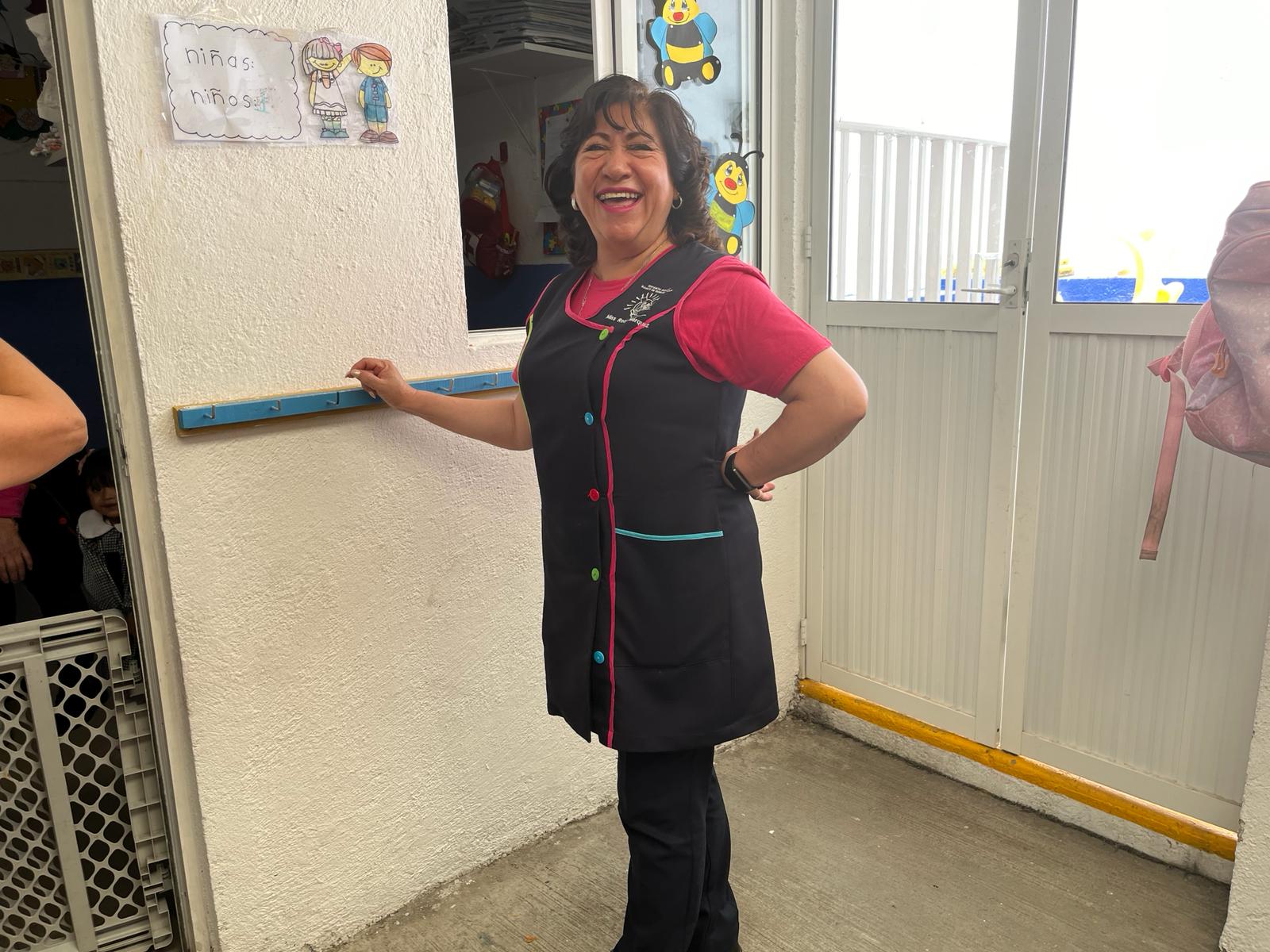
I started at the daycare in August 2021. It was a very difficult year. We were emerging from Covid. We had to learn to teach online and from our homes. Sadly, at that time, my husband died of Covid, and I was hospitalized and intubated for fourteen days. Now, post-Covid, there is a new outlook. The number of boys and girls coming to the daycare is increasing; people speak very well of our services. We are already eight teachers. Teaching through projects is working well for us. We have taken training courses in active schools rather than methodical ones. Our boys and girls learn to explore and investigate. It is self-learning. In addition to education, we strive to care for nutritional value, and we have managed to resume the dining hall. We hope that more people will continue to find in our institution a safe space for growth.
I conclude with gratitude for the sacred stories that have been shared with me. Certainly, this is a story of faith, hope, and action, where the Gospel lights the way to a future brimming with possibilities.


