
Since we know you love being part of the moments that unite us for our common home, we invite you to the global event where small actions can inspire great change. Reserve your spot and join from anywhere in the world:
Peace with creation!


Article 68 (highlight): The creation operates in balance. There is production and consumption. This is part of the laws of nature. It operates in a healthy way only if we give it a space to grow, ripen, rot or decompose and be used again in ecosystem. Just as God rested on the seventh day when God created the universe/and cosmos, every parts of creation need rest for a reason.
Genesis 29-30 And God said, “Behold, I have given you every plant yielding seed which is upon the face of all the earth, and every tree with seed in its fruit; you shall have them for food. And to every beast of the earth, and to every bird of the air, and to everything that creeps on the earth, everything that has the breath of life, I have given every green plant for food.”
Article 208 (highlight): We can show concern for things that are beyond us. There is an attitude of indifference where we do not concern ourselves with what is happening to our brothers and sisters including the other parts of nature surrounding us.
Article 231 (highlight): Social love and culture of care will connect our lives more socially, politically, economically and culturally so that our spirituality is more integrated. Our relation can mature towards a responsible and systemic charity for regeneration and renewal of our commitment to care for our common good where we have concrete actions on our social responsiblity.


Spiritual Care Department supported the Earth day by being able to raised the importance of advocacy that plastic pollution has become an epidemic in the world. It is all around our home, communities, parishes, schools, restaurants, streets, rivers, beaches, etc. How do we stop and be more aware that we are all contributors to this epidemic? How do we stop our arrogance against nature that we cannot do whatever we want in terms of our shopping, eating, and living practices having the plastics parts of the daily consumption and trash? By the questions that we gave to the employees in one of our hospitals, it helped to stop people that there is an issue and they too can raise awareness that there is an issue to be tackled. We sponsored a raffle in one of our hospitals during the Earth Month to raise awareness and ask the people about the three questions:
1. What is the theme of this year’s (2024) Earth Day? Stop Plastic
2. Plastics are a danger to humanity and all living creatures, disrupting the delicate balance of life on earth. True
3. United States Health costs this much increase due to chemicals used in plastics: $200 Billion

Pope Francis, through Laudato Si, is teaching us that we are all connected and where everything impacts another creature or entity in the bios. Pope Francis has been advocating and inviting people of the world towards ecological conversation. Even further, Yaka in his article “Rethinking Justice: Struggles for Environmental Commons and the Notion of Socio‐Ecological Justice,” argues that with a socio-ecological consciousness we become aware that human and non-human life can co-exist with dignity.
Everybody has their own way of expressing their care of the earth and perhaps some are not yet aware of how their carbon footprint impacts the bigger picture. Each of these contributes to the climate change which we all share. Pope Francis wrote the Laudate Deum as a follow-up on what has transpired since the Laudato Si in 2015.

Reflection Questions:
· What have you done differently for Laudato Si or what are you able to do for Laudato Si Care of our Common Home?
· How do you see the Laudate Deum of Pope Francis helping in raising the urgency of the Climate Crisis?
· What are you able to do for your community knowing about this topic?
June 5 is the World Environment Day, let us be mindful that the environment is a common good and deserves our attention to be mindful stewards of it. Find out more about this event in https://www.unep.org/events/un-day/world-environment-day-2024

Written by Sr. Marylou Rodriguez CCVI.
Events
God showed
us how the power of contemplation and actions can free the people from slavery and
oppression (John 5:8). God wants our
participation. Human beings can participate
in creation or destruction. They can contribute to good or to bad in the world.
As human
beings, we thrive through cooperation, collaboration, and just social interactions. We naturally are attracted to beauty,
goodness, and things that make us joyful, but we can become immune to what is
wrong.
We can make
bad choices repeatedly and refuse to recognize those. Or we can take time to
contemplate our actions and make choices to cultivate the good. We have the
power to break the convenient sinful habits with something that is good.
Someone pays
for the wrong convenience that we opt to choose. The fracking and burning of fossil fuels
producing various single-use disposable items, and mass-produced resources in
capitalist economy contribute easily to global climate crisis. Someone who is poor and vulnerable, with the
least means to mitigate the risk, eventually can reap the bad effects of our
actions.
What
alternatives do we have?


Sisters
Consuelo, Juanita, and Angela encouraged everyone to remember that we are part
of the solution. They highlighted the importance of looking at our daily
consumption and our actions (e.g., recyclables, reusables, etc.).
Jesus asked the blind man to pick up his mat and walk. He did not magically heal the blind man and continue to leave him in a place of despair. The man had hoped for salvation for thirty-eight years. Jesus wanted him to actively participate in his cure. The solution to Climate Change will not magically happen. We have the abilities to put the solution into action. God wants us to pick up our mat and walk.
A few days before the event, Sr. Marylou R. head out to Marquee Plaza to fall in line among the hundreds who wanted to get a free tree to make the City of San Antonio green. This was the prize that we planned to give away for the UIW students and advocate for Care of Our Common Home. Sr. Mary P, Sr. Josetta E, and Sr. Marylou R helped each other to get the materials set-up especially the QR codes for the bookmarks.

"The Incarnate Word Sisters,


 |
| JPIC stands for Justice, Peace and Integrity of Creation |
Súmate is back!
This contest is an excellent opportunity to work as a team, collaborate with those in need, and take care of our common home.
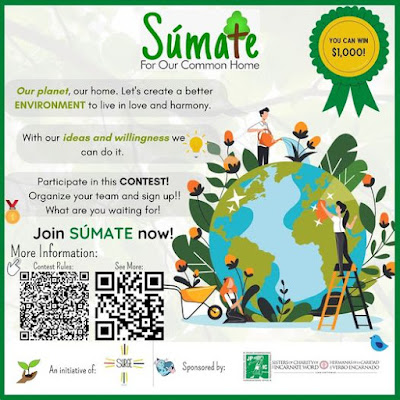
Let's value life; let's be agents of transformation. Our planet is our home. It is the place where we enjoy our families and our friendships. Our common home is waiting for us to value and protect it.
Marylou Rodriguez, our novice sister, shares with us her presentation prepared for the Philippine Sisters Gathering at Zoom (October 17, 2021). Through the reality in the Philippines, Marylou shares how each effort and/or action no matter how small it is perceived can make a difference.
You can watch the presentation by clicking here:
https://my.visme.co/view/dmpd1jyv-plastic-and-sustainability

The JPIC Commission gives important details about the what is being done and what can be done about the religious participation in COP26. Many religious women and men are listening to the cries of the Earth and the Poor. They are raising awareness about difficult world situations, giving answers at a local level and international level, advocating to give voice to the voiceless and find solutions together to face the world's crisis. Here there is a video which explain the JPIC Commission USG-UISG and presents examples of how religious preparing and will participate in the COP 26. Enjoy this video!
In addition, a Religious Addressing Factors of Climate Change for COP26 video presented by Sowing Hope for the Planet features clips from a recent webinar where religious shared their actions and perspectives on climate change activism. The participants shared experiences on how climate change affects farming communities and access to food, as well as their efforts towards raising awareness about unethical investing and other strategies that we can use to mitigate the effects of climate change.
Finally, the Solidarity in Building a Better world video features inspiring and engaging conversations from religious encouraging involvement in the Laudato Si' Action Platform, resources available from the LSAP website, preparation for COP26, local contributions to climate change activism and news and shared perspectives from members around the world including Japan, the Philippines, the USA, Peru and Bolivia.
Advocacy opportunity and resources
As you know well, human activity is warming our planet at an unprecedented rate. The UN’s Intergovernmental Panel on Climate Change (IPCC) warns that humanity only has a few years to avoid catastrophic climate change. Solutions exist now that can help slow and even reverse this climate warming. However, we need faith-filled voices to strengthen our nation’s moral and political will to enact bold policies that dramatically reduce greenhouse gas emissions and care for the common good.
Take action
The Catholic Climate Covenant is offering us the opportunity to take action NOW! Here are three simple and impactful actions you can take TODAY!
1. Sign and share The Catholic Climate Action Petition for Individuals,
2. Ask authorized leaders or representatives of Catholic institutions to sign the Climate Action Letter is for Catholic Institutions.
Utilize new EPA report on inequitable impact of climate change
Compelling advocacy narratives combine stories of impacted persons with concrete data. The new report from the Environmental Protection Agency on social vulnerability and climate change could be a useful tool as you shape messaging for your congregation, leadership, and elected officials. This report improves our understanding of the degree to which four socially vulnerable populations— defined based on income, educational attainment, race and ethnicity, and age—may be more exposed to the highest impacts of climate change. The data tracks with the Preferential Option for the Poor and helps us see how to advocate for those most vulnerable. You can access the full report HERE.
The Season of Creation continues! Webinars and resources
● Cry of the Earth, Cry of the Poor: Reducing our Carbon Footprint - In this webinar hosted by the Catholic Health Association on Sept. 23 from 1-2PM ET, Gary Cohen, president and founder of Health Care Without Harm, along with representatives from Ascension and Providence St. Joseph Health, will share how they are working to eliminate the carbon emissions of their organizations as well as concrete actions health care organizations can take to adopt renewable energy and achieve carbon neutrality. Learn more and register here. See all of CHA's 2021 Feast of St Francis resources.
● Season of Creation Liturgy Guide authored by Jim Hug, SJ and a talented creative team and with the partnership of the Ecology Desk of Vatican Dicastery for Promoting Integral Human Development: Laudato Si’ Action Platform and LISTEN: Laudato Si’ International Scholars of Tertiary Education Network. Click HERE to download in English and HERE for Spanish.
● Information and the guide for the Season of Creation 2021 can be found at https://seasonofcreation.org/
● Vatican News coverage highlighting ecumenical nature of the season.
Examples of impactful action as you prepare your LS plan
Thank you to everyone who continues to share their community and congregation efforts to prepare for the Laudato Si’ Action Platform. In the last update, we highlighted an example of a diocesan action plan that contained practical examples that could be applied to religious orders. If you are looking for more examples of impactful action, check out the LSAP resource HERE with specific activities by LS goal.


