Showing posts with label Women's Global Connection. Show all posts

Tuesday, March 1, 2022

Stir into Flame the Gift of Global Sisterhood

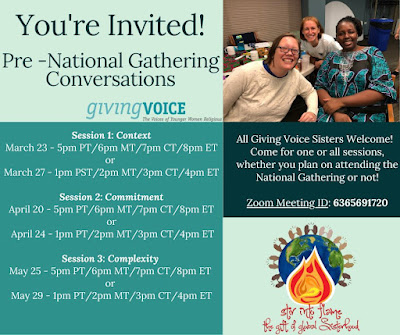
Every two years, Giving Voice hosts a National Gathering to give opportunities for Catholic Sisters under age 50 to build relationships and provide a space to dream together.  The pandemic required us to put our gathering on hold last year, so we are incredibly excited to announce our first National Gathering in three years!  The theme of our 2022 gathering is Stir into Flame the Gift of Global Sisterhood.  During this four days gathering we hope to share our lives, our hearts, and our dreams for our shared future together as women religious.

Three series of Pre-National Gathering Conversations will start in March! All GV sisters are welcome, whether there is a plan on attending the National Gathering or not. Here's the zoom link for all dates: https://us02web.zoom.us/j/6365691720

The 2022 gathering "Stir into Flame the Gift of Global Sisterhood" information is here:
When: July 14-17, 2022. 
Where: Oblate Renewal Center - San Antonio, TX
Registration Deadline: April 1 for in-person attendees. 
Event Participation: Catholic sisters under age 50. A woman whose fiftieth birthday falls during a Giving Voice event is welcome to attend the event in its entirety.


Friday, November 2, 2018

Mujeres que alivian


En nuestra Misión de actualizar el amor salvador y misericordioso del Verbo Encarnado promoviendo la dignidad humana, nosotras las Hermanas de la Caridad del Verbo Encarnado nos esforzamos por vivir la proclamación del Reino de Dios con un compromiso muy fuerte frente a las situaciones de injusticia, violencia, trata de personas, xenofobia  y atención al cuidado de la creación desde la diversidad de nuestros ministerios.

Hace unos días, con el soporte de nuestro ministerio Women’s Global Connection (WGC) me acerqué a los grupos de mujeres en Nuevo Chimbote, Cambio Puente y San Juan de Lurigancho que WGC conecta, impulsa y fortalece. Así también a las familias que estos 3 grupos de mujeres, a su vez acompañan.

Mujeres de Costa Blanca, Nuevo Chimbote - Perú
Uno de los proyectos que me llevó a encontrarme con las familias aborda el acceso a Agua de calidad. Este proyecto facilita el uso de filtros para brindar agua potable, desarrolla talleres de salud-saneamiento y monitorea a las familias beneficiadas para extender el acceso de agua. Y es que, según el Instituto Nacional de Estadística e Informática (INEI), casi dos millones de peruanos que viven en zonas urbanas no acceden a la red pública de agua. De hecho la calidad del agua es cuestionada. Siendo las personas de menores recursos quienes creen que reciben agua de menor calidad.

Según las entrevistas a las madres de este proyecto, en una de las periferias de Nuevo Chimbote, para cubrir las necesidades de agua al día, las personas podrían llegar a pagar hasta 96 soles mensuales por agua que reciben a tráves de contenedores visiblemente inadecuados.

Ante la pregunta de qué tan lejos estarían dispuestas a caminar por agua de calidad, sus respuestas coincidieron “lo que sea necesario. El agua es para todo. Pero hay gente que no se da cuenta, no la cuida y la desperdicia”. Esto último resonó en mi corazón y me invitó a revisar mis propias prácticas en relación con este recurso; pues como dice el Papa Francisco en su enciclíca Laudato Si “…el acceso al agua potable y segura es un derecho humano básico, fundamental y universal… Este mundo tiene una grave deuda social con los pobres que no tienen acceso al agua potable, porque eso es negarles el derecho a la vida radicado en su dignidad inalienable”. 

Cuando hablamos sobre su salud y el agua, sus rostros irradiaban esperanza pues perciben que el filtro –aunque lento en el proceso de limpiar el agua- ha disminuido las enfermedades estomacales.  Algunas mencionaron que son los más pequeños quienes notan muy bien que el agua es diferente, pues lo dicen en voz alta.

Pushaq Warmi - Mujeres que guían. Nuevo Chimbote, Perú
Realmente motivador palpar como Women´s Global Connection fortalece a las familias y comunidades para lograr una transformación, ofreciendo a las jóvenes y mujeres oportunidades educativas, tecnológicas y de negocios a través de distintas colaboraciones.

He visto -con admiración- como estas mujeres son capaces de potenciar y evidenciar sus habilidades de liderazgo y creatividad al servicio de su entorno. Por ejemplo Edith en Nuevo Chimbote, Maribel en Cambio Puente y Karina en San Juan de Lurigancho –entre las múltiples actividades que realizan- están logrando sus proyectos de vida a través del arte producido por sus propias manos.  Pues tienen una mayor autonomía, son reconocidas y sus aportaciones económicas mejoran su calidad de vida y las de sus familias. Y es que en Perú, aunque las mujeres le dedican más horas semanales al trabajo, entre remunerado y no remunerado, comparado con los hombres, sus ingresos suponen un 29,2% menos que ellos, según cifras del INEI.

Shipibas Artesanas - San Juan de Lurigancho, Perú
“A través de nuestro arte amazónico expresamos lo que somos y lo que somos capaces de hacer” dice Karina, una Shipiba líder de su comunidad establecida en San Juan de Lurigancho, Lima. Como ella también Edith y Maribel impulsan artesanías andinas y costeñas respectivamente.
Todo este movimiento, según me comparten, les ha permitido una mayor participación en diversos espacios y en igualdad de condiciones. Definitivamente están rompiendo con la creencia que el trabajo de la mujer vale menos que el del hombre.

Mujeres Emprendedoras, Cambio Puente, Perú
Tuvimos, también, oportunidad de agradecer por la herencia recibida en la espiritualidad y carisma Congregacional que hace posible la Misión; ello nos hizo traer a todas las mujeres que nos han inspirado. Culminabamos sintiéndonos privilegiadas y desafiadas por toda la sabiduría que hemos recibido de tantas mujeres y que va de una generación a otra.

Culmino compartiéndoles que me siento muy orgullosa de dar testimonio que desde las distintas presencias y ministerios en la Congregación estamos usando nuestros dones para servir a Dios empoderando a la gente, en especial a las mujeres. 


Conoce más sobre Women's Global Conection: www.womensglobalconnection.org

Thursday, April 12, 2018

St. Anthony's Students Raise Money for Rain Harvester

They’ve done it again!


St. Anthony Catholic High School sophomores have raised enough money for the women WGC partners with in Tanzania to build yet another rainwater harvester!


This is the third clean water tank that this amazing local high school has funded under the tutelage of faculty member Dr. Christopher Samuel (pictured here with some of the sophomore leaders).

This recent class raised the money faster than any previous class - a testament to the fact that St. Anthony is a place where justice is an action, not just a theoretical concept. Thank you!


For more information on how you or your organization can partner with WGC on our women's empowerment projects, please check out our 
website here or email us at wgcinsa@gmail.com.

Monday, March 27, 2017

CCVI Present at UN Commission on the Status of Women

From left: Marta B. Peláez, Family Violence Prevention Services, Inc.;
Sr. Martha Ann Kirk, University of the Incarnate Word; Sumeyra Tek,
Dialogue Institute of the Southwest; Dr. Lisa Uribe, Women’s Global Connection;
Dr. Fatma Arslan Korkmaz, Dialogue Institute of the Southwest.
Not pictured: Dr. Jessica Kimmel, UIW Professor Emeritus
Written By Sr. Martha Ann Kirk, CCVI
A group of San Antonio women traveled to the United Nations’ Commission on the Status of Women conference in New York City last week to present on how leadership opportunities can combat inequality and gender gaps on local and global levels.
The unique collaborative included Family Violence Prevention Services CEO Marta B. Peláez, Women’s Global Connection Executive Director Dr. Lisa Uribe, and myself, Sr. Martha Ann Kirk, University of the Incarnate Word professor of religious studies.
The three of us presented “Women’s Empowerment Through Local Leadership” on day four of the 12-day conference, and Dr. Jessica Kimmel, UIW professor emeritus and president of the World Council of Curriculum and Instruction, gave a keynote speech.
During her remarks, Uribe shared the poignant words of a girl in Tanzania who was grateful for the rainwater harvesting project Women’s Global Connection (WGC) she had helped begin there.
Courtesy / Women’s Global Connection
A young girl harvests rainwater in Tanzania.
“I don’t get punished for being late to school now,” she said. “When I had to spend so much time carrying water for our family, I would be late for school.”
The San Antonio-based nonprofit helped three Tanzanian women go to Uganda for training on how to build and maintain rainwater harvesters. 
“We have assisted and encouraged local women, and now there are over 700 women in 60 villages harvesting rainwater,” Uribe said. “WGC has a goal to ‘train the trainers’ and is promoting many other women’s empowerment projects in Peru, Zambia, and Tanzania.”
Peláez, whose organization oversees the Battered Women and Children’s Shelter, told session participants how prevalent gender discrimination can be, even within U.S. families and communities. Long before children go to school, they need to learn that the subordination of females is wrong, she said. She recalled an instance in which she told a boy that he should not be using drugs.
“If you heard what goes on at our home at night when my father beats my mother, you would take drugs also,” the boy told her.
Helping children in a household of abuse can be more complicated than helping the mothers, Peláez said, adding that children learn to be both abusers and victims. Peláez noted how interconnected these issues are, as did other presenters from around the world. Female subordination is at the root of gender discrimination, which brings poverty, domestic violence, human trafficking and wars, she said.
The session was organized and moderated by Dr. Fatma Arslan Korkmaz from the Dialogue Institute of the Southwest and Sumeyra Tek from the Commission of Women for Humanity, a working group under the Dialogue Institute.
During the discussion, Korkmaz noted that access to resources for women worldwide is a key to empowerment.  “Women are not given equal resources and opportunities to empower themselves,” she said, “so they are eventually underrepresented in decision-making platforms.”
“One of my African students gave me a rope, which I have hanging in my home to remind me of his words about African girls being tied and sold into slavery,”said Kimmel, who taught at UIW. The university has students from more than 60 countries.
The Commission on the Status of Women, which was established in 1946, documents the reality of women’s lives throughout the world and shapes global standards.In my portion of the talk, I referred to the book titled Youth Civic Engagement, a part of the UN World Youth Report that reflects on and sets goals for youth “to participate fully and effectively in all aspects of the societies in which they live.” Getting students involved in community service is important, so I gave examples from my books Iraqi Women of Three Generations: Challenges, Education, and Hopes for Peace and Hope and HealingMy research has focused on how students at schools in Iraq started by Turkish people develop skills, virtues, confidence, and leadership for building a better society. I also cited examples of mentoring youth and encouraging skill-building through community service in San Antonio – which UIW is doing through the Ettling Center for Civic Leadership.
Ambassador Anwarul. K. Chowdhury of Bangladesh, former UN Under Secretary General, referred to unequal pay for women in an Oxfam Report. He noted that statistics show that given current trends, “it will take 170 years for women to be paid the same as men.”
The ambassador, who spearheaded the development of UN resolution 1325, a landmark resolution on “Women, Peace, and Security,” explained that women do unpaid work such as care of children, the elderly, and homes, 10 times more than men do. Women’s unpaid work globally is valued at $10 trillion. Additionally, women lack equal access to resources like land. If they did, it is estimated that there would be 150 million less hungry people in the world because women would make good use of those resources.
Originally printed in the Rivard Report: March 24, 2017 

Monday, March 13, 2017

Women's Global Connection Celebrates and Honors Women

KSAT-TV interviewing Lisa at the UIW Women’s Fair

Women's Global Connection honored the women and girls they partner with worldwide last week at the UIW Women's Fair AND caught the eye of local television station KSAT-TV, which interviewed Executive Director Lisa Uribe.  You can watch the report here!!

Lisa highlighted WGC's mission promoting the leadership and learning capacity of women and girls and got a chance to talk about the upcoming unique collaboration that will take the message of women's empowerment to New York City this week!

The group, including Sr. Martha Ann Kirk CCVI, consists of the following San Antonio organizations:

  • The Dialogue Institute of the Southwest
  • The Battered Women and Children’s Center (Family Violence Prevention Services, Inc.)
  • Women’s Global Connection
  • University of the Incarnate Word

The discussion will analyze the significant effects of economic, social and educational empowerment towards women’s leadership.  It will center on best practices and highlight the importance of opportunities for women to initiate peace in their respective communities.


Development Associate Tamarra Mencey at the WGC booth
 at the UIW Women’s Fair

“Women are not given equal resources and opportunities to empower themselves, so they are eventually underrepresented in decision-making platforms,” said Fatma T. Arslan Korkmaz, moderator of the panel and a representative of the Dialogue Institute of the Southwest.

Lisa of WGC will speak about how economic inequality impedes women worldwide by erecting barriers to formal financial institutions and saving mechanisms. The cycle traps women in vulnerable, low-paid, or undervalued jobs.  WGC works with women in Tanzania, Zambia and Peru on projects involving small businesses, microfinance, nutrition, clean water and education.

“We get to regularly witness how access to education and economic resources creates leadership opportunities for women in these developing countries,” Lisa said. “Investing in women and girls has a multiplier effect on productivity and sustained economic growth for a region.”

Marta B. Peláez, CEO of the Battered Women and Children’s Shelter, will address how social inequality in the form of subordination of women results in gender discrimination.  Women and girls are the ones who suffer most from poverty, wars, human trafficking and domestic violence, she said.

And Sr. Martha Ann, a CCVI and UIW professor, will speak about the successes over the last several years in increasing educational attainment for women and the challenges that remain.  "Peace-building efforts across the globe depend on the full participation of women and girls in education and leadership opportunities," she said.  
Monday, November 21, 2016

Living Laudato Si: Women's Global Connection

This month we lift up and celebrate the great work of Women’s Global Connection in living Laudato Si.  Women’s Global Connection is a ministry of the Sisters of Charity of the Incarnate Word started by Sr. Dot Ettling and Sr. Neomi Hayes in 2001 to promote the learning and leadership capacity of women locally and globally.  The organization is currently run by Executive Director Lisa Uribe.  Women’s Global Connection (WGC) has projects supporting women in San Antonio, Tanzania, Zambia, and Peru. 

One project that deeply connects with the message of Laudato Si is their water project in Bukoba, Tanzania.  Pope Francis reminds us, “Fresh drinking water is an issue of primary importance, since it is indispensable for human life and for supporting terrestrial and aquatic ecosystems. Sources of fresh water are necessary for health care, agriculture and industry” (LS 28).   

Women are traditionally the ones to go and gather water from rivers or lakes to use each day, and these trips to gather water can take up to 6 hours each day between 3-4 trips.  The water containers they use typically only hold five gallons, weighing about 44 pounds, which are carried back to their village.  Due to the time required for this task, many girls are unable to continue with their studies, and girls and women are also at greater risk of physical attack or sexual violence during these trips to gather water. 

One innovative solution to assist with this water gathering is a device called the Hippo Water Roller, which is a large barrel holding 24 gallons of water that can be pushed or rolled with a resistance making it feel like just over 20 pounds.  One fill up of this Hippo Water Roller can provide enough water for a family of five for a day, only requiring one trip.  However the high cost of the Hippo’s, including shipping from South Africa where they are made, makes this purchase near impossible for most of the families in Bukoba, Tanzania.   

The approach of Women’s Global Connection to this problem of access to sufficient clean water sources matches their mission: access to education and resources.  One example of this is the WGC Rainwater Harvester Building Project begun in 2011 as part of their Clean Water Project.  Women are trained in the skills of building a rain harvester and the whole community comes together to gather the materials and participate in the construction which takes about one week.  One water harvester can serve 25 families in the village.  Since 2011, 35 rain harvesters have been constructed, benefiting more than 800 families.    
Another is collaboration with the Women’s Water Initiative to train women in the implementation of water related strategies including tools to educate their community about hygiene and water protection as well as technical skills to build rainwater harvesting tanks, water treatment technologies and toilets.


We celebrate and congratulate Women’s Global Connection for their commitment to women around the world and their work to ensure access to clean drinking water for so many families in Tanzania!  Thank you for living Laudato Si by strengthening communities, sharing resources and knowledge, and protecting our mother earth through women’s empowerment and leadership!