Showing posts with label education. Show all posts

Monday, October 5, 2020

San Antonio Challenges of Discrimination, Poverty, Education, Health Care, Environment, and Immigration Revealed in Murals


                                                                                                                                                                  San Antonio challenges of discrimination, poverty, education, health care, environment, and immigration are revealed in murals in west side San Antonio.   Community members compassionately and creatively tell their stories.  San Anto Cultural Arts Center has led people to gather and to create.  The problems are not unique to San Antonio.  When the U.S. is compared to other countries through the Social Progress Index, national weaknesses are apparent. As people learn of weaknesses, they can improve. This is a time of opportunity for improvement. 

 A graduate of Incarnate Word High School, Adriana Garcia, created two of the murals shown in this 12 minute film, "Brighter Days," and "De Todos Caminos Somos Todos Uno" in English, "From All Roads We Are All One."   She was selected and recognized as part of the Americans for the Arts 2019 Public Art Network (PAN) Year in Review (50 projects were selected out of 361). The mural is part of  the San Pedro Creek improvements project.

 Arts have been an important part of education in Incarnate Word schools. Sister Maria del Socorro Lazo, CCVI, (1893-1956) from Chihuahua, Mexico, started teaching at Incarnate Word College in 1941. She was highly respected as an outstanding artist in Texas.  


Tuesday, November 27, 2018

Reflecting on the Life of Peacemaker Betty Reardon

Incarnate Word College hosted Betty Rearden, a leader in peace education in 1986. IWC, now the University of the Incarnate Word, continues to deepen in peace education (See recent events at: https://www.uiw.edu/PeaceDay/).  

In Betty Rearden’s 90th year of life, we can learn from her pioneering work and carry that forward.

“Issues and Themes in 6 Decades of Peacelearning: Examples from the Work of Betty Reardon (Post #1)
Unless this process of disarmament be thoroughgoing and complete and reach men’s very souls, it is impossible to stop or to reduce armaments, or – and this is the main thing – ultimately to abolish them entirely. – Pope John XIII, April, 1963

…our primary long range interest… is general and complete disarmament designed to take place in stages permitting parallel political developments to build new institutions of peace which would take the place of arms. – Pres. John F. Kennedy, June 1963
Contemporary Commentary By Betty Reardon

The 1960s have been recorded as a turbulent divisive decade as will the one we live through now. Two of those years had particular relevance to the theme of this series, 1963 and 1968. 1963 was the year of the promulgation of the Papal Encyclical Pacem in Terris, the delivery of the “American University Speech,” Toward a Strategy of Peace, and the deaths of their authors Pope John XXIII and US President John F. Kennedy, losses that dimmed the hopes for peace kindled by the common message both had put forth to the world. Yet, it was also the year of the Nuclear Test Ban Treaty that emerged from the movement that in 2017 brought the UN to adopt the Treaty on the Prohibition of Nuclear Weapons. Indeed, in these events are the roots of the current global politics we seek to illuminate in our practice of peace education, and inspiration for the renewal of action on disarmament. . . http://www.peace-ed-campaign.org/let-us-examine-our-attitude-toward-peace/

Betty Rearden helped shape many ideas which have grown into Global Citizenship Education: (English) https://en.unesco.org/themes/gced/  and (Spanish) https://es.unesco.org/themes/ecm

Friday, October 6, 2017

Work to End the Death Penalty for #RespectLifeMonth

"The Golden Rule also reminds us of our responsibility to protect and defend human life at every stage of its development. This conviction has led me, from the beginning of my ministry, to advocate at different levels for the global abolition of the death penalty."
Pope Francis, September 24, 2015
In the two years since Pope Francis's plea, we have made great strides towards ending the death penalty. Let's continue this important work to end the death penalty this October. 
With Respect Life Month now here, Catholic Mobilizing Network (CMN) has created a Respect Life Month Toolkit to enable you to educate, advocate, and pray to end the death penalty.
Below we've also highlighted three things you can do right now to raise your voice for life this October.
Take Action to Stop an Execution: There are five executions scheduled this month. Raise your voice now through CMN's easy one-click letters and insist the dignity of all life be respected. Sign-up for CMN's Mercy in Action and take meaningful actions that are making a difference.  
Educate, Advocate, and Pray: Sign CMN's National Catholic Pledge to End the Death Penalty and encourage other's to sign. Join advocates and leaders like Sr. Helen Prejean, Fr. Jim Martin SJ, Cardinal Daniel DiNardo, and many more who have already taken the Pledge! 
Advocate for ALL Life in your Parish: CMN has prepared a Respect Life Month Toolkit filled with new and exciting materials including a new vigil and prayer service. Put these free, downloadable tools to use.  
Thank you for raising your voice and advocating for the dignity of ALL life!  

Monday, February 27, 2017

How to Teach Teens About Human Trafficking

Victims of human trafficking – modern slavery – perform labor or commercial sex acts by force, fraud or coercion. Many victims are children.
While human trafficking occurs nationwide and to people of all socioeconomic levels, runaway and homeless youth are among the vulnerable, according to the National Human Trafficking Hotline.
"Numerous exploiters have talked about the fact that they do target schools," says Jeneé Littrell, administrator of safe and supportive schools for the San Mateo County Office of Education in California. "It's a place where young children are, and young children are vulnerable."
Teens can go through many typical stages that could put them at risk, like starting to seek external validation as well as independence from the family, says Littrell, who was the lead author of "Human Trafficking in America's Schools," a 2015 guide from the Department of Education.
It's critical for schools to educate staff and students about human trafficking, Littrell says. There could be student victims or others being recruited. Schools are filled with caring adults who have relationships with students who can help young people in need of assistance, she says.
High school officials can use the following strategies to build awareness of human trafficking.
1. Make sure staff understand human trafficking: Teachers don't need to be human trafficking experts, but they should know what modern slavery is, how it happens in their community, what to look for and who to turn to if there is a student they are concerned about or a victim comes forward.
Some of the warning signs: Students with bruises, tattoos or branding and unexplained trends in absences. For example, if a student is often absent on Monday and Friday it may be because their exploiter is making them travel to different locations.
2. Integrate human trafficking education into the curriculum: Modern slavery lessons naturally fit into a lesson about the history of slavery, says Littrell.
She recommends educators check out the following organizations that deal with human trafficking education: the Frederick Douglass Family Initiatives3Strands Global FoundationProtect and Love146.
When looking for outside organizations or experts to bring in to discuss this issue, school officials should look for individuals and groups with a service provider background, who know how to use appropriate terminology, are mindful of students who have experienced trauma and strive to create a safe environment.
3. Be aware of school culture when discussing human trafficking: Educators don't want to unintentionally increase the risk for young people on campus when discussing human trafficking, says Littrell.
Always be mindful of physical and emotional safety when discussing this topic, she says. There could be networks on campus and often human trafficking is related to gang activity.
For example, say there is a student who is a victim of trafficking and people on campus know. A teacher might have a seemingly innocent conversation with the victim, but the exploiter might learn of this and the student could then face retaliation. 
Littrell got involved with human trafficking education a number of years ago while working for a school district in the San Diego area. School staff started to notice that local students were being recruited into human trafficking rings and being exploited.
Human trafficking education should be tailored to the community and not just involve a one-off lesson or assembly, she says – it needs to be a whole-school approach.
Original article posted on US News and World Report

Monday, January 23, 2017

FREE Peacebuilding Modules for Educators


CRS’ justice and peacebuilding programs engage civil society and the public and private sectors to foster inclusion, equity and accountability. Our programs are conflict sensitive, aiming to minimize potential harm and maximize social benefits for all. They are also gender sensitive, helping to reduce inequalities between women, boys and girls at the individual, household, community, national and international levels. 
In 2015, CRS invested $31.4 million in 76 justice and peacebuilding projects in 33 countries.

 This year, in partnership with the Kroc Institute at the University of Notre Dame and the Catholic Peacebuilding Network, we developed 5 distinct academic modules on Peacebuilding, which are free and open to all:

Thursday, January 12, 2017

FREE Webinars on Nonviolence

Campaign Nonviolence Webinar Series with Rivera Sun
This webinar series with Author and Educator Rivera Sun is intended to bring US-based and international activists together to learn, understand, advocate and move towards a nonviolent world. It is offered in collaboration between Campaign Nonviolence and the Netherlands-based organization SVAG (Foundation/Association for Active Nonviolence) and its project ToNoWo (Towards a Nonviolent World).

Introduction Webinar – Nonviolent Activism: Oppose and Propose
Wednesday, January 18th, 2017
11:30am-1pm Eastern  (US)
Cost: Free

Learn the basic skills you need for making change with nonviolent action. Join this practical webinar that covers the basic concepts, the 198+ Methods of Nonviolent Action, strategy and campaign design, and also the “Two Hands of Nonviolence” that create an unstoppable force to oppose injustice and propose solutions. Get strategic planning tools, further resources, and learn from nonviolent struggles throughout history.

Please RSVP to receive the login info! Here’s where to register: https://zoom.us/meeting/register/0df0dc5e5a344a9e34538d7d4481ef37

Invite Others! Share the Facebook Event: https://www.facebook.com/events/621148008056153/


Register for additional upcoming webinars here:


Monday, November 21, 2016

Living Laudato Si: Women's Global Connection

This month we lift up and celebrate the great work of Women’s Global Connection in living Laudato Si.  Women’s Global Connection is a ministry of the Sisters of Charity of the Incarnate Word started by Sr. Dot Ettling and Sr. Neomi Hayes in 2001 to promote the learning and leadership capacity of women locally and globally.  The organization is currently run by Executive Director Lisa Uribe.  Women’s Global Connection (WGC) has projects supporting women in San Antonio, Tanzania, Zambia, and Peru. 

One project that deeply connects with the message of Laudato Si is their water project in Bukoba, Tanzania.  Pope Francis reminds us, “Fresh drinking water is an issue of primary importance, since it is indispensable for human life and for supporting terrestrial and aquatic ecosystems. Sources of fresh water are necessary for health care, agriculture and industry” (LS 28).   

Women are traditionally the ones to go and gather water from rivers or lakes to use each day, and these trips to gather water can take up to 6 hours each day between 3-4 trips.  The water containers they use typically only hold five gallons, weighing about 44 pounds, which are carried back to their village.  Due to the time required for this task, many girls are unable to continue with their studies, and girls and women are also at greater risk of physical attack or sexual violence during these trips to gather water. 

One innovative solution to assist with this water gathering is a device called the Hippo Water Roller, which is a large barrel holding 24 gallons of water that can be pushed or rolled with a resistance making it feel like just over 20 pounds.  One fill up of this Hippo Water Roller can provide enough water for a family of five for a day, only requiring one trip.  However the high cost of the Hippo’s, including shipping from South Africa where they are made, makes this purchase near impossible for most of the families in Bukoba, Tanzania.   

The approach of Women’s Global Connection to this problem of access to sufficient clean water sources matches their mission: access to education and resources.  One example of this is the WGC Rainwater Harvester Building Project begun in 2011 as part of their Clean Water Project.  Women are trained in the skills of building a rain harvester and the whole community comes together to gather the materials and participate in the construction which takes about one week.  One water harvester can serve 25 families in the village.  Since 2011, 35 rain harvesters have been constructed, benefiting more than 800 families.    
Another is collaboration with the Women’s Water Initiative to train women in the implementation of water related strategies including tools to educate their community about hygiene and water protection as well as technical skills to build rainwater harvesting tanks, water treatment technologies and toilets.


We celebrate and congratulate Women’s Global Connection for their commitment to women around the world and their work to ensure access to clean drinking water for so many families in Tanzania!  Thank you for living Laudato Si by strengthening communities, sharing resources and knowledge, and protecting our mother earth through women’s empowerment and leadership!  

Monday, October 24, 2016

Free Online Courses in Sustainability

Alison, a company based on Galway, Ireland is offering the following courses free online in the field of sustainability.  Click on the title of each course for more information and registration.

1) The Green Plan Champion for Communities 
In the free online course The GreenPlan Champion for Communities learn how a community can save money, reduce carbon and help society by joining The GreenPlan. The GreenPlan is a system that empowers society to tackle climate change.

2) Environmental Science 
This course will teach you all about the earth and its system, while giving you a good understanding of its resources. It will help you to recognize the factors that affect our environment. You will know the difference between renewable and non-renewable energy sources and understand how to manage water supplies.

3) Sustainable Development 
Sustainable development is a type of economic growth pattern where the use of resources meets the needs of the human population while conserving the environment at the same time. Sustainable development means resources are used in such a way that both current and future human needs can be met. This free online Diploma in Sustainable Development reviews a diverse range of topics including what exactly sustainability is and what systems of practice are most commonly used, and in particular, examines the importance of sustainable development in counteracting global climate change.


Monday, October 17, 2016

Human Trafficking Efforts at UIW and FREE Online Course

BACKGROUND:  Sister Martha Ann Kirk recently received a small grant from the Lilly Foundation for the following project re: Human Trafficking:

Fall Semester:  In the fall semester at UIW a group of faculty members will learn more about human slavery through monthly gatherings, guest speakers, and the blog. 
Spring Semester:  In the spring semester the group of UIW faculty will teach their classes and have students do some sort of project in this area.

BLOG:  The following blog has been set up at UIW in connection with the Lilly Grant to focus on human slavery:                           http://speakingforhumandignity.blogspot.com

Check out the blog posting from Tuesday, October 4: 

FREE ONLINE COURSE:  “Ending Slavery:  Strategies for Contemporary Global Abolition”

·       DATE:  Begins October 17 and goes for four weeks.
·       COST:  The course is FREE.
·       MAIN INSTRUCTOR:  Lead by Kevin Bales, a leading expert in contemporary slavery, the course will cover the most cutting-edge research available.
·      This is NOT a UIW course.  It is a free, online course available to people anywhere in the world.

·        HOW TO REGISTER
a.      go to blog listed above
b.     find the blog posting from Tuesday, October 4
c.      click on the link:  “Click to register now”  http://campaigns.walkfree.org/q/Ca2CI7m6LwOU6Klv7xAyOmsS2IsK7Fgc-TVBejUV9oGrTL-GE50Lb1eTG

Watch the lead educator, Kevin Bales, TED Talk on Ending Modern Day Slavery!


Tuesday, December 22, 2015

Peacemaking in Peru

(An article from our friends and sisters over at Women's Global Connection)
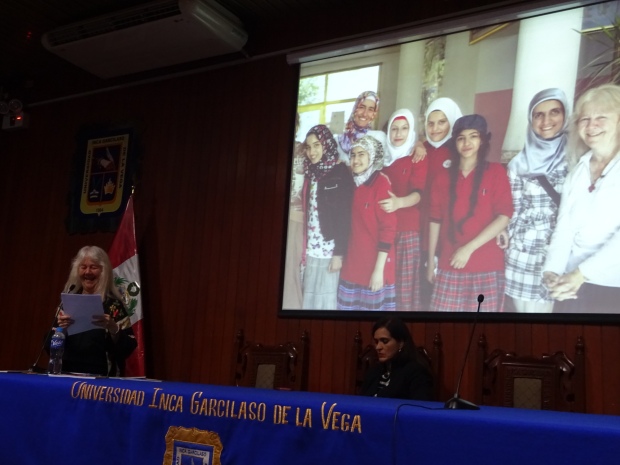
(By Nicole Foy) As most of our Women’s Global Connection/UIW immersion trip travelers were leaving to come home from Peru, Sr. Martha Ann Kirk stayed behind and was gearing up for one of her (and our!) favorite things: educating others about how societies thrive when they focus on promoting women’s rights, education, and peacemaking.
B-Ir students DSC01911
Sr. Martha Ann pictured
About 70 people attended the event at Lima’s Universidad Inca Garcilaso de la Vega, including local citizens, students, faculty and Turkish people. The story of how Martha Ann was tapped for the presentation is an interesting story of collaboration and teamwork.
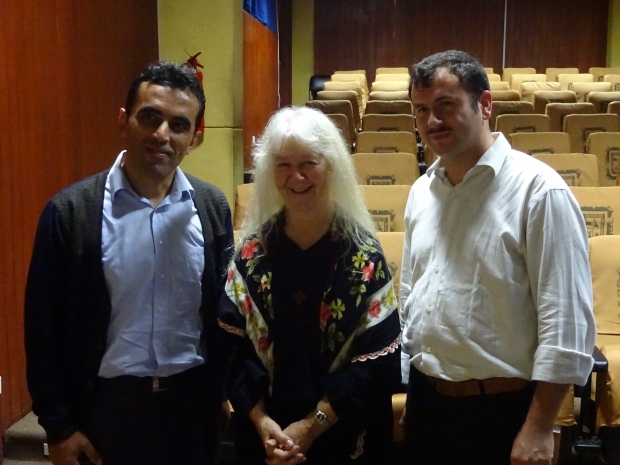
Imam Beytullah Cholak of the San Antonio branch of the Dialogue Institute of the Southwest (DIS) informed the Inca Dialogue Society in Lima that Martha Ann, a member of the DIS advisory board would be on an immersion trip in the region this month. Kadir Keskin of the DIS collaborated with CCVI Sr. Katty Huanuco, the Director of the Incarnate Word Sisters International Justice, Peace, and Integrity of Creation Office, to organize a program.
B-Laura DSC01920
Laura Vargas pictured
The event also included Laura Vargas, the executive secretary of the Interreligious Council of Peru, a part of International Religions for Peace. Sponsoring organizations included Asociación de Amistad Perú Turquia,  the Gulen Institute, Inca Sociedad de Diálogo, Peace Islands Institute, and Universidad Inca Garcilaso de la Vega.
In her speech, Martha Ann quoted former Secretary-General of the United Nations Kofi Annan, who noted that studies have shown that “there is no tool for development more effective than the empowerment of women. No other policy is as likely to raise economic productivity, or to reduce infant and maternal mortality. No other policy is as sure to improve nutrition and promote health – including the prevention of HIV/AIDS. No other policy is as powerful in increasing the chances of education for the next generation. And I would also venture that no policy is more important in preventing conflict, or in achieving reconciliation after a conflict has ended.”
As usual, Martha Ann is a diplomat for peace wherever she goes!
C- leaders DSC01946
Sezai Kara, of Asociación de Amistad Perú Turquia, Martha Ann Kirk, CCVI, and
Kadir Keskin, president of AAPT Inca Sociedad de Diálogo 
The Muslims who hosted the program in Lima are part of the Service (Hizmet) Movement, which has been inspired by Turkish scholar Mr. Fethullah Gulen.  The day of the presentation in Lima, the French newspaper Le Monde published a moving op-ed by Gulen who called for Muslims to become more active in countering ignorance of their faith. The following is a quote from his article: “Our responsibility as Muslim citizens is to be part of the solution despite our grievances. If we want to defend the life and civil liberties of Muslims around the world, and the peace and tranquility of every human regardless of their faith, we must act now to tackle the violent extremism problem in all its dimensions: political, economic, social and religious. By setting virtuous examples through our lives, by discrediting and marginalizing the extremist interpretations of religious sources, by staying vigilant toward their impact on our youth, and by incorporating democratic values early in education, we can counter violence and terrorism as well as totalitarian ideologies that lead to them.”
B-Associate DSC01895
Incarnate Word Associate member, Martha Zea, Sr. Martha Ann, and
Laura Vargas, executive secretary of Religions for Peace in Peru.
Martha Ann is the author of the book “Iraqi Women of Three Generations: Challenges, Education, and Hopes for Peace.” She has found discrimination against women to be entrenched there, but has been inspired by the Hizmet education movement as a counter to such ignorance. She explained that young women educated in the Hizmet schools have self-confidence and leadership skills. They also have learned  dialogue, forgiveness, reconciliation, and social responsibility.   
Read more about the trip and other WGC trips at their travel blog: https://wgctravelblogue.wordpress.com/2015/12/21/peacemaking-in-peru/ 

Wednesday, August 20, 2014

Four mobile-based tools that can bring education to millions

“Education is the most powerful weapon which you can use to change the world”, Nelson Mandela is famed for saying. Yet access to good quality learning is still denied to millions around the world, particularly in developing countries where teaching standards and education facilities are often poor.
The ubiquity of mobile phones is presenting educators with a new, low-cost tool for teaching. Here we look at four mobile-based solutions delivering real results for low-income learners.