Showing posts with label ministries. Show all posts

Sunday, June 3, 2018

UIW Participates in SA300 Tree-Centennial Program

By Teofilo Reyes, Ettling Center for Civic Leadership & Sustainability Community Outreach Coordinator, and Phillip Lopes, Assistant Facilities Director and Energy and the Environment Subcommittee Member.  Article originally appeared on UIW blog
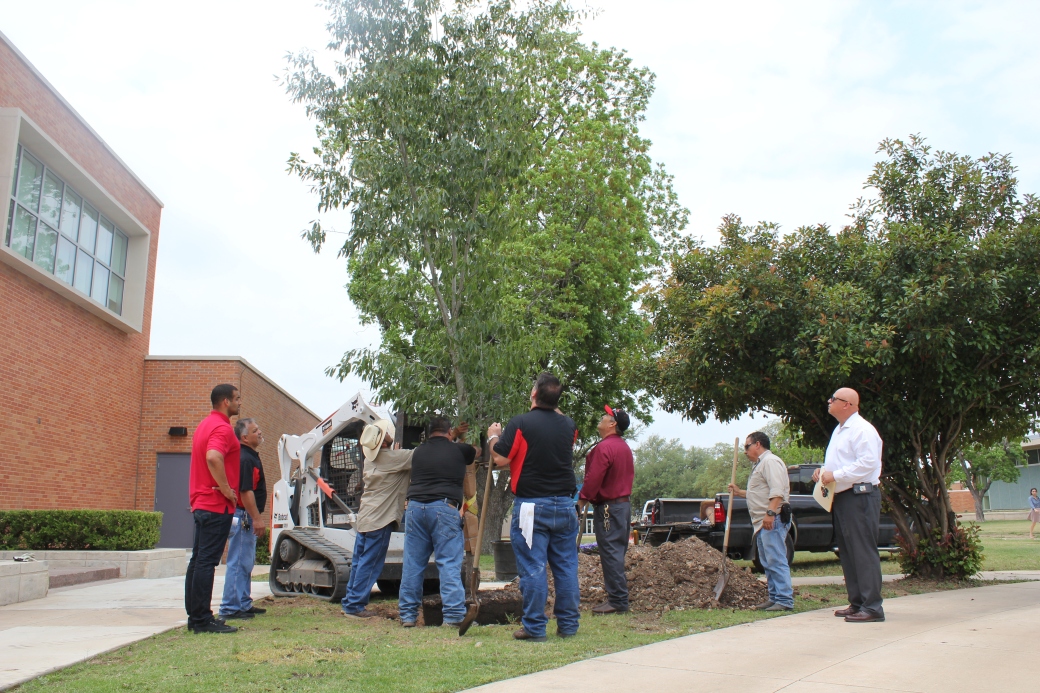
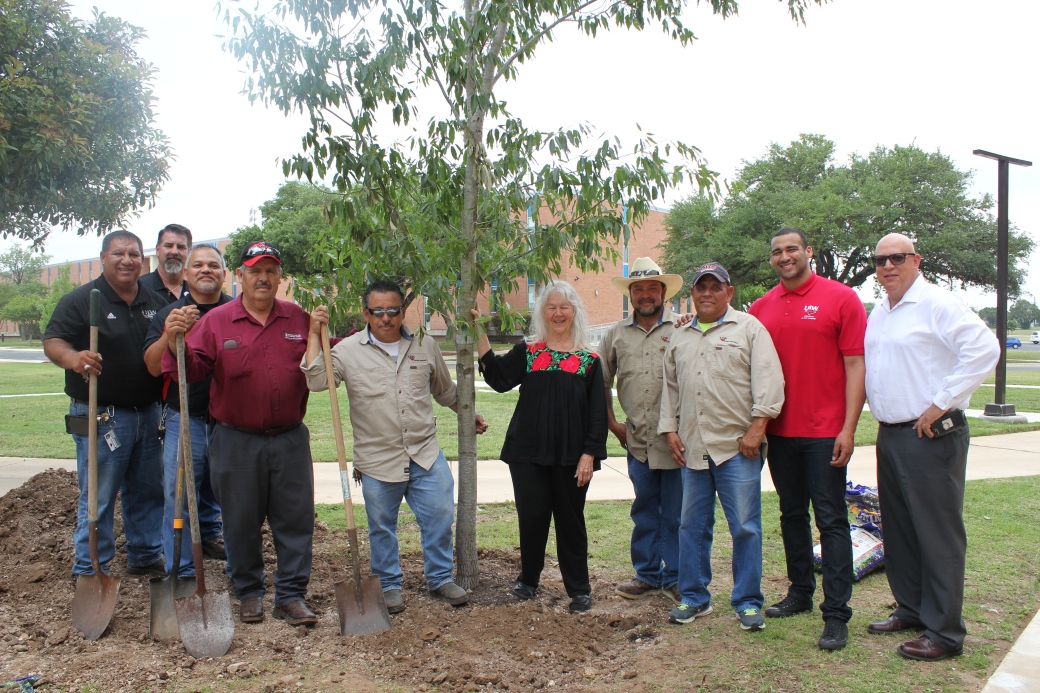
The University of the Incarnate Word took part in San Antonio’s Tree-Centennial program on Tuesday, May 2. The Tree-Centennial initiative, led and managed by the City of San Antonio Parks and Recreation Department, honors San Antonio’s Tricentennial (SA300) celebration to enhance the city’s tree canopy and green spaces by planting 300 trees over the course of 2018.
IMG_0774
The program was launched with tree plantings at various higher education institutions across the city. The University of the Incarnate Word is a prominent institution for higher learning, not just in San Antonio or across the Texas region, but globally – serving students and communities throughout the world. UIW is participating in the Tree-Centennial program because it embodies the spirit of “citizenship and commitment to community” by bettering the places where we live, learn, labor and enjoy leisure in our city.
We chose to plant this beautiful Sierra Oak tree at the University of Incarnate Word’s new School of Osteopathic Medicine because this young oak tree will symbolize the budding growth and grandeur these medical students will achieve through serving the health needs of patients around the globe. We worked with our friends at Mortellaro’s Nursery in Schertz, Texas to find a fresh tree that is strong and beautiful, but also one that is native to the south, tolerant of heat and requires little watering once established. The Sierra Oak was the perfect fit.
IMG_0779
Tree-Centennial is another great opportunity for UIW to expand its sustainability efforts across the San Antonio community. Pope Francis’ encyclical ‘Laudato Si’ demonstrates the responsibility not only as a single organization, but as habitants of this wonderful planet to take care of one another through compassion and action.  Tree-Centennial is another step forward for UIW students, staff, and faculty to engage and educate the community on the various social, economic, and health benefits of being environmentally conscious.
Sustainability balances human development and growth with the welfare of the natural world, both in the present and for the future. The emphasis placed on social justice by the Sisters of Charity of the Incarnate Word and the establishment of care for creation as a tenet of Catholic social teaching inspiring sustainability as a part of the university’s legacy. The University is committed to meeting people’s cultural, educational, economic, and ecological needs in ways that protect and restore the natural environment.
SA300 has beautifully celebrated the many facets that make San Antonio unique, and Tree-Centennial is another great example of what sustainability means to the citizens of San Antonio and the city’s legacy.
IMG_0801

Thursday, February 22, 2018

JPIC Office Statement on Gun Violence


The Office of Justice, Peace, and Integrity of Creation (JPIC) for the Sisters of Charity of the Incarnate Word – in response to the suffering caused by various forms of violence around the world - continues to say No! to the violence that demeans and destroys God’s holy creation, and Yes! to a culture of life.  We extend our deepest sympathies to all those in the Parkland, FL community who were impacted by the most recent school shooting in our country.  As a Congregation that seeks to incarnate the healing and saving love of God in the world, we stand strong in our commitment to Gospel nonviolence and lament the rampant and senseless violence plaguing our society today. 

Just four days prior to the shooting in Parkland, FL, a meeting of “Moms Demand Action for Gun Sense in America” was held at the University of the Incarnate Word with candidates for state and federal office present to discuss their gun violence prevention policies.  Many Incarnate Word Sisters and Sisters of other congregations participated.  It is the responsibility of all people of faith and good will to work together to promote a culture of peace and nonviolence, where students and teachers don’t have to fear for their lives each day as they enter school. 

Our CCVI ministries include a high school in St. Louis, MO, two high schools and a university in San Antonio, TX, and more than 8 educational institutions in Mexico.  We are aware of and share in the fear and uncertainty felt by students, parents, and staff of educational institutions, and are inspired by their powerful determination to prevent future school shootings and gun violence. 

We stand in solidarity with the students of Marjory Stoneman Douglas High School and others around the country who are rising up to demand action on gun control legislation so that no other school and community have to face this tragedy.  While we keep all those impacted by gun violence in prayers, we follow the lead of Pope Francis who reminds us that we have to take action to answer those prayers as the Body of Christ in the world today: “You pray for the hungry.  Then you feed them.  That’s how prayer works.” 

We pray for the victims and those mourning, and we seek to prevent future tragedies and end senseless gun violence by calling upon our elected officials to find the courage to reject the influence of the corporate gun lobby and immediately pass legislation that:

1) Bans semi-automatic assault weapons with high-capacity magazines (such as the AR-15);
2) Requires universal background checks for all gun purchases; and
3) Makes gun trafficking a federal crime. 

Please join us not only in thought and prayer, but in action by contacting your current elected representatives (both state and national) and demand the legislative points above.  Also educate yourself about the candidates up for election in the mid-term this year and make gun reform a top priority.  Future mass shootings are not inevitable. 

We draw our hope and strength through Jesus Christ, the Incarnate Word, who inspires us to co-create a culture of peace and nonviolence.  Let us be his healing hands in the world today. 


Monday, October 23, 2017

College and University Recycling Collation Workshop at UIW

CURC, the College and University Recycling Collation, held their national workshop at the University of the Incarnate Word, October 15, 2017. Brian Roe, Pennington Biomedical Research Center at Ohio State University, spoke on “Food waste reduction / Collaborative planning for dining food waste.” A third of the food in the US is wasted. If students become aware, they waste less. Signs, apps, and teaching are among the successful reminders that can be used. 

UIW students helping with the workshop included Ashely Otley, Cheyenne Schultz, Kathleen Aeschlimann, Hector Vargas, Carolina Calvillo, Violet Balleza, Brajae Robinson, Dhanya Prasad, Jordan Collins. 
UIW students Violet Balleza, Brajae Robinson,
Daniel Potter (Sustainability Operations Manager),
Dhanya Prasad, Jordan Collins, and
Ruben Garcia (the UIW Grounds Manager)
assist in hosting the CURC National Workshop.

People shared many ideas from their schools. One said that when they have large events, they have “Trash Talkers” who stand near the bins and help people put things in the correct place for recycling. At the University of Oregon, during a past move out from the dorms, they have taken pictures of what has been thrown away. Now the school has a game where students are invited to identify what could be recycled. If they identify three things, they win a box to use for moving their things.

Sara Nichols, of the State of Texas Alliance for Recycling (STAR) gave information on Recycling in Texas and the Economic Impacts. STAR educates from “school children to senators” and she said with a laugh “Much of the content is the same!” She shared trends in recycling and packaging, why this is important, what is being done and what needs to be done. Lighter packaging is better. All need to work towards better ways of measuring progress in these areas. Corporations want to fund groups that are going in to make a change. Austin is the home of the universal recycling ordinances. Municipalities have much power to change things.

Nichols went on to explain that the US recycling rate has been stagnant at 34% for the last few years. Texas is recycling about 22%. Texas is huge. It is important. We have four of the ten fastest growing cities in the US. For every 10k going into landfill one job is created, while for every 10k recycled ten jobs are created. An average family of four spends $15,000 a year on food that is wasted.

Brian Halverson, of the City of San Antonio spoke on the City of San Antonio Commercial / Institutional Recycling Initiatives. City of San Antonio collects waste from all private homes and this means about 350,000 customers.  ReWorksSA is a separate program, an initiative of the Solid Waste Management Department working on recycling and resource recovery. It is working to motivate the non-private customers.

Some of the San Antonio city goals are to recycle of 60% of single-family residential waste by 2015 and to improve recycling opportunities for businesses. The focus is on small and medium size businesses because many large businesses have already started. For example, H.E.B. does much recycling, especially with cardboard. ReWorksSA provides incentives, information, and other resources.

Jennifer Hobson, University of Texas, Austin, shared on Engaging student volunteers and cultivating institutional support for zero waste efforts. Generally students expect recycling all over campus. Any campus group can apply for funding for a recycling project. At UT Austin, they have had paper recycling since the 1990’s. She works with internal stack holders and supports and encourages them. It is expensive to put trash in the landfill, so that encourages interest in recycling. It is important to keep educating people on how much is saved and how much benefit there is. People do not realize this. Students need to have experiences, not just classroom learning. They work with leadership classes, and a project management class that designs things in the fall and implements them in the spring. They had 26 students working on 9 projects. Many are doing waste audits. They are working with the food service.

UIW participates in “RecycleMania” a competition of colleges and universities throughout the US to grow in skills of sustainability. A ceremony to recognize campuses involved in “RecycleMania” was held. Campuses that have a total number of 4.1 billion students are participating in the “RecycleMania” competition. The competition is really to raise student awareness and get them involved. This is not just about tonnage, but about understanding and implementing many aspects of recycling. A new category this year is the “Race to Zero Waste,” which involves taking an individual building on campus and intensively measuring how things are recycled. Agnes Scott College was the winner. Loyola Marymount University in Los Angeles got the grand champion awards for winning in a number of areas, including Diversion, Paper, and Corrugated Cardboard. All campuses were encouraged to start preparing for “Get the Game for 2018!” 


Alex Fried founder and director of PLAN, the Post-Landfill Action Network showed a picture of the relationships of issues. Recycling is important, but US society also needs to focus on patterns of consumption and consumerism. PLAN is a student-led zero waste movement. Students learn more and are equipped with the necessary skills and resources to implement solutions in their campus communities. This empowers students to be change makers.

Amy Preble, UNC Chapel Hill explained their Residence Hall Composting. In 2014 students in residence halls started this taking compost to the community gardens. Their dining rooms have compostable containers. As of 2017 fourteen residence halls have joined in participating. Have “Compost Kick-off” at the beginning of the year and students can check out a bin. Twice a week there is pick up. Many videos on campus composting are posted on YouTube. One of their many ways of communicating is “Green Games,” long standing student-led activities for other students to learn and participate.

The student on the left developed the “Composting Cow”
to remind people to participate. 

Alyssa Halle-Schramm, Austin Community College, described their Paper Towel Composting. They do not have large dinning halls, but many grab and go cafes so that complicated trying to do recycling in these. ACC does have a Culinary Arts program and also a child development program and both of these are active in recycling and composting. For the last four years ACC has focused on recycling paper towels in bathrooms. This program is easy to pilot and easy to sell. An industrial compost companies picks up.

Students are considering what might be the best recycling mascot, what will help people learn and think

Bill Rudy, Brigham Young University spoke on Container Sensors. This campus has 32,000 students. Gardeners spend much time servicing garbage cans. A student developed a sensor that can be put into any bin and they can read how full the bin is. The gardeners only have to go there when the bin is full.

Deb Kutska, Oakton Community College in the Chicago area gave information on Improving Diversion. She started in 2014 as the first Sustainability professor. When she started the college had 19% recycling and now they have 36%. They have a goal to recycle 50%. They have about six Zero Waste events a year.

They created the “Talkin’ Trash Taskforce” to identify problem areas. They made a “sculpture” to make people think. At the Child Development Center, they recycle everything and the children easily learn to sort and do this.

The “Students for Social Justice” led a “bottle ban” initiative, and the campus now has this. Students can get water at the water stations, and not plastic bottles of water are sold on campus. 

Lydia Vandenbergh, Penn State University, gave examples of their extensive studies on Bin Signage. They have an on-going effort to make things clear for all so that waste is not mixed or contaminated. 

Scott Pasternak of Burns & McDonnell spoke on “Impacts on Recycling Commodity Values, Focusing on Contamination. He considered economic and market drivers. Dallas has a new recycling system. They have what seems to be one of the best glass recycling systems, which leads to “Super-Clean” glass. He offered some “Keys to successful campus, multi-family and commercial recycling programs:” Public education, convenient access, performance measures (how do you check), management buy-in, conduct waste audits and workshops for businesses to focus recycling programs.

Alex Antram, the Director of the Headwaters at Incarnate Word led a tour. Participants had an opportunity to tour recycling and sustainability sites on the campus, or visit the 53-acre Headwaters nature sanctuary located adjacent to the UIW campus. About half of the people attending direct university recycling services. Most of the visitors were from out of state and they praised the beauty of the Incarnate Word campus. UIW faculty attending felt renewed and inspired and want to further develop recycling .

Article by Sr. Martha Ann Kirk, CCVI, Chair of the International JPIC Committee 

Teofilio Reyes (Community Outreach Coordinator, Ettling Center),
Dr. Kevin Salfen (Associate Professor of Music),
Sr. Martha Ann Kirk (Professor of Religious Studies and the Ettling Center),
Dr. Barbara Aranda-Naranjo (Associate Provost for
Civic Engagement and Sustainability),
Dr. Alison Whittemore (Professor of Engineering),
Dr. Helen E. Smith (Associate Professor of Pharmacy), and
Professor Heather Barton-Weston (Dimensions of Wellness Coordinator)
assisted in hosting the national CURC workshop.


Monday, July 24, 2017

Justice, Peace, and Sustainability at the Summer Seminar for Lay Leaders

Participants in the 2017 CCVI Summer Seminar
June 20-22, 2017 twenty-seven lay leaders from CCVI ministries throughout the United States and Mexico gathered in San Antonio, TX for the second Summer Seminar hosted by the Congregation of the Sisters of Charity of the Incarnate Word.  The Summer Seminar is a three day formation workshop for lay leaders in CCVI ministries where they learn about incarnational spirituality, the CCVI charism and mission, Congregational history, and reflect on topics like cross-cultural communication, justice, peace, and integrity of creation, and what it means to be a sponsored ministry of the Congregation.

Jennifer Reyes Lay leading a session on JPIC
Assisting with the Summer Seminar was Jennifer Reyes Lay, Assistant Director of the Congregational JPIC Office, who led a workshop on "Threads of Justice, Peace, and Integrity of Creation."  This workshop helped show how the work for justice, peace, and care of creation is not like one square of a quilt that can be added or removed, and is separate from the other squares, but rather are the very threads that knit the whole tapestry together.  If you try to remove the threads, the whole tapestry comes apart.  This work of JPIC is integral to the mission and vision of the Sisters of Charity of the Incarnate Word, and to the ministries it sponsors, because it is integral to the life and mission of Jesus, the Incarnate Word, and the universal Catholic Church.
The final project - threads of
justice, peace, and creation in
CCVI ministries

Participants engaged in an activity of "paper weaving" to physically engage this metaphor of the JPIC threads and tapestry.  Groups wrote on pieces of paper about the different justice, peace, and care of creation work or policies they are doing or have in place at their ministries, and then wove these pieces into the larger paper.  It was inspiring to hear about all of the great work happening throughout the CCVI ministries, inspired by the charism to incarnate the love of God and heal the body of Christ suffering in our world today.  Together we are creating a beautiful tapestry of justice, peace, hope, and love!

The Summer Seminar also did a great job of living into the sustainability goals for meetings that the Congregation set back in 2016: "At least 50% of all materials and refreshments used in meetings will be environmentally friendly."  Some of these sustainability initiatives included: offering reusable water bottles to all participants to use throughout the week and having a large water jug available to refill water bottles; offering ceramic coffee mugs each morning instead of disposable cups; serving food buffet style to eliminate unnecessary packaging and waste; offering a non-meat protein at every meal; turning off the lights and all electronic equipment when the meeting room wasn't in use; carpooling out of town guests from the retreat center where they were staying to the Heritage Center where the meetings were in one large van; and providing clearly marked separate bins for trash and recycling.  We thank the organizers including Dr. Denise Doyle, Sr. Mary Henry, and Sr. Brigid Marie Clarke for not only providing great content and hospitality for the summer seminar, but also being good stewards of our common home!

Reusable mugs and water bottles


Food served buffet style

Recycling bins and waste marked
separately.  Water jug to re-fill
water bottles.

Thursday, July 14, 2016

Congregational JPIC Office Participation in CCVI Summer Seminar

Participants of the CCVI Summer Seminar
The Congregational JPIC Office was honored to participate in the Summer Seminar sponsored by the Sisters of Charity of the Incarnate Word for lay leaders in CCVI sponsored ministries at the end of June.  The seminar was hosted at the Heritage Center in San Antonio, and had about 30 participants from many different ministries throughout the United States and Mexico.  The three day seminar offered prayer, education, and discussion each day on Incarnational spirituality, the foundation of why we do what we do in our respective ministries and our common mission in furthering the work and charism of the Congregation.  It also included presentations on cross-cultural communication, the history and mission of the Congregation, what it means to be a sponsored ministry, how to sustain our ministries, and how to take all this information back home to the participants’ respective ministries.

The Assistant Director of the Congregational JPIC Office shared with participants about the history and formation of the JPIC Office, the current work and focus, and emphasized the cross-collaboration that can happen and is already happening between ministries, as well as the wealth of resources our Office has to provide to ministries in the areas of justice, peace, and integrity of creation.  It was a wonderful experience building relationships with our many lay ministry leaders and increasing awareness about the JPIC Office and how we can help support various facets of the Congregation.  Thank you to all who participated, the other presenters, and especially to Denise Doyle who did a fantastic job pulling everything together and handling all of the logistics!   

To view the powerpoint presentation offered at the workshop by the JPIC Office click here:  http://bit.do/ccNwx


Wednesday, July 13, 2016

San Antonio Sustainability Workshop

On June 21, 2016 over 50 sisters, associates, collaborators, and UIW students gathered together at the University of the Incarnate Word in San Antonio, TX for the Congregational JPIC Office’s Sustainability Workshop.  Presenters at the workshop included Monica Cruz from the Ettling Center for Civic Leadership and JPIC Committee Member, Daniel Potter from the Sustainability Office at UIW, Dr. Ricardo Gonzalez from the Ettling Center, Lisa Uribe from Women’s Global Connection, Sr. Chris Stavinoha and Audra Cardona from Incarnate Word High School, Rene Escobedo and Rosi Cortez from St. Anthony’s High School, Corinne Francis from CHRISTUS Health, Pamela Ball and Howard Homan from Headwaters, Sr. Jean Durel from the Elders Care for Creation committee and GLT, and Jennifer Reyes Lay from the JPIC Office. 

The morning was spent learning and sharing about the amazing work going on in our ministries and congregation related to Sustainability.  There are many great collaborations already happening across ministries, and contacts made at the workshop will hopefully lead to even more!  Participants also spent time in prayer and reflection, discerning and voting for a collective sustainable action to be taken by the Congregation, and remember the many men and women around the world who have dedicated their lives to environmental justice and caring for our common home.  There was also an option tour offered in the afternoon in which about a dozen people participated, getting to see firsthand the wonderful community gardens on campus and also the solar house. 

We ended the morning singing together “The World is About to Turn,” with hope that as we continue to live Laudato Si and care for our common home the world really is at a point of turning for the good of all creation.  Thank you so much to all who presented, attended, participated, and left committed to doing their part to live more sustainably!