Sunday, December 1, 2019

Disarming Our Own Hearts, Nuclear Disarmament Needed According to Pope Francis

On the flight home from Tokyo, Nov. 26, 2019, Pope Francis restated his conviction that “the use of nuclear arms” and “the possession” of such weapons “is immoral.” He said the Catechism of the Catholic Church will be amended to include this teaching.  He added that he was moved by his visits to Hiroshima and Nagasaki, where atomic weapons were used by the United States at the end of World War II. He described what he learned about the suffering experienced at Hiroshima as “a true human catechesis on cruelty.”
At Hiroshima, he said, “I repeated that the use of nuclear arms is immoral…. Not just the use, but also the possession because an accident of possession or of the folly of some leader...could destroy humanity.
“Let’s think of what Einstein said: ‘The fourth world war will be fought with sticks and stones.’”
“There is no assurance [nuclear energy production] will not cause a disaster,” Pope Francis said, noting the twin disasters of Fukushima and the 1986 disaster at Chernobyl in Ukraine.”

Read more in the America Media article by Gerard O’Connell, November 26, 2019.    
August 7-8, 2020, concerned groups led by Pace e Bene, the nonviolence movement founded by the Franciscans, will gather for Campaign Nonviolence National Conference for the 75thanniversary of the Nuclear Bomb in Albuquerque, New Mexico. They will learn about the Catholic Initiative growing throughout the world and they will go pray at Los Alamos, New Mexico, where the first nuclear weapons were made. 

While the issue of nuclear weapons may not seem relevant in our daily lives, global approaches grow from personal worldviews and spirituality.  On a daily basis, do I seek the destruction of  what is different and who is different from my point of view. Or am I engaged in a process of compassion, of disarming my own heart, and of personal and global transformation grounded in hope? 
While inviting people to change hearts and minds is complex, we should investigate research that says, “3% of US military spending could end starvation on earth.” Isaiah’s words are an invitation for now, “Beat your swords into plowshares and spears into pruning hooks.” Our commitment to the poor needs to include the analysis of systems and honest searches for root problems.  As long as a people base their economy on the production of weapons, they may not be willing to look at realities. 
In San Antonio, Texas, Jews, Muslims, and Christians joined in an Interfaith Thanksgiving Service, November 24, 2019, at University United Methodist Church. Both religious leaders and civic leaders including Mayor Ron Nirenberg,  Sheriff Javier Salazar, and Councilmen John Courage and Manny Paleaz  spoke.  University of the Incarnate Word Music faculty Orit Eylon led the children’s choir from Agudas Achim Synagogue.  Sister Martha Ann Kirk, CCVI, was invited to share a Prayer for Unity. She said,  "I was invited as a Catholic representative to speak in this service. Our Catholic leader Pope Francis is in Japan now and prayed in Nagasaki this morning.  I have also seen the ruins and prayed there.  

He said, “in a world where millions of children and families live in inhumane conditions, the money that is squandered and the fortunes made through the manufacture, upgrading, maintenance and sale of ever more destructive weapons, are an affront crying out to heaven.”

While in 1945, people were seeking to stop the burning of children at Auschwitz, burning thousand of children in Hiroshima and Nagasaki was a questionable way to do that.  We seek a world safe for our children, the only way to find that is to unite and make a world safe for all children, immigrant children---all children.   Yes, unite for the dignity of all, the life of all.

So we unite tonight, what a beautiful sign of hope.

We listen to each other, what a beautiful window to light.

We speak to the Holy Compassionate One, what an opportunity for our hearts of stone to be transformed into hearts of compassion.

Let us pray.  Let us pray with eyes open and turn around looking at each other, seeing, as many people as we can. . . smiles are permitted.  YES, turn around!

Source of all life, may we cherish each person as precious.  

Source of true security, may we disarm our hearts.

Source of all love, may we let your unselfish, embracing love flow through us . . .

Our presence here is a plea that we may be one. 

We trust in your goodness,  Amen. 
The Interfaith Thanksgiving Service with  UIW student Jake T. Thayer, Sr. Martha Ann Kirk, Mayor Ron Nirenberg, Dr. Orit Eylon, and UIW student  Magali Martinez. 

Wednesday, November 27, 2019

Climate Friday & Black Friday

The next big International strike on November 29th coincides with Black Friday. This is a good time to reflect on how our consumer behavior influences our environment and other humans on this planet. Do we really need cheap items for sale on this day?
The purpose of this questioning is not to shame individuals but rather to point the finger towards the corporations who exploit humans and nature for ever-cheaper prices. Boycott Black Friday by boycotting their attempts to trick us into buying things we don’t need! 
Join the strike on Friday, November 29th: https://www.fridaysforfuture.org/events/map

Black Friday this year in St. Louis is for a climate rally! Come on in front of the Galleria Mall from 9:00am - 1:00pm.
You can learn more and register here: https://bit.ly/2qUvfUL


Thursday, November 21, 2019

Amazonia: New Paths for the Church and for Integral Ecology

Luke Hansen, S.J. writes, "The three-week Special Assembly of the Synod of Bishops for the Pan-Amazonian Region, on the theme, “Amazonia: New Paths for the Church and for Integral Ecology,” concluded on Oct. 27, 2019, in Rome. Here are five key takeaways from the synod.
1. The synod was prophetic in placing Amazonian and indigenous communities at the center of the synod process and for making a clear option for these communities over foreign economic interests.
In the two-year preparatory process for the synod, the Pan-Amazonian Ecclesial Network, or REPAM, coordinated about 300 listening sessions in the Amazonian region. About 22,000 people were directly involved in the territorial assemblies and smaller dialogue groups, and another 65,000 people participated in parish groups."  
To read of the other significant ideas that emerged, click here .

Tuesday, November 19, 2019

“Compassion Tree” Planting, San Antonio, Texas


Rev. Ann E. Helmke, Community Faith-Based Liaison, San Antonio Department of Human Services, in the name of the international "Compassion Tree Project," invited all to renew the earth by planting trees. 

The Compassion Tree Project (CTP) starts at a local level as a symbolic representation of the commitment and responsibility to re-green the world. It then expands beyond its own location and moves to support already-existing re-greening efforts around the world. The Compassion Tree Project joins us all together in a single global effort, connecting us all in our common humanity. It mobilizes us to take action to do something about devastated lands and the climate crisis. We will be planting more than bio-diversity (by ensuring the planting of only indigenous trees/plants) - we will also be planting compassion, peacemaking, and economic freedom; thereby restoring our planet’s ecological balance.” https://charterforcompassion.org/the-compassion-tree-project

San Antonio City Councilwoman Ana Sandoval, who was serving as mayor pro tem at a global conference in Monterrey, Mexico, accepted a challenge from that Sister City to plant 40,000 trees in San Antonio. Monterrey has already planted over 30,000 as part of the Compassion Tree Project in the International Charter for Compassion’s effort  https://charterforcompassion.org/the-compassion-tree-project     

As of 2020, the City of San Antonio has a web page about local tree planting activities https://www.sanantonio.gov/ParksAndRec/Want-to-Help/Compassion-Tree-Project  Plant a tree and let them know!


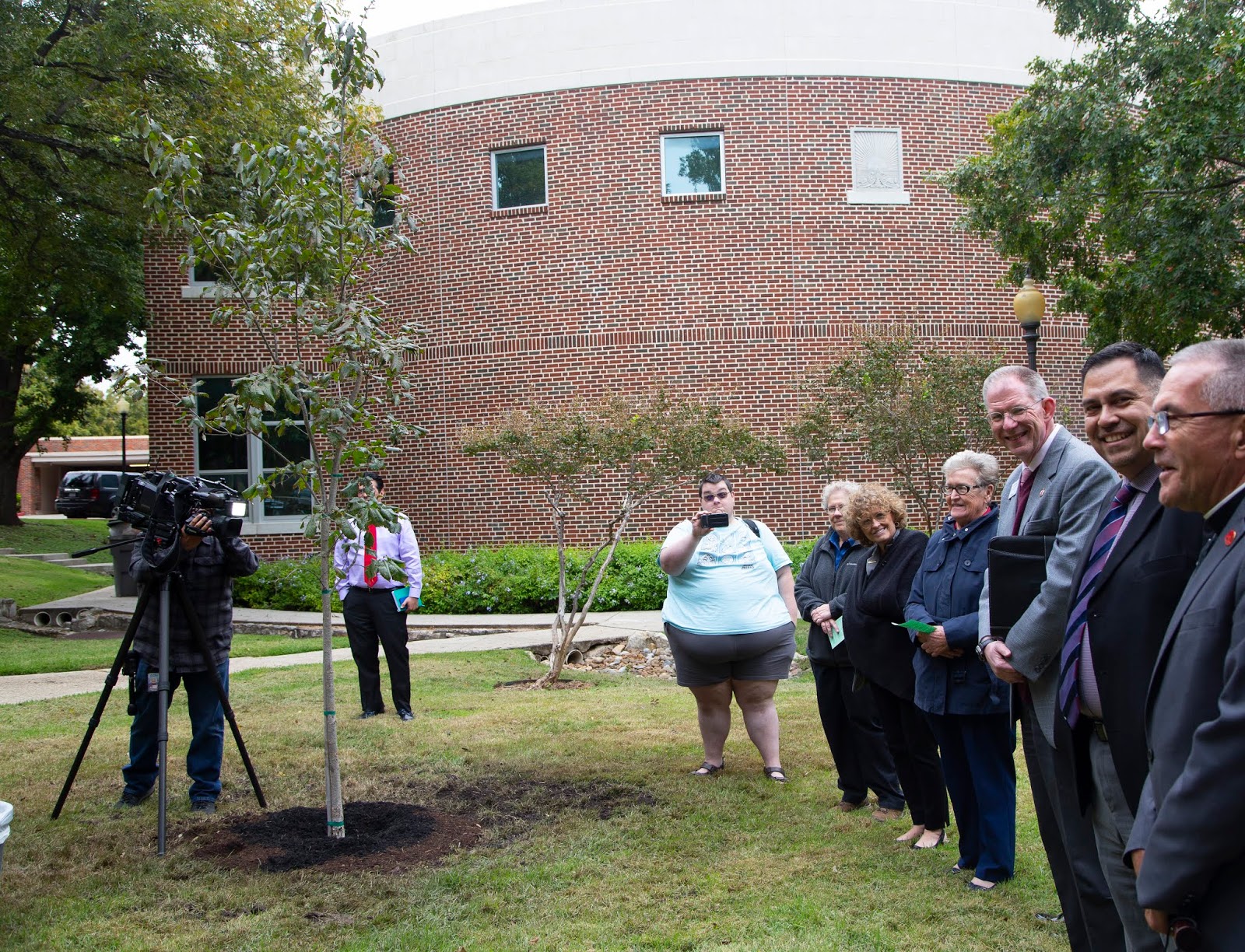
Representatives of the City of San Antonio, the University of the Incarnate Word, and the Sisters of Charity of the Incarnate Word united in planting a “Compassion Tree” October, 30, 2019, UIW Peace Day, on the Incarnate Word Campus near the clock tower and in view of the Headwaters, a 53-acre Nature Sanctuary. https://www.headwaters-iw.org/

The planting at UIW was to invite the many active tree planters and new tree planters into the global effort. Rev. Ann E. Helmke, the Community Faith-Based Liaison in the San Antonio Department of Human Services spoke both as a city representative, but more importantly, as a delegate of the international leaders in the Compassion Tree Project. 
The international Charter for Compassion movement has started the “Compassion Tree Project” so that billions of trees can offset global warming.  San Antonio and Monterrey are both  officially recognized as Cities of Compassion.  The Catholic Climate Covenant Movement in light of Pope Francis’ invitation, Laudato Si, to care for creation, has been promoting tree planting. See page 4 of the guide, "We are all connected,"  https://catholicclimatecovenant.org/files/attachment/program/Participant_Program-Final.pdf

Participants included:
Rev. Ann E. Helmke, Community Faith-Based Liaison, SA Department of Human Services; Michael F. Larkin, Chief of Staff and Special Assistant to the UIW President for External Relations; Sister Teresa Stanley, Sisters of Charity of the Incarnate Word Leadership:  Sister Cindy Stacey, the Headwaters at Incarnate Word; and Dr. Ricardo Gonzalez, the Director of the Ettling Center for Civic Leadership and Sustainability.  Ruben Garza, UIW Grounds Supervisor and his crew care for hundreds of trees and plants. The ceremony was led by Sister Martha Ann Kirk, who with her students, had initiated the Charter for Compassion movement in San Antonio ten years ago.  She is the co-chair of  the San Antonio Catholic Archdiocesan Task force to promote Laudato Si, care of creation.     http://w2.vatican.va/content/francesco/en/encyclicals/documents/papa-francesco_20150524_enciclica-laudato-si.html
Read more of San Antonio’s growth in compassion and hopes to be a model for other cities http://saccvi.blogspot.com/2019/07/compassion-lab-about-global-and-local.html     

The Compassion Tree movement invites people to plant native trees and this relates to other ideas of sustainability encouraging the use of foods and plants that grow in your area.  This is a Chinquapin Oak (or Chinkapin Oak, Quercus muehlenbergii) which is a native and its acorns are one of the best sources of food for many types of wildlife. Carolyn Walden, the past president of the Boerne Chapter of the  Native Plant Society of Texas, in the Boerne Star on February 12, 2011, wrote, “Chinquapin oaks produce acorns that are sweet and eaten by wildlife and humans. They are the sweetest of all oak acorns. Ripe acorns can be taken out of the thin, tan to brown shell and eaten. Unripe green acorns will be bitter. Acorn meats can be processed and dried or roasted and used to make bread dough, muffin batter and a coffee substitute. The hardwood of the chinquapin, although not used widely commercially, is valued for woodworking.” https://npsot.org/wp/boerne/publications/native-grown-articles/chinquapin-oak-a-nice-good-looking-shade-tree   
Soon there will be more information on how citizens, groups, schools, and institutions can participate adopting trees and compassionately renewing and re-greening the city. The City of San Antonio Department of Parks and Recreation is helping to promote this. 

See a film of the UIW Compassion Tree planting made by Scott Wild, UIW Communications Arts major. https://www.youtube.com/watch?v=2tgdOUku1rY&t=20s    

Saturday, November 9, 2019

Ciudad Juárez, frontera de sueños


(Por: Isac Roque - Joven Pre-Asociado CCVI - Perú)  Hace unos días estuve en Ciudad Juárez, México; ubicada en el desierto del norte mexicano, Ciudad Juárez pertenece al estado de Chihuahua y colinda con El Paso, Texas (EE.UU.). Tuve la impresión que esta fronteriza ciudad está resquebrajándose. Y es que centenares de inmigrantes  están como detenidos en Ciudad Juárez. Ellos y ellas, en su mayoría centroamericanos y caribeños, permanecen en Ciudad Juarez aún con el sueño de ingresar a Estados Unidos. Esto podría ser por la drástica medida que el gobierno de México estableció: un mayor control migratorio. Quizá, una carga muy pesada para la población en Ciudad Juarez y para quienes llegan a esta Ciudad con la esperanza de una vida digna.

Al parecer México está aplicando más medidas de control en sus fronteras y en rutas migrantes a partir del Acuerdo al que llegó con Estados Unidos el 7 de junio pasado. Algunas personas indican que este Acuerdo fue negociado luego de que el flujo se disparó y el presidente estadounidense Donald Trump amenazará con cobrar aranceles a los productos mexicanos. Cabe mencionar que la administración de Trump comenzó en enero la aplicación del protocolo para que migrantes de terceros países esperen su proceso de asilo en México, una medida sin precedente y con la que busca desalentar la migración de centroamericanos a su país.

Por ello, alrededor de 2.100 migrantes están alojados en albergues de iglesias y en un refugio abierto (desde agosto) por el gobierno mexicano, mientras que organizaciones civiles y habitantes han estado donando alimentos y ropa. Pero no a todos esto les parece bien y creo yo, tampoco es suficiente. Es inevitable ver la tristeza en las calles, pero también es inevitable mirar la esperanza de cientos de personas que buscan una vida mejor. Es grandioso encontrarse con gente que se ha abierto a la acogida y solidaridad. Es alentador ver a gente que es con sus actos puentes de esperanza. Son personas que defienden la vida.

Me permito decir en voz alta: ¡no “normalicemos”! Esto no es normal. Esta realidad está frente a nosotros, forma parte de la vida diaria. Nos guste o no, existe la extrema pobreza; hay gente que está caminando, luchando, por vivir. Aún hay personas que no pueden permanecer en su país porque no tienen condiciones básicas de vida. Todos y todas podemos, debemos actuar. Precisamos denunciar las injusticias, la incompetencia de las autoridades que hacen ‘vista gorda’ a esta realidad y no plantean soluciones de fondo.

Recuerda, por favor, muchos de los migrantes huyen de sus países por la violencia, crisis social o política… están buscando vivir. La migración es su único camino. El tema de fondo es que todos somos parte de una misma tierra, todos somos humanos y las fronteras solo existen en nuestras mentes. No seamos indiferentes ni mucho menos generemos odio con nuestras palabras ( o 'chistes'). Busquemos ser puentes de encuentro, de esos puentes del que les compartía líneas arriba: personas que defienden la vida todos los días.