Showing posts with label #WithRefugees. Show all posts

Friday, September 17, 2021

National Migration Week Toolkit

National Migration Week 2021 takes place September 20-26 and will climax with the Vatican's celebration of the World Day of Migrants and Refugees on Sunday, September 26. This year's theme is Towards an ever wider “we." Pope Francis emphasizes that "this focus calls on us to ensure that after all this, we will think no longer in terms of 'them' and 'those,' but only 'us'' (Fratelli Tutti, 35). 

The National Migration Week Toolkit is full of educational and prayer resources and ideas to take action during this week of awareness about our migrant and refugee brothers and sisters. Read more and share with your friends, family, and local parish by clicking:

https://justiceforimmigrants.org/wp-content/uploads/2021/07/FInal-NMW-Toolkit-2021-Temp-2.pdf?eType=EmailBlastContent&eId=a6b040e2-3979-43d1-91a6-d1728b26bfb9


Join the STU, Jhon J. Brunetti Human Trafficking Academy, for a live webinar to learn about this year’s theme for the 107th World Day of Migrants and Refugees, An Ever Wider “WE,” as it relates to people on the move and survivors of human trafficking.  Distinguished panelists will contextualize the discussion through the present situation of Afghan migrants and refugees
https://www.humantraffickingacademy.org/event/an-ever-wider-we-case-study-afghanistan/?eType=EmailBlastContent&eId=a6b040e2-3979-43d1-91a6-d1728b26bfb9


Tuesday, June 4, 2019

Intersectionality of Human Trafficking with Migrants, Refugees and Internally Displaced People

US Catholic Sisters Against Human Trafficking has created a helpful reflection on the connections between human trafficking and the realities and vulnerabilities of migrants, refugees, and internally displaced people.  Below is an excerpt and you can download the full resource in English HERE


"Human trafficking is always an exploitation of vulnerability and migrants are among the most vulnerable populations. This vulnerability can arise in an instant, as a result of conflict or after a natural disaster. Migrants and refugees experience vulnerability along every step of their journey. What are some of the trafficking risks for refugees? Most lack money, food or shelter at some time during their journey making them vulnerable to traffickers. They experience a lack of community, family, social structures and networks.

The IOM identifies hopelessness as a determining factor in victim recruitment. The trauma of leaving their home and their experiences along the way may dispose them to be less self-protective and enable them to be easily coerced as victims of trafficking. Many may be travelling alone and if they are missing, nobody will know nor look for them.

Women and children are especially vulnerable to trafficking. Women may experience social isolation or other negative consequences resulting from sexual violence. UNICEF reports that one in ten Syrian refugee children in neighboring host countries are engaged in child labor and that refugees as young as three years old are working.

Large numbers of displaced people increase competition over already limited resources. This may increase desperation making displaced populations more willing to take risks. UNHCR resettles a relatively small percentage of refugees and this massive disparity between those with a need for resettlement and those who actually receive resettlement creates tremendous opportunities for traffickers.The more heavily secure the border the greater need migrants feel to acquire the assistance of smugglers which often leads to trafficking.

Camps for refugees and internally displaced persons are prime targets for traffickers. The concentration of vulnerable, displaced people combined with a lack of security, services, and oversight make them ideal locations for traffickers to operate. In long-standing camps, traffickers are able to build relationships with corrupt camp officials and establish trafficking rings. An estimated 580,000 Rohingya Muslims have crossed into Bangladesh (August-October 2017) and organized trafficking rings are embedded in refugee camps, looking for vulnerable people to traffic for both sex and labor."

Friday, May 31, 2019

Prayer for World Refugee Day

Adonai,
Lord and Master,

Many are the journeys your people have taken:
Abraham’s journey led from fear to understanding;
Moses’ journey led from bondage to liberty;
the disciples’ journey led from death to new life.

Even today, your people journey— 
immigrants and refugees,
pilgrims and nomads,
searching for hope,
searching for opportunity,
searching for peace,
searching for you.

Lord, I know that I too am called to journey.
Yet too many times,
I have heard your call,
and my feet have remained unmoved.

Continue to call me
beyond my comfort and into encounter.
And when I meet a companion on the road,
may we find you in each other’s embrace.
Let us share the journey.

Amen

source: Share the Journey #sharejourney 

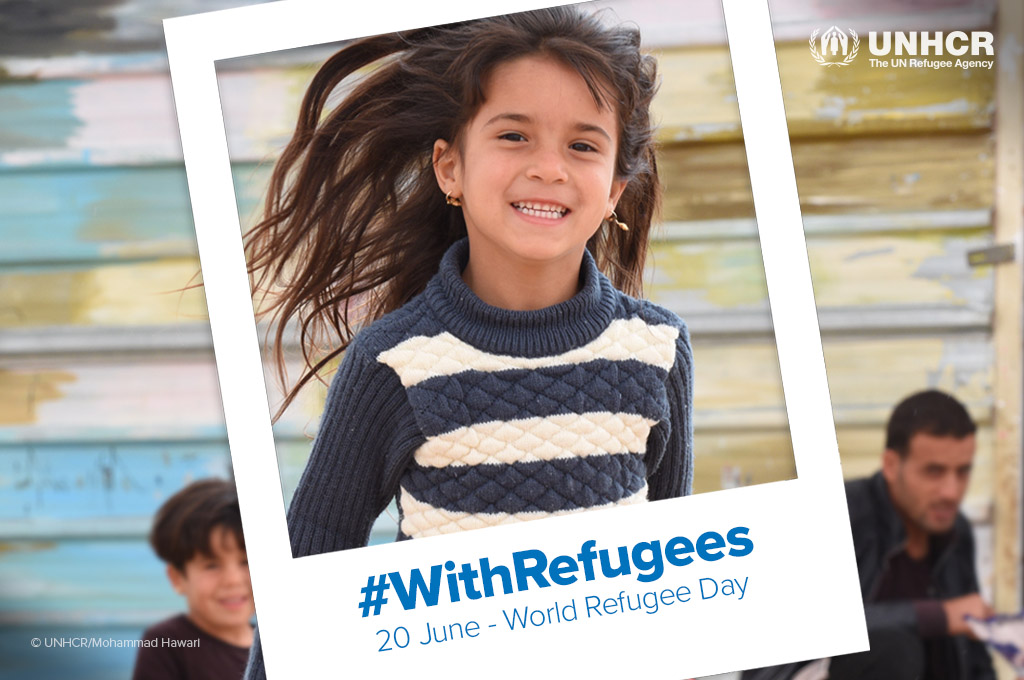
World Refugee Day - #With Refugees

In a world where violence forces thousands of families to flee for their lives each day, the time is now to show that the global public stands with refugees.

To do this, the UN Refugee Agency launched the #WithRefugees petition in June 2016 to send a message to governments that they must work together and do their fair share for refugees.

On World Refugee Day, held every year on June 20th, we commemorate the strength, courage and perseverance of millions of refugees. This year, World Refugee Day also marks a key moment for the public to show support for families forced to flee.

Background
Every minute 20 people leave everything behind to escape war, persecution or terror.

There are several types of forcibly displaced persons:

Refugees
A refugee is someone who fled his or her home and country owing to “a well-founded fear of persecution because of his/her race, religion, nationality, membership in a particular social group, or political opinion”, according to the United Nations 1951 Refugee Convention. Many refugees are in exile to escape the effects of natural or human-made disasters.

Asylum seekers
Asylum seekers say they are refugees and have fled their homes as refugees do, but their claim to refugee status is not yet definitively evaluated in the country to which they fled.

Internally Displaced Persons
Internally Displaced Persons (IDPs) are people who have not crossed an international border but have moved to a different region than the one they call home within their own country.

Stateless Persons
Stateless persons do not have a recognized nationality and do not belong to any country.
Statelessness situations are usually caused by discrimination against certain groups. Their lack of identification — a citizenship certificate — can exclude them from access to important government services, including health care, education or employment.

Returnees
Returnees are former refugees who return to their own countries or regions of origin after time in exile. Returnees need continuous support and reintegration assistance to ensure that they can rebuild their lives at home.

UN Action
1951 Refugee Convention and its 1967 Protocol

Refugees are among the most vulnerable people in the world. The 1951 Refugee Convention and its 1967 Protocol help protect them. They are the only global legal instruments explicitly covering the most important aspects of a refugee’s life. According to their provisions, refugees deserve, as a minimum, the same standards of treatment enjoyed by other foreign nationals in a given country and, in many cases, the same treatment as nationals.

The 1951 Convention contains a number of rights and also highlights the obligations of refugees towards their host country. The cornerstone of the 1951 Convention is the principle of non-refoulement. According to this principle, a refugee should not be returned to a country where he or she faces serious threats to his or her life or freedom. This protection may not be claimed by refugees who are reasonably regarded as a danger to the security of the country, or having been convicted of a particularly serious crime, are considered a danger to the community.

The rights contained in the 1951 Convention include:
  • The right not to be expelled, except under certain, strictly defined conditions;
  • The right not to be punished for illegal entry into the territory of a contracting State;
  • The right to work;
  • The right to housing;
  • The right to education;
  • The right to public relief and assistance;
  • The right to freedom of religion;
  • The right to access the courts;
  • The right to freedom of movement within the territory;
  • The right to be issued identity and travel documents.
Some basic rights, including the right to be protected from refoulement, apply to all refugees. A refugee becomes entitled to other rights the longer they remain in the host country, which is based on the recognition that the longer they remain as refugees, the more rights they need.

Office of the United Nations High Commissioner for Refugees
The Office of the United Nations High Commissioner for Refugees (UNHCR), also known as the UN Refugee Agency, was established on 14 December 1950 by the United Nations General Assembly. The agency is mandated to lead and coordinate international action to protect refugees and resolve refugee problems worldwide. Its primary purpose is to safeguard the rights and well-being of refugees. It strives to ensure that everyone can exercise the right to seek asylum and find safe refuge in another State, with the option to return home voluntarily, integrate locally or to resettle in a third country. It also has a mandate to help stateless people.

UNHCR's mandate distinguishes it from other humanitarian actors, requiring it to provide international protection to refugees who do not enjoy the protection of their governments. It also recognizes that international cooperation and support are needed to complement the efforts of the host country, which bears the primary responsibility for meeting the needs of refugees.

Rebuilding Lives in Peace and Dignity
UNHCR provides legal protection for refugees and seeks long-lasting solutions to their problems, by helping them either return voluntarily to their homes or settle in other countries. Its objective is to help refugees and other forcibly displaced persons rebuild their lives in peace and dignity.

The agency aims to uphold the rights of all displaced people, including women, children, older persons and people living with disabilities. Its seeks to reunite them with their families, protect them from sexual exploitation, abuse, violence and military recruitment, and offers education and training, health services, etc.

When there is a massive influx of refugees or internally displaced persons (IDPs) in a region, UNHCR can dispatch 300 skilled personnel in less than 72 hours following a crisis and leads the relief action to provide refugees and IDPs with emergency shelter — refugee camps, collective centres, makeshift shelters — and essential goods, including tents, blankets and plastic sheeting.

UNHCR also helps build clinics, schools and water wells for shelter inhabitants and gives them access to health care and psychosocial support during their exile. It coordinates family reunification activities and demobilization, disarmament and integration programmes for children associated with armed forces.

Repatriation and Integration
A refugee’s voluntary repatriation to her or his country or region of origin is considered the most successful outcome of all. Upon a refugee’s return home, UNHCR organizes “go-and-see” follow-up visits and provides safety information while engaging in community reconciliation activities and providing legal aid.

Refugees who cannot return home often locally integrate into host societies or resettle in a third country. In such cases, UNHCR supports integration programmes, such as cultural orientation, language and vocational training, and offers legal advice as well as psychological support to ensure that people are well integrated and resettled into societies in peace.

World Refugee Day Local Events - San Antonio and St. Louis

For Sisters and Friends in San Antonio, TX and St. Louis, MO we encourage you to attend the following events to celebrate World Refugee Day 2019.

San Antonio
No photo description available.

World Refugee Day Art Event

Tuesday, June 18th at 6:00pm
Brick at Blue Star Arts Complex

Join Catholic Charities for an evening of art, entertainment, and libations as we raise awareness and promote advocacy for the refugee community. Guests can expect a special evening including international cuisine and entertainment, a henna artist, and a silent auction with items made by our newcomers.

Contact Elizabeth Ortiz at (210) 242-3151 or eortiz@ccaosa.org for more information or tickets.

St. Louis

Bagels and Coffee: World Refugee Day 
Thursday, June 20, 2019, 8:00 - 9:15 am
International Institute, 3401 Arsenal St, St. Louis, MO 63118
RSVP to info@iistl.org or Eventbrite at least 24 hours in advance
Join us for an informative panel discussion plus Q&A to recognize World Refugee Day as designated by the United Nations. 
Event is free and open to the public - please park in the off-street lot in the rear; enter from Louisiana Ave.
Doors open 15 minutes prior to start of program. This program is part of IISTL's ongoing Bagels & Coffee Speaker Series.

World Refugee Day Celebration 

Thursday, June 20th at 6:00pm 
Grace United Methodist Church 
6199 Waterman Blvd, 63112

You are invited to a Welcome Neighbor STL Supper Club event to support refugee families recently settled in St. Louis. Enjoy food, conversation, and catching up with friends – old and new. From cultural exchange to just plain fun, look forward to a great evening.

These meals present an opportunity for immigrant families to share knowledge and skills unique to them. It is also an opportunity for us to get a glimpse into their culture. These fundraising efforts can set them on a path of greater independence and confidence in their lives here in in the USA.

When you attend a Welcome Neighbor STL Supper Club, your meal will be prepared by immigrant neighbors who will share their culture and cooking skills by providing a table full of traditional food from their country of origin.

Suggested donation: $25 per person.

Pope’s message for 2019 World Day of Migrants and Refugees

Dear Brothers and Sisters,

Faith assures us that in a mysterious way the Kingdom of God is already present here on earth (cf. Gaudium et Spes, 39). Yet in our own time, we are saddened to see the obstacles and opposition it encounters. Violent conflicts and all-out wars continue to tear humanity apart; injustices and discrimination follow one upon the other; economic and social imbalances on a local or global scale prove difficult to overcome. And above all it is the poorest of the poor and the most disadvantaged who pay the price.

The most economically advanced societies are witnessing a growing trend towards extreme individualism which, combined with a utilitarian mentality and reinforced by the media, is producing a “globalization of indifference”. In this scenario, migrants, refugees, displaced persons and victims of trafficking have become emblems of exclusion. In addition to the hardships that their condition entails, they are often looked down upon and considered the source of all society’s ills. That attitude is an alarm bell warning of the moral decline we will face if we continue to give ground to the throw-away culture. In fact, if it continues, anyone who does not fall within the accepted norms of physical, mental and social well-being is at risk of marginalization and exclusion.

For this reason, the presence of migrants and refugees – and of vulnerable people in general – is an invitation to recover some of those essential dimensions of our Christian existence and our humanity that risk being overlooked in a prosperous society. That is why it is not just about migrants. When we show concern for them, we also show concern for ourselves, for everyone; in taking care of them, we all grow; in listening to them, we also give voice to a part of ourselves that we may keep hidden because it is not well regarded nowadays.

“Take courage, it is I, do not be afraid!” (Mt 14:27). It is not just about migrants: it is also about our fears. The signs of meanness we see around us heighten “our fear of ‘the other’, the unknown, the marginalized, the foreigner... We see this today in particular, faced with the arrival of migrants and refugees knocking on our door in search of protection, security and a better future. To some extent, the fear is legitimate, also because the preparation for this encounter is lacking” (Homily in Sacrofano, 15 February 2019). But the problem is not that we have doubts and fears. The problem is when they condition our way of thinking and acting to the point of making us intolerant, closed and perhaps even – without realizing it – racist. In this way, fear deprives us of the desire and the ability to encounter the other, the person different from myself; it deprives me of an opportunity to encounter the Lord (cf. Homily at Mass for the World Day of Migrants and Refugees, 14 January 2018).

“For if you love those who love you, what recompense will you have? Do not the tax collectors do the same?” (Mt 5:46). It is not just about migrants: it is about charity. Through works of charity, we demonstrate our faith (cf. Jas 2:18). And the highest form of charity is that shown to those unable to reciprocate and perhaps even to thank us in return. “It is also about the face we want to give to our society and about the value of each human life... The progress of our peoples... depends above all on our openness to being touched and moved by those who knock at our door. Their faces shatter and debunk all those false idols that can take over and enslave our lives; idols that promise an illusory and momentary happiness blind to the lives and sufferings of others” (Address at the Diocesan Caritas of Rabat, 30 March 2019).

“But a Samaritan traveller who came upon him was moved with compassion at the sight” (Lk 10:33). It is not just about migrants: it is about our humanity. Compassion motivated that Samaritan – for the Jews, a foreigner – not to pass by. Compassion is a feeling that cannot be explained on a purely rational level. Compassion strikes the most sensitive chords of our humanity, releasing a vibrant urge to “be a neighbour” to all those whom we see in difficulty. As Jesus himself teaches us (cf. Mt9:35-36; 14:13-14; 15:32-37), being compassionate means recognizing the suffering of the other and taking immediate action to soothe, heal and save. To be compassionate means to make room for that tenderness which today’s society so often asks us to repress. “Opening ourselves to others does not lead to impoverishment, but rather enrichment, because it enables us to be more human: to recognize ourselves as participants in a greater collectivity and to understand our life as a gift for others; to see as the goal, not our own interests, but rather the good of humanity” (Address at the Heydar Aliyev Mosque in Baku, 2 October 2016).

“See that you do not despise one of these little ones, for I say to you that their angels in heaven always look upon the face of my heavenly Father” (Mt 18:10). It is not just about migrants: it is a question of seeing that no one is excluded. Today’s world is increasingly becoming more elitist and cruel towards the excluded. Developing countries continue to be drained of their best natural and human resources for the benefit of a few privileged markets. Wars only affect some regions of the world, yet weapons of war are produced and sold in other regions which are then unwilling to take in the refugees produced by these conflicts. Those who pay the price are always the little ones, the poor, the most vulnerable, who are prevented from sitting at the table and are left with the “crumbs” of the banquet (cf. Lk 16:19-21). “The Church which ‘goes forth’... can move forward, boldly take the initiative, go out to others, seek those who have fallen away, stand at the crossroads and welcome the outcast” (Evangelii Gaudium, 24). A development that excludes makes the rich richer and the poor poorer. A real development, on the other hand, seeks to include all the world’s men and women, to promote their integral growth, and to show concern for coming generations.

“Whoever wishes to be great among you will be your servant; whoever wishes to be first among you will be the slave of all” (Mk10:43-44). It is not just about migrants: it is about putting the last in first place. Jesus Christ asks us not to yield to the logic of the world, which justifies injustice to others for my own gain or that of my group. “Me first, and then the others!” Instead, the true motto of the Christian is, “The last shall be first!” “An individualistic spirit is fertile soil for the growth of that kind of indifference towards our neighbours which leads to viewing them in purely economic terms, to a lack of concern for their humanity, and ultimately to feelings of fear and cynicism. Are these not the attitudes we often adopt towards the poor, the marginalized and the ‘least’ of society? And how many of these ‘least’ do we have in our societies! Among them I think primarily of migrants, with their burden of hardship and suffering, as they seek daily, often in desperation, a place to live in peace and dignity” (Address to the Diplomatic Corps, 11 January 2016). In the logic of the Gospel, the last come first, and we must put ourselves at their service.

“I came so that they might have life and have it more abundantly” (Jn 10:10). It is not just about migrants: it is about the whole person, about all people. In Jesus’ words, we encounter the very heart of his mission: to see that all receive the gift of life in its fullness, according to the will of the Father. In every political activity, in every programme, in every pastoral action we must always put the person at the centre, in his or her many aspects, including the spiritual dimension. And this applies to all people, whose fundamental equality must be recognized. Consequently, “development cannot be restricted to economic growth alone. To be authentic, it must be well-rounded; it must foster the development of each man and of the whole man” (SAINT PAUL VI, Populorum Progressio, 14).

“So then you are no longer strangers and sojourners, but you are fellow citizens with the holy ones and members of the household of God” (Eph 2:19). It is not just about migrants: it is about building the city of God and man. In our time, which can also be called the era of migration, many innocent people fall victim to the “great deception” of limitless technological and consumerist development (cf. Laudato Si’, 34). As a result, they undertake a journey towards a “paradise” that inevitably betrays their expectations. Their presence, at times uncomfortable, helps to debunk the myth of a progress that benefits a few while built on the exploitation of many. “We ourselves need to see, and then to enable others to see, that migrants and refugees do not only represent a problem to be solved, but are brothers and sisters to be welcomed, respected and loved. They are an occasion that Providence gives us to help build a more just society, a more perfect democracy, a more united country, a more fraternal world and a more open and evangelical Christian community” (Message for the 2014 World Day of Migrants and Refugees).

Dear brothers and sisters, our response to the challenges posed by contemporary migration can be summed up in four verbs: welcome, protect, promote and integrate. Yet these verbs do not apply only to migrants and refugees. They describe the Church’s mission to all those living in the existential peripheries, who need to be welcomed, protected, promoted and integrated. If we put those four verbs into practice, we will help build the city of God and man. We will promote the integral human development of all people. We will also help the world community to come closer to the goals of sustainable development that it has set for itself and that, lacking such an approach, will prove difficult to achieve.

In a word, it is not only the cause of migrants that is at stake; it is not just about them, but about all of us, and about the present and future of the human family. Migrants, especially those who are most vulnerable, help us to read the “signs of the times”. Through them, the Lord is calling us to conversion, to be set free from exclusivity, indifference and the throw-away culture. Through them, the Lord invites us to embrace fully our Christian life and to contribute, each according to his or her proper vocation, to the building up of a world that is more and more in accord with God’s plan.

In expressing this prayerful hope, and through the intercession of the Virgin Mary, Our Lady of the Way, I invoke God’s abundant blessings upon all the world’s migrants and refugees and upon all those who accompany them on their journey.

From the Vatican, 27 May 2019

FRANCIS

2019 World Refugee Day Action Ideas

Thursday, June 20th ─ and the entire month of June ─ we come together to celebrate the courage and resilience of refugees and their contributions to U.S. communities. We also raise our voices in opposition to the U.S. government’s decision to turn its back on refugees, through reducing resettlement in the United States and expanding policies that keep families apart.
While the United States was once a leader in protecting refugees, the current administration has dismantled our refugee resettlement program by 75%. But the need has never been greater, as the world is currently grappling with the worst refugee crisis in history. As refugees and friends of refugees, we are calling on the administration to preserve and expand refugee resettlement in the United States and enact policies that help refugees rebuild their lives.
Top 4 Ways to Protect Refugees and Restore the U.S. Resettlement Program
  1. Start by Sharing the Message on Social Media: Starting June 1 and every day thereafter, send a message of support on social media. Sample tweets available here. Sample graphics are available here: bit.ly/WRDGraphics2019.Sample videos on welcoming refugees are linked, as well as a longer form video for screening at events. Follow @WeAreAllUSA on Twitter and "like" We Are All America on Facebook for more. Please use #WRD2019 in all postings.
  2. Host or Attend a Local World Refugee Day Event: Even small events, multiplied across the country, send a powerful message to the Trump administration and Congress that welcoming refugees and immigrants matters. Host a local World Refugee Day event or attend an event already being planned. We Are All America has a map where you can register your event, or find out what is going on in your area. Our partners Church World Service suggest a Journey Sabbath to dedicate a worship service to refugees. You can also link up with I Am An Immigrant actions. More resources are available here.
  3. Call Congress - National Call-in Day June 20th: Click here for information on calling Congress, and share with your networks for our massive call-in day June 20th, World Refugee Day. Sample script and click-to-call tool available here.
  4. Support Local Refugees Welcome Resolutions: Ask your state & local policymakers to pass Refugees Welcome resolutions in June. Click here for a sample resolution. Visit contactingcongress.org/local and usa.gov/elected-officials for contact information. Tweet at your governor and state legislators. Don’t forget #WRD2019!

Tuesday, May 28, 2019

Support Refugees and Prevent Trafficking

Image result for with refugees
U.S. Catholic Sisters Against Human Trafficking (USCSAHT) invites you to join us in honoring refugees. On June 20, World Refugee Day, we commemorate the strength, courage, and resilience of refugees. Today, an unprecedented 68.5 million people around the world have been forced from home. Among them are nearly 25.4 million refugees, over half of whom are under the age of 18.1 Every 15 minutes a family is forced to flee their homeland.
We know that there is a strong link between forced migration and human trafficking. Men, women, and children are made vulnerable to human trafficking by the mass displacement caused by violence, extreme poverty, humanitarian crises, climate change, natural disasters, and conflict. Impoverished, vulnerable families are targeted by traffickers who promise to provide education and opportunity only to exploit them through forced labor, sexual exploitation, enslavement, or organ theft.
Stand in solidarity #WithRefugees and #StopRefugeeTrafficking on World Refugee Day, Thursday, June 20, 2019. Join us in calling our Representative and Senators and urging them to support two pro-refugee bills:

  1. H.R.2146 / S.1088 GRACE Act
  2. H.R. 2214 / S.1123 NO BAN Act
Visit our website to learn about our 2019 World Refugee Campaign and discover more ways that you can support refugees on June 20 and throughout year. You’ll find backgrounders, resources for prayer, stories of trafficked immigrants and  asylum seekers, sample social media posts and more.
If you would prefer to download and print the 2019 World Refugee Toolkit, you’ll find a PDF file HERE.
Join us and Stand in Solidarity #WithRefugees and #StopRefugeeTrafficking on World Refugee Day, Thursday, June 20! 

Wednesday, June 20, 2018

Congregational Statement on Zero Tolerance Immigration Policy

A painting by Kim Vanderheiden of Oakland


We, the Sisters of Charity of the Incarnate Word, San Antonio, Texas, oppose and condemn the unjust implementation of the “zero tolerance” immigration policies.  
Our values and the Gospel of Jesus Christ impel us to reject completely any policy that ignores and defiles the dignity of the human person, and uses the most vulnerable among us for political purposes.
We join our voices and our concerns with the United States Conference of Catholic Bishops, the Leadership Conference of Women Religious, the Catholic Health Association, and many other organizations, denominations, and faith and civic leaders in condemning this policy.   We urge members of the United States Congress to act immediately to halt the unjust, immoral and unconscionable implementation of this policy.

“What you do to the least of these, you do to me” (Matthew 25:40).

With Refugees!

TODAY is World Refugee Day. The plight of refugees connects to all other areas of justice, peace, and the care of creation.  There are populations of refugees known as climate refugees who are forced to flee their homes and country due to the impacts of climate change.  There are refugees who are fleeing poverty and violence in their native countries – a poverty and violence often caused and/or supported by other world powers.  We know that refugees are at greater risk for becoming victims of human trafficking due to their vulnerable and desperate situations.  

Refugees seeking asylum in the United States and other countries are being locked up, separated from their families, and denied their basic human rights.  The reality of refugees helps us to see how all life on this planet is connected, and how we all have a responsibility to alleviate the conditions that cause people to flee from their homes, and also offer hospitality and welcome to those who come to our countries seeking safety and a better life for their families.     

We hope that everyone finds at least one way commemorate World Refugee Day by raising awareness, joining in prayer, and/or taking action to defend the rights of refugees.  Our faith calls us to welcome the foreigner and offer hospitality to those in need, “for just as you did it for one of the least of these, you did it for me [Jesus, the Incarnate Word]” (Mt 25, 40).  


Action ideas: goo.gl/j13cXf 

Wednesday, June 28, 2017

Sign a Petition to Stand #WithRefugees

Each day war forces thousands of families to flee their homes.People like you, people like me.
To escape the violence, they leave everything behind – everything except their hopes and dreams for a safer future.
UNHCR, the UN Refugee Agency believes all refugees deserve to live in safety.
Add your name to the #WithRefugees petition to send a clear message to decision makers that they must act with solidarity and shared responsibility.
We stand together #WithRefugees.  Please stand with us.

The petition asks decision makers to:
  • Ensure every refugee child gets an education.
  • Ensure every refugee family has somewhere safe to live.
  • Ensure every refugee can work or learn new skills to support their families.
The campaign continues until a global compact for refugees is adopted in 2018.


Monday, June 19, 2017

Refugees: An opportunity to grow together

“Let us all, as one human family, strive to build bridges of solidarity rather than walls of division.” Read this Ecumenical statement which we join in solidarity with on this World Refugee Day.

The Christian Bible tells the story of two men, Peter and Cornelius, utterly divided by religious belief and culture, who in encountering each other discovered a truth about God’s common will for them that neither had previously grasped. They learnt that the Holy Spirit brings down walls and unites those who might think that they have nothing in common.


All around the world, women, men, and children are forced by violence, persecution, natural and human-caused disasters, famine, and other factors, to leave their homelands. Their desire to escape suffering is stronger than the barriers erected to block their way. The opposition by some countries to the migration of forcibly displaced people will not keep those who undergo unbearable suffering from leaving their homes.

Wealthy countries cannot evade their responsibility for the wounds inflicted on our planet – environmental disasters, the arms trade, developmental inequality – that drive forced migration and human trafficking. While it is true that the arrival of migrants in more developed countries can present real and significant challenges, it can also be an opportunity for openness and change. Pope Francis poses this question to us: “How can we experience these changes not as obstacles to genuine development, but rather as opportunities for genuine human, social and spiritual growth?” Societies that find the courage and the vision to go beyond the fear of foreigners and migrants soon discover the riches that migrants bring with them, and always have.

If we, as a human family, insist on only ever seeing refugees as a burden, we deprive ourselves of the opportunities for solidarity that are also always opportunities for mutual learning, mutual enrichment, and mutual growth.

It is not enough for Christians to profess to love Christ: belief is authentic only if it is expressed in loving action. We are one Body of Christ, undivided. In the words of Dietrich Bonhoeffer, “It is only through Jesus Christ that we are brothers and sisters of one another…. Through Christ our mutual belonging is real, integral, and for all time.” If we are one body, we are knitted into a solidarity that defines us and makes demands of us.
Signs of solidarity can be multiplied beyond the borders of religion and culture. Meeting believers of other persuasions encourages us to deepen our knowledge of our own faith, and in our encounter with our refugee brothers and sisters, God speaks to us and blesses us as He did Cornelius and Peter.

In every genuine encounter, an exchange of gifts takes place. Sharing with others what we have and own, we discover that all is given freely by God. At the same time, in welcoming those whom we encounter, we meet the God who is always already present with the vulnerable, at the peripheries, and in the other.

Increasingly around the world we witness the building of walls to keep out the displaced: not just physical walls, but also walls of fear, prejudice, hatred, and ideology. Let us all, as one human family, strive to build bridges of solidarity rather than walls of division. Our refugee sisters and brothers present us with opportunities for mutual enrichment and flourishing: it is God who brings us together.


With the development of new international frameworks – Global Compacts on Migrants and on Refugees – in 2018, States should not only ensure a more effective responsibility-sharing in response to large movements, but they should also accept the opportunity to recognize and highlight the significant contributions that refugees and migrants make in their host communities.