Showing posts with label reflection. Show all posts

Friday, May 31, 2019

Pope’s message for 2019 World Day of Migrants and Refugees

Dear Brothers and Sisters,

Faith assures us that in a mysterious way the Kingdom of God is already present here on earth (cf. Gaudium et Spes, 39). Yet in our own time, we are saddened to see the obstacles and opposition it encounters. Violent conflicts and all-out wars continue to tear humanity apart; injustices and discrimination follow one upon the other; economic and social imbalances on a local or global scale prove difficult to overcome. And above all it is the poorest of the poor and the most disadvantaged who pay the price.

The most economically advanced societies are witnessing a growing trend towards extreme individualism which, combined with a utilitarian mentality and reinforced by the media, is producing a “globalization of indifference”. In this scenario, migrants, refugees, displaced persons and victims of trafficking have become emblems of exclusion. In addition to the hardships that their condition entails, they are often looked down upon and considered the source of all society’s ills. That attitude is an alarm bell warning of the moral decline we will face if we continue to give ground to the throw-away culture. In fact, if it continues, anyone who does not fall within the accepted norms of physical, mental and social well-being is at risk of marginalization and exclusion.

For this reason, the presence of migrants and refugees – and of vulnerable people in general – is an invitation to recover some of those essential dimensions of our Christian existence and our humanity that risk being overlooked in a prosperous society. That is why it is not just about migrants. When we show concern for them, we also show concern for ourselves, for everyone; in taking care of them, we all grow; in listening to them, we also give voice to a part of ourselves that we may keep hidden because it is not well regarded nowadays.

“Take courage, it is I, do not be afraid!” (Mt 14:27). It is not just about migrants: it is also about our fears. The signs of meanness we see around us heighten “our fear of ‘the other’, the unknown, the marginalized, the foreigner... We see this today in particular, faced with the arrival of migrants and refugees knocking on our door in search of protection, security and a better future. To some extent, the fear is legitimate, also because the preparation for this encounter is lacking” (Homily in Sacrofano, 15 February 2019). But the problem is not that we have doubts and fears. The problem is when they condition our way of thinking and acting to the point of making us intolerant, closed and perhaps even – without realizing it – racist. In this way, fear deprives us of the desire and the ability to encounter the other, the person different from myself; it deprives me of an opportunity to encounter the Lord (cf. Homily at Mass for the World Day of Migrants and Refugees, 14 January 2018).

“For if you love those who love you, what recompense will you have? Do not the tax collectors do the same?” (Mt 5:46). It is not just about migrants: it is about charity. Through works of charity, we demonstrate our faith (cf. Jas 2:18). And the highest form of charity is that shown to those unable to reciprocate and perhaps even to thank us in return. “It is also about the face we want to give to our society and about the value of each human life... The progress of our peoples... depends above all on our openness to being touched and moved by those who knock at our door. Their faces shatter and debunk all those false idols that can take over and enslave our lives; idols that promise an illusory and momentary happiness blind to the lives and sufferings of others” (Address at the Diocesan Caritas of Rabat, 30 March 2019).

“But a Samaritan traveller who came upon him was moved with compassion at the sight” (Lk 10:33). It is not just about migrants: it is about our humanity. Compassion motivated that Samaritan – for the Jews, a foreigner – not to pass by. Compassion is a feeling that cannot be explained on a purely rational level. Compassion strikes the most sensitive chords of our humanity, releasing a vibrant urge to “be a neighbour” to all those whom we see in difficulty. As Jesus himself teaches us (cf. Mt9:35-36; 14:13-14; 15:32-37), being compassionate means recognizing the suffering of the other and taking immediate action to soothe, heal and save. To be compassionate means to make room for that tenderness which today’s society so often asks us to repress. “Opening ourselves to others does not lead to impoverishment, but rather enrichment, because it enables us to be more human: to recognize ourselves as participants in a greater collectivity and to understand our life as a gift for others; to see as the goal, not our own interests, but rather the good of humanity” (Address at the Heydar Aliyev Mosque in Baku, 2 October 2016).

“See that you do not despise one of these little ones, for I say to you that their angels in heaven always look upon the face of my heavenly Father” (Mt 18:10). It is not just about migrants: it is a question of seeing that no one is excluded. Today’s world is increasingly becoming more elitist and cruel towards the excluded. Developing countries continue to be drained of their best natural and human resources for the benefit of a few privileged markets. Wars only affect some regions of the world, yet weapons of war are produced and sold in other regions which are then unwilling to take in the refugees produced by these conflicts. Those who pay the price are always the little ones, the poor, the most vulnerable, who are prevented from sitting at the table and are left with the “crumbs” of the banquet (cf. Lk 16:19-21). “The Church which ‘goes forth’... can move forward, boldly take the initiative, go out to others, seek those who have fallen away, stand at the crossroads and welcome the outcast” (Evangelii Gaudium, 24). A development that excludes makes the rich richer and the poor poorer. A real development, on the other hand, seeks to include all the world’s men and women, to promote their integral growth, and to show concern for coming generations.

“Whoever wishes to be great among you will be your servant; whoever wishes to be first among you will be the slave of all” (Mk10:43-44). It is not just about migrants: it is about putting the last in first place. Jesus Christ asks us not to yield to the logic of the world, which justifies injustice to others for my own gain or that of my group. “Me first, and then the others!” Instead, the true motto of the Christian is, “The last shall be first!” “An individualistic spirit is fertile soil for the growth of that kind of indifference towards our neighbours which leads to viewing them in purely economic terms, to a lack of concern for their humanity, and ultimately to feelings of fear and cynicism. Are these not the attitudes we often adopt towards the poor, the marginalized and the ‘least’ of society? And how many of these ‘least’ do we have in our societies! Among them I think primarily of migrants, with their burden of hardship and suffering, as they seek daily, often in desperation, a place to live in peace and dignity” (Address to the Diplomatic Corps, 11 January 2016). In the logic of the Gospel, the last come first, and we must put ourselves at their service.

“I came so that they might have life and have it more abundantly” (Jn 10:10). It is not just about migrants: it is about the whole person, about all people. In Jesus’ words, we encounter the very heart of his mission: to see that all receive the gift of life in its fullness, according to the will of the Father. In every political activity, in every programme, in every pastoral action we must always put the person at the centre, in his or her many aspects, including the spiritual dimension. And this applies to all people, whose fundamental equality must be recognized. Consequently, “development cannot be restricted to economic growth alone. To be authentic, it must be well-rounded; it must foster the development of each man and of the whole man” (SAINT PAUL VI, Populorum Progressio, 14).

“So then you are no longer strangers and sojourners, but you are fellow citizens with the holy ones and members of the household of God” (Eph 2:19). It is not just about migrants: it is about building the city of God and man. In our time, which can also be called the era of migration, many innocent people fall victim to the “great deception” of limitless technological and consumerist development (cf. Laudato Si’, 34). As a result, they undertake a journey towards a “paradise” that inevitably betrays their expectations. Their presence, at times uncomfortable, helps to debunk the myth of a progress that benefits a few while built on the exploitation of many. “We ourselves need to see, and then to enable others to see, that migrants and refugees do not only represent a problem to be solved, but are brothers and sisters to be welcomed, respected and loved. They are an occasion that Providence gives us to help build a more just society, a more perfect democracy, a more united country, a more fraternal world and a more open and evangelical Christian community” (Message for the 2014 World Day of Migrants and Refugees).

Dear brothers and sisters, our response to the challenges posed by contemporary migration can be summed up in four verbs: welcome, protect, promote and integrate. Yet these verbs do not apply only to migrants and refugees. They describe the Church’s mission to all those living in the existential peripheries, who need to be welcomed, protected, promoted and integrated. If we put those four verbs into practice, we will help build the city of God and man. We will promote the integral human development of all people. We will also help the world community to come closer to the goals of sustainable development that it has set for itself and that, lacking such an approach, will prove difficult to achieve.

In a word, it is not only the cause of migrants that is at stake; it is not just about them, but about all of us, and about the present and future of the human family. Migrants, especially those who are most vulnerable, help us to read the “signs of the times”. Through them, the Lord is calling us to conversion, to be set free from exclusivity, indifference and the throw-away culture. Through them, the Lord invites us to embrace fully our Christian life and to contribute, each according to his or her proper vocation, to the building up of a world that is more and more in accord with God’s plan.

In expressing this prayerful hope, and through the intercession of the Virgin Mary, Our Lady of the Way, I invoke God’s abundant blessings upon all the world’s migrants and refugees and upon all those who accompany them on their journey.

From the Vatican, 27 May 2019

FRANCIS

Monday, May 20, 2019

Deep in the Heart(break) of Texas

(from the Marianist Social Justice Collaborative)
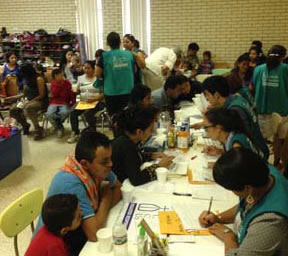
Mary Vanderhoof, our former MSJC Asst. Director, recently traveled to the US/Mexico border to work with refugees and asylum-seekers entering this country. I encourage you to read her powerful, truly moving story of working with these people in their need and what one person was able to do to respond.

"I have recently returned from a week of service at the Humanitarian Respite Center (HRC) in McAllen, Texas... HRC offers food, shelter, and basic services to refugee families from Central America who have been released from detention by ICE to await an asylum hearing. In the past, I've served in Trenton NJ, Appalachia, and Uganda, but this was the hardest week of service I have ever experienced. It left my heart broken, but as Rumi once wrote, "The wound is where the light enters." 

I returned from Texas filled with the light of love and compassion for the refugee families, yearning to share that light and help others understand that these are not "bad hombres." They are fathers and mothers fleeing from gang violence, domestic violence, organized crime, human traffickers, and extreme poverty (e.g., starvation due to climate-change-provoked crop failures) who come to the US desperately seeking safety, security and a chance to support their family. 
(Read more...)

Mary ends her reflections this way:
What can I do now? I know I can't just go back to life here in New Jersey and not be changed by this experience. Whether it's advocacy with legislators, or sending cases of supplies to the Respite Center, or recruiting more volunteers to come with me when I return to McAllen in the fall, I must do something. If you feel the same, I'll be happy to send you ways you can help.

You can reach Mary at mary.vanderhoof@gmail.com

Rejecting the Mindset of the Forever War

The Incarnate Word Congregation has committed itself to exploring the Catholic Nonviolence Initiative. Let us consider and discuss this article: 

Image result for end perpetual war"The Forever War is not just in the Middle East. It is in Korea, where US troops still stand to post along the DMZ. It is in Vietnam, where hundreds of thousands of children have been born with spina bifida, neural tube problems, missing limbs, missing vertebrae, autoimmune disorders and more, four decades after the US finished hosing that nation down with Agent Orange. And yes, the Forever War is also in Iraq, which practically glows at night from all the depleted uranium the US has detonated there since 1991.

This is why we find ourselves today talking about torture the way other people talk about their sandwich order, and why powerful voices see fit to accuse torture survivors of treason. We have been thoroughly debased by all this war, all this violence, all this death for so many years. The most popular video games come with body counts. Neighbors with massive arsenals are the norm, and massacres flicker by like dandelion seeds.

We are a crumbling nation not just in a moral sense, but in a literal one. The trillions of dollars spent on the Forever War have turned our economy into a shaky shell game, and deprived us of the opportunity to make education, infrastructure, genuine health care and artistic achievement the cornerstones of our culture. When capitalism sits at the table with democracy, sooner or later all the plates are empty save for a golden few. The United States did not invent the concept of using war to plunder the treasury. It simply perfected the practice." 

Thursday, November 29, 2018

Testimony from Sr. Bertha Flores on Ministering to Migrants in El Paso, TX

There are no words to describe what a shelter is. Only when one is a witness of the relief provided to so many people, can one value and appreciate a shelter in all its magnitude. We were blessed recently to be part of the solidarity shown to immigrants at the St. Charles Shelter in El Paso, Texas, and to see how it attracts, as a magnet, the unity of other people and institution. We arrived at the shelter on Monday, November 4, 2018. The staff toured the facilities with us and explained the policies and daily procedures.
St. Charles Borromeo Seminary in El Paso, TX
The Saint Charles Shelter operates with a team of volunteers, most of whom are women 50 years old or older, who provide services to the migrants related to food, lodging, laundry, and telephone connections with their relatives or with those who will receive them. They also provide transportation services to bus stations or to the airport. Ten full-time volunteers live at the shelter.

The maximum capacity at the shelter is 100. Thirty to forty migrants arrive daily; at times this number increases to sixty or seventy. They come from Honduras, San Salvador, Guatemala a, d Brazil and stay for two or three days.

Volunteers cook and serve breakfast. Lunch and dinner are prepared by different groups from parishes in El Paso and neighboring places. Towels and sheets used by the refugees are washed daily; blankets are disinfected with spray.

Every day, a bus drives people from Migration Detention Centers to the eight different shelters in El Paso. Most of them are detained at these shelters from four to fifteen days where they receive only one meal a day and can bathe only once during their stay. The temperature in the Detention Centers is kept low, so when the immigrants reach the shelter, they are exhausted, and most of the children have colds. Most immigrants travel with one or two children, and some bring babies.

Many experience various forms of stress. One afternoon, a woman who traveled alone with her five-year old child fainted while she was waiting to take a shower. The child was very scared and cried. He feared that his mother could die. Those minutes seemed like hours to us until his mother, a 24-year old woman, recovered.

When the immigrants arrive at the shelter, after we welcome them, they register and contact by telephone the people who will receive them in this country. They call across the country – to New Jersey, Maryland, Maine, New York, Massachusetts, Virginia, North Carolina, North Dakota, South Dakota, Indiana, Missouri, Kansas, California, Louisiana, Georgia, Florida, Texas, New México– and because they have no money, they ask their contacts to buy tickets for their trip. They are always hungry when they arrive. It is very moving to see how the babies “devour” food. If they drop a piece of food, they pick it up with their little hands and put it in their mouths. Sometimes the pieces of food are so small that they could be considered crumbs. It is difficult to hold back our tears when we see this. The babies are not the only ones who do this; children and adults do the same. After dinner, the atmosphere changes and they begin to feel the effects of the warm welcome and hospitality they have received.


Before their departure from the shelter, we give the migrants clothes suitable for the places where they will go. We also provide them with a backpack for their use during the trip containing items for personal hygiene, a towel, a blanket and a pillow.

But why do they come here?

Most of them are escaping from extreme poverty conditions and from the violence of organized crime which is increasing in Central America. Yesterday, a couple with three children arrived from Guatemala. They had to run away because two armed men, covered with hoods, demanded the payment of a fee for the small business they have there. Because they did not receive the fee, they shot the husband six times, at point-blank range, and they left him, presuming he was dead. Fortunately, he survived. He still has the marks of the six bullets around his waist and heart. One of the bullets broke a bone in his arm and he is wearing a metal support with six screws. Thanks be to God he is alive.

Yesterday, we received three small girls with their heads full of lice. They were very frightened and were crying. Thank God we had an excellent medicine cabinet so we could give them the first treatment. Word spread that I was excellent in treating this problem and I was told that others who needed attention would be referred to me!

Some of the immigrants arrive very ill with colds and other ailments. Yesterday, a boy and a girl with chicken pox came to the shelter. A doctor, who visits every day after work, immediately took the necessary precautions. The mothers take care of the smaller children and those who are ill.

The children are a living lesson of resilience. They arrive exhausted, sad and nervous, but the next day they are outside playing football and are happy! Usually, their parents join them.  Many mother care for the smallest ones or those who are sick.

As the days go by our energy is exhausted, and after a week we must take a pause and rest to recover strength and energy.   .

Tuesday, November 27, 2018

Walking Towards Hope: Advent Resource

The Interfaith Immigration Coalition’s Holy Days and Holidays committee has developed a series of eight prayers, Walking Toward Hope, which can be used throughout the Advent and Christmas seasons. Each two-page reflection guide includes a brief reflection on the scripture of the day, the story of an immigrant or refugee, suggested actions, and a list of additional resources.

This year, we invite you to join the spiritual journey of “Walking Toward Hope,” by participating in the 8 part series focusing on the following themes:

1. Week One, December 2 - Walking Away From Family Detention 
2. Week Two, December 9  - Resisting Negative Rules & Exclusions 
3. Week Three, December 16  - Welcoming Asylum Seekers 
4. Week Four, December 23 - Defending Families Facing Deportation
5. Christmas Eve, December 24 - Celebrating Reunions & Protections  
6. Holy Innocents, December 28 - Alternatives to Detention 
7. Feast of the Holy Family , December 30 - Root Causes of Refugees  
8. Epiphany/Dia de Reyes, January 6 - Walking Together at the Border

We hope you find these reflections helpful as we prepare to celebrate the feast of God’s love incarnate and strive to make room in our hearts and communities for all those who are “walking toward hope”.

You can download the prayer-series from the IIC's Holidays and Holy Days web page.

Testimony from Serving Migrants in El Paso by Sr. Ceci Zavala CCVI

My experience at the shelter of El Paso was very hard because of the migrants’ suffering and struggles.  Most of the migrants (mother and child or father and child) arrived without dignity because the conditions of their journey or their time at the detention center made them to lose it.

It was also a joy to see them recover their dignity at the time they left the shelter.  That is why, the service at the shelter is simple HUMANITARIAN help.

I also enjoyed the team work of many, many, many volunteers. The donations (clothes, food, time) of many people gave me back HOPE; hope in the good will of people, hope that other world is possible…

By Sr. Ceci Zavala, CCVI 

Sr. Ceci Zavala CCVI


Monday, July 2, 2018

A Visit from the Holy Family

Image result for jesus and mary immigrationJesus and Maria stayed at our convent last night! 

Well, actually three—two mothers from El Salvador and one from Honduras each with a precious little son, one- or two-years old. 

One woman explained that four men had come to their home, shot her brother, and cut off his head.  She took her son and fled. They traveled for over a month, anyway that they could to reach our border.  They turned themselves in seeking help.

All three of the mothers and sons have relatives here.  Early this morning Sister Marichui took them to the airport. They are on their way to California, Florida, and Virginia---one to be with her mother whom she has not seen since she left El Salvador twenty-years ago.

I was left wondering, how can we in the international family work together so that all countries can be safe, all can stay in their homes near the rest of their families, enjoying their culture and language and uniqueness?

Until we do better figuring that out, our convent Annunciation Community feels better that we are blessed by these international guests from time to time. They teach us courage, perseverance, resilience, hope and LOVE.

Their presence leads me to hard questions about how we have contributed to the creation of unjust global economics---questions I would rather avoid.

I had some extra books by Dr. Seuss because my grandniece and nephew already had the ones I had bought for them. When Sr. Marichui and I asked the boy which he would like, he delightedly picked the one with the cow on the cover. He turned the pages pointing to the animal. Even if my Spanish is not good, I am great making animal sounds. He smiled. His mother said that he loved to be read stories.

The children learn quickly.  What can we learn from the children?

Written by Sr. Martha Ann Kirk, CCVI 

The Sisters of Charity of the Incarnate Word, since their founding
have continue to respond to the needs of suffering children.
Pictured above is Mother St. Pierre in 1888 with orphaned children.

Monday, August 14, 2017

Corruption in Peru

by Selena Mitchell, Incarnate Word Missionary

Corruption. The undercurrent of injustice, wrongdoing, stealing, and lying has plagued so many government agencies. It has also disrupted daily interactions among Peruvians. It is no secret that this beautiful country regarded for its culinary arts and known for its natural wonders, struggles to progress and develop in a way where the majority can benefit and thrive. The constant push-pull of wanting to uphold justice and yet allowing short cuts to supersede the latter leads to inefficiency and suffering. However, this article will not go into the history of corruption in Peru nor the current events, although some background will be used for context. Rather the article will observe the ways in which a country’s leadership affects communities on a small scale. Thereby highlighting that even within micro-societies they lend itself to the country’s battle with corruption. The trickle down theory of economics states that over time the benefits of the wealthy will reach the majority. If this same theory is applied to behavior, business practices, and expectations, then one has a better time grasp of how corruption has infiltrated the lives of Peruvians.

Whether we choose to accept the influences of media and state leadership or not, we cannot deny that previous presidents such as Alberto Fujimori, indeed caused long term repercussions -- coming from a societal and cultural perspective. Author Julio Carrion wrote, “In the Fujimori Era [...] corruption was a primary constitutive feature of the regime. By effectively eradicating any oversight of the executive branch by the legislature or the judiciary, Fujimori and his inner circle were free from scrutiny and could act with impunity” in “The Fujimori Legacy: The Rise of Electoral Authoritarianism in Peru”. In essence Fujimori laid the groundwork for a government ridden with corruption and crime. He was able to infiltrate all aspects of the political system and remove respect for authority in the sense that the need to follow protocols and regulations wavered. His long list of wrong-doings in many ways has stayed with the country. This is not to say that Fujimori was the sole culprit of corruption in Peru but rather he was a major player in its continued existence. Unfortunately, overtime the shock value of crime decreases until one becomes jaded. When that transpires, a country has a major challenge ahead in reducing illegal actions.

A chemist professor at the University of San Pedro in Chimbote shares his perspective on corruption on a community level. He explains that one reason why people act without accountability is because their bosses have chosen to think of themselves rather than the whole. In other words, the system of checks and balances has slowly degraded over time. Indirectly he is supporting the argument that Fujimori and the overall Peruvian government holds responsibility for not being able to uphold procedures and justice as it should. Such that those within power and those striving to obtain it are unable to distinguish between right and wrong. Specifically in Chimbote, although similar behaviors can probably be found throughout Peru, there is this mindset that things are not going to change so therefore why try to change them. Perhaps this outlook derives from the years of living under an overall unsupportive government and police system. But the resulting actions or lack thereof often equate to being unsupportive or undermining to one another.

The ease that comes from paying off a police officer to avoid getting a ticket or for having outdated car documents should be startling. Yet, it has become the norm. Just as plans for a new construction project is priced higher than calculated and the extra money benefits the companies, has become common knowledge, but should be startling. Similarly when a politician assists a non-profit agency to receive a scholarship or operating funds, it is almost expected that a portion of that money will be given to the politician, also known as a kickback. These examples of real life occurrences are just some of the ways in which corruption in simple forms take place. Of course, these examples do not represent all Peruvians but surely some. Like myself, many often wonder where these behaviors derive from. Are they a result of poverty or greed?

Knowing the answer to that question may never be made evident. However, the earliest form of a classroom is the home. Children and parents learn their moral code, manners, and cultural norms from family members and friends. Should we want future generations to live in a more just and accountable society, we must first take ownership of our own behaviors and how we influence those around us. An educated community gains power by knowing their rights as citizens. Thereby acquiring the ability to check the power of the local government and the police force. Because when all is said and done, a government without a community cannot run well. To continue to allow the instances previously mentioned to occur, permits the erosion of the system’s foundation. One would only hope that through education and accountability those caught in corruption will be prosecuted. With the long term result of ending the people’s suffering and preventing the daily microaggressions against one another. 

Thursday, June 15, 2017

Laudato Si Turns Two!

June 18, 2017 is the second anniversary of the publication of Pope Francis’s historic encyclical Laudato Si: On Care for Our Common Home.  How have you been living Laudato Si over the past two years?  Check out the resources below to keep Laudato Si alive in your hearts and your community today and in the years to come. We hope you will also spread the word through sharing these resources!  
CATHOLIC HEALTH ASSOCIATION HAS A COMPENDIUM OF RESOURCES AVAILABLE ON THEIR WEBSITE
Prayer Resources

Addressing Climate Change
In Laudato Si', Pope Francis makes a moral and scientific argument for recognizing and taking action on climate change. This video highlights portions of his case while also highlighting Catholic health care's response to reduce our contribution to the problem of climate change.
·     Watch the video minus the closing prayer (less than 4 minutes)
ADDITIONAL RESOURCES
  • Vatican website for the encyclical
  • Mercy International Association – Nine Days of Prayer. Commencing on Saturday, June 10 and concluding on Sunday, June 18, Mercy International will share reflects on verses from Laudato Si', with a short video in the form of a reflection, song or story included in the reflection page for each day. They will be available at Mercyworld.org starting June 7.
  • Catholic Climate Coalition
o    Laudato Si’

New Documentary: Peace Be with You

Peace Be With You! 

As we, the Incarnate Word Community, continue our study and reflection on Gospel Nonviolence, this short film made by a local chapter of Pax Christi, the international peace organization,  could lead us to deeper discussion and deeper prayer: 


Consider gathering a few friends or your Mission or Associates Group to watch and discuss it. 

Pax Christi invites those who watch the film to respond: “As we call upon our Catholic Church to recommit to the centrality of Gospel nonviolence: What nonviolent practices and strategies are you, your community, or your region/local chapter group engaged in to bring about sustained peace?"

Please share your insights, etc. with Rachel Schmidt, Communication Coordinator at rschmidt@paxchristiusa.org  

Tuesday, April 25, 2017

A Reflection on Racism and Sexism

Wednesday, March 8th I found myself amidst a line of women, linked hand in hand in solidarity for women’s rights locally and internationally. We wore the color black to honor and remember those who lost their lives fighting for equality, representation, and justice. Additionally, we represented those in societies where women have limited presence outside of the traditional roles. As we looped around the Mercado Modelo and up towards the Plaza de Armas, I could not help but wonder where were all the other women in Chimbote? How does the struggle differ for Afro-Peruvian Women? and better yet how does my own experience as a Black Woman from the United States relates to the diaspora in Peru? Perhaps these questions do not have definite answers and maybe that is how it should be, for the vagueness leaves room for growth and improvement.
In conversations with Chimbotanos I often hear “We live in a machismo society.” This statement holds true in a consistent subtle manner. In the way that few women drive, men are not expected to contribute to the household besides providing income, and the domestic violence both physical and verbal that often goes unresolved, are just a few examples. Machismo, the strong and often aggressive masculine pride, is so rooted in the culture that often citizens do not realize that it is a problem worth correcting. Knowing that a female is unequal and treated more like an object rather than a whole person who deserves respect, can lead to complacency and jadedness if unable to find an outlet. The greater problem lies in when one has grown up in such a society that to consider an alternate way of living is beyond anyone’s imagining. However, that does not mean that all women are satisfied with the imbalance of power and willing to remain mute. I believe there is an undercurrent of dissatisfaction with the treatment of women both in Chimbote and even globally that has been made evident with campaigns such as “Ni una menos” and informational fairs encouraging women to speak up and step out of the abusive relationship. 

“El que no tiene de Igna tiene de Mandigna”

     Outside of the immediate context of Chimbote, the themes of racism and sexism touch women of color in Peru and the United States in parallel ways. As a Black American Woman raised in the land of freedom and the American Dream, the color of my skin and my gender automatically set me back from my peers. The moment I enter into the workforce my pay would most likely be less than that of my male counterparts and my features would not be deemed as beautiful but rather something to mock and change as a result of historical events. Recently throughout the United States, women of color have been making some headway with obtaining greater representation in the media and visual images. According to a Huffington Post article, Black feminists are pushing to be incorporated into the daily perception of beauty rather than as exocitic or appropriated. The movement initially focused on  reproductive issues, equality in health care prevention of sexual harassment, and other pertinent issues. However, Lindsay Hoffman, the writer, explains that “[today] the movement is pushing for the return of African-American women to African standards of beauty, as seen in the natural hair movement. In a society where only one type of beauty is celebrated, the Black feminist is working so that we not only call silky hair and light skin pretty but also coarse, kinky hair and dark skin.” TV shows such as “Scandal” and “Because of Jane” help to portray African American women who are intelligent, influential, and graceful. Opposed to the common “Angry black woman” or the “servant” stereotype. Thus improving the idea that Black woman can obtain high level positions and/or be educated. Fortunately, Black feminist are aiming to include voices of all minorities and to address the multifaceted nature of the woman.
The progress of the Black feminist movement has encouraged Latinas with African ancestry to unite by creating a label for themselves: Afro-Latinas. Unfortunately, media often omits or rather diminishes cultural diversity both within the United States and Latin America. The issue of colorism, which is privileging lighter skin over darker skin, within Peru specifically, creates a false reality that is then attempted to be made real via individual interactions and governmental legislation. From a CNN article commenting on the complexities of prejudice in Peru, the piece explains that “the country has socio-economic gaps along race lines and its inherent, if subtle, discrimination can mean an indigenous woman may only ever work as a maid; a black man may only ever aspire to be a hotel doorman.” In other words, fair skinned women with the ideal body type, following European beauty standards, are those who have the best entertainment roles, jobs, and overall societal treatment. Yet this ignores so many of those who have contributed to the country’s story. But as a foreigner, I did not want to force my experiences and understanding of racism to that of Peru’s. Therefore, out of curiousity I asked Peruvian women their perspective on racism and gender discrimination in Peru.
Initially, their responses invited me to think that racism does not really exist in Chimbote or Peru at large. Instead the use of words such as “Negra” and “Morena” are used to identify someone because of their difference just as one might say “Gorda” or “Flaca.” However from Afro Peruvians themselves, their experiences say otherwise. From a Youtube channel, Una Chica Afroperuana, two girls talk about comments they are tired of hearing. Comments such as, “eres bonita para ser negra/ you are pretty for a black girl” and “la mayoria de cosas negativas, lo vinculamos con el color negro/ the majority of negative things are described with the color black.” In other words, being black is associated to being not good enough and the very word has negative connotations. One has to wonder why hardly anyone says “you are pretty for a white girl.” These examples show that perhaps the racial discrimination may not be as apparent or oblivious as in the United States but it exists nonetheless.
If we follow the definition of the word “racism,” the belief that a particular race is superior or inferior to another thus determining cultural or individual achievement; then clearly Afro-Peruvian women are combating against more than machismo. Fortunately, their voices are beginning to be acknowledged. From a BBC article In 2010, Frecuencia Latina, a popular Peruvian channel, suspended a popular comedic character called El Negro Mama due to threat of legal action from Lundu, an African-Peruvian civil rights organisation led by Monica Carrillo. In 2012, an Afro-Peruvian woman became the first to win a racial discrimination case in Peru. Activist groups such as Ashanti Peru, based in Lima, make it their mission to strengthen Afro identity, leadership, human rights, and culture, locally and nationally.

Regrettably, women are still dealing with too many setbacks in today’s society, but if we choose to unite under dignity and love for one another, change is possible. With organizations such as La Casa de la Mujer, Lundu, and Ashanti Peru, the fight to continue uplifting women regardless of economic standing, cultural makeup, or skin color will persist. While keeping in mind women’s rights and equal representation. Thus, using International Women’s Day, not just a day to celebrate the power and beauty of women, but rather the reminder that yes, we have come along way, but we still have a long way to go! In the words of Bell Hooks, an American feminist and social activist, “The moment we choose to love we begin to move towards freedom.” 


By Selene Mitchell - Incarnate Word Missionary

Monday, February 13, 2017

Lenten Reflection Guide on Nonviolence

2017 Lenten Reflection Guide logo


The season of Lent begins March 1. In this time of turmoil on so many fronts, we offer our 2017 Lenten Reflection Guide. Come pray, study, and act with us. 

Our 
2017 Lenten Reflection Guide: A Journey with Gospel Nonviolence contains reflections, questions, prayers, and actions based on each week’s Gospel reading and the discussions by Catholic peacemakers at the landmark Nonviolence and Just Peace conference in Rome in April 2016. Use it individually or in small groups. Share it with your friends, family, and faith communities.

Now more than ever we need to pray, study, and act for peace.

Download our Lenten Reflection Guide today.

From the Maryknoll Office of Global Concerns

Monday, January 23, 2017

Laudato Si’ Reflection Resource On Care for Our Common Home:

LaudatoSiReflectionResource-2017 

– Scripture quotes coordinate with 2017 Scripture readings, but they are useful at any time of any year.

– Suggestions for pertinent videos and hymns that enhance the experience.

– Devoting the first of five sessions to the Introduction establishes a solid foundation for accepting the full document.

– Practical weekly action suggestions lead to lasting commitments.


Scripture quotes from the appropriate Sunday are explored in the light of various Earth concerns: Water, Air, Soil, all of Earth’s species and ecosystems.  As people of faith, we want to respond not only to Jesus’ suffering and death, but also to the suffering and death within creation, where God lives and acts, and we are part of a united whole: our home.
Whatever the aspect of creation being highlighted, participants reflect on excerpts from each Sunday’s Scripture readings in the light of our place in the Universe Story and the presence of the divine within it from the beginning — and within us, as we respond to the threats to Earth’s gifts.  Meetings include silence, prayer, input, discussion, action suggestions, and socializing.

Lent 2017: I Thirst


I Thirst 2017 – 14 sides
Tengo Sed 2017 – 14 sides Please use the 2014 version.

Monday, January 16, 2017

Call for Prayer and Reflection on Martin Luther King Jr. Day

Praised be the Incarnate Word!

Today is the memorial of Rev. Martin Luther King. An appropriate day to consider the transitions the United States government will experience this week. Transitions which will affect our ministries, our families and every country where we serve in unexpected and unforeseen ways.  

The fear, the concern, and yes, even the expectation and hope the new Presidency is raising invite us all to unite in prayer for the good of all people living in the United States and for all countries influenced by them.

Our Congregation lives and serves in all those countries this is why we are called to unite in prayer – personally, in community and also with other organizations around the world.  

And as we commit to the hope the Incarnation continues to represent for our planet we invite you to reflect using the words of Martin Luther King, spoken as part of his acceptance speech for the Nobel Peace Prize in 1964.

Today these words are as relevant as they were then!

United with all of you in prayer,
CCVI General Leadership Team

Martin Luther King, Nobel Peace Prize Acceptance Speech 1964 (excerpts)

I accept this award today with an abiding faith in America and an audacious faith in the future of mankind. I refuse to accept despair as the final response to the ambiguities of history. I refuse to accept the idea that the "isness" of man's present nature makes him morally incapable of reaching up for the eternal "oughtness" that forever confronts him. I refuse to accept the idea that man is mere flotsom and jetsom in the river of life, unable to influence the unfolding events which surround him. I refuse to accept the view that mankind is so tragically bound to the starless midnight of racism and war that the bright daybreak of peace and brotherhood can never become a reality.

I refuse to accept the cynical notion that nation after nation must spiral down a militaristic stairway into the hell of thermonuclear destruction.I believe that unarmed truth and unconditional love will have the final word in reality. This is why right temporarily defeated is stronger than evil triumphant. I believe that even amid today's mortar bursts and whining bullets, there is still hope for a brighter tomorrow.

I believe that wounded justice, lying prostrate on the blood-flowing streets of our nations, can be lifted from this dust of shame to reign supreme among the children of men. I have the audacity to believe that peoples everywhere can have three meals a day for their bodies, education and culture for their minds, and dignity, equality and freedom for their spirits. I believe that what self-centered men have torn down men other-centered can build up.

I still believe that one day mankind will bow before the altars of God and be crowned triumphant over war and bloodshed, and nonviolent redemptive good will proclaim the rule of the land. "And the lion and the lamb shall lie down together and every man shall sit under his own vine and fig tree and none shall be afraid."

I still believe that We Shall overcome!

-Martin Luther King (1964)

Friday, December 16, 2016

Peace is the Way

One of the many names for Jesus, the Incarnate Word, was the “Prince of Peace” (Eph 2:14 and Is 9:6).  In this time of Advent as we prepare to welcome the Prince of Peace into the world anew, we take a few minutes to reflect on this concept of peace in our own lives, our communities, and our world. 
Jesus came to bring peace to the world.  The first message of the risen Christ to his disciples was, “Peace be with you” (Lk 24:36).  We exchange these greeting with one another during our weekly celebration of the Eucharist: “Peace of Christ be with you.”  So what is this peace of Christ? The Peace Christ revealed in the Scriptures is not just about the absence of war, but rather the fullness of life. 
Think about the words of the prophet Isaiah that Jesus said he came to fulfill, “The Spirit of the Lord is upon me, because he has anointed me to proclaim good news to the poor. He has sent me to proclaim freedom for the prisoners and recovery of sight for the blind, to set the oppressed free, to proclaim the year of the Lord’s favor.” (Lk 4:17-21)  This is the peace we are called to help co-create with the Spirit of God. 
“To be at peace, humankind must be in right relationship with one another and with God.”  The work of peace, justice, and the care of creation all seeks to bring healing and wholeness to these broken relationships between ourselves, the planet, and God.  We can see how all of the areas are interwoven, and how we will not be able to achieve the peace of God, without first achieving justice in our world. 
Looking at the realities facing us today, we have a lot of work to do to realize the peace and justice of God.  We are inundated with news and stories of violence and injustice in our world today.  This violence can take many forms whether physical, mental, emotional, or spiritual.  All that denies the dignity and equal worth of all God’s creation is a form of violence. 
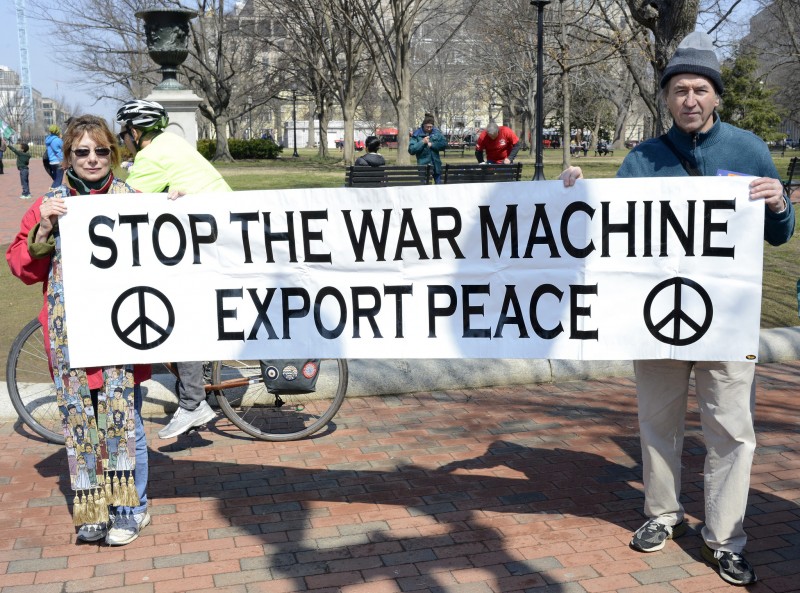
One of the most blatant forms of physical and psychological violence is the perpetual warfare and exorbitant military spending of the U.S. government.  How can we ignore the pain and final messages of the people in Aleppo experiencing violent confrontations and bombings?  And there are many other parts of the world experiencing the same violence of war and conflict.
"America Has Been At War 93% of the Time – 222 Out of 239 Years – Since 1776. "  54% of the Federal Discretionary Budget in 2016 went to Military and Defense.  Gun violence continues to plague our communities, with over 13,000 deaths and over 26,000 injuries from firearms in 2015.
            In Mexico, it is now going on ten years since the start of the “war against drug trafficking” (2006), and even if the main Mexican drug kingpins have been detained, their capture or abasement by the federal forces has not translated into a decrease of violence in the country or a weakening of the drug cartels. In reality, there were 172,876 reported homicides from 2007-2016, according to the statistics of the National Public Security System (SNSP), and 28,937 people were disappeared, according to the National Registry of Missing or Missing Persons.
Although the internal war in Peru ended in 2000, remnants of terrorist groups and drug trafficking operating in the valley of the Apurímac, Ene and Mantaro rivers (VRAEM) have become a priority for the State which is why they continue to strengthen the institution of the Armed Forces. And while some countries have reduced spending on defense, in Peru defense spending has increased 1.7 billion soles between 2012 and 2016.
The face of victims of violence in Peru is that of a young woman. A recent study by the Catholic Pontifical University in Peru indicates that at the national level that 7 out of 10 women between the ages of 18 to 29 have been victims of violence; and in Lima-Callao it is as high as 9 out of 10.  In fact, on average, 11 femicides and 23 attempted murders are reported each month, the highest figures in the last seven years according to the Ministry of Women. 
Selfishness, hard heartedness, intolerance, fundamentalism… the world is hurting.  Humanity has turned against itself.  We need to ask for forgiveness for the destruction of so many lives.  We need to rethink our relationships.  We need to work for peace; life depends on it. 
So what can we do to be artisans of peace?  Earlier this year representatives from around the world gathered to discuss experiences of nonviolence, Jesus’ way of nonviolence, how Nonviolence and Just Peace is already being lived out in communities, and how to move beyond unending wars – replacing the doctrine of “Just War” with “Just Peace.” 
The final statement coming out of this gathering is titled: “An Appeal to the Catholic Church to Recommit to the Centrality of Gospel Nonviolence.”  Some of the highlights of that appeal include: incorporating nonviolence explicitly into the life and work of the Church, training ourselves in nonviolent practices and strategies, initiating a global conversation on nonviolence, rejecting “just war theory,” and being a prophetic voice to challenge unjust world powers. 
Pope Francis for the World Day of Peace also calls us to recognize: “Non-Violence: A Style of Politics for Peace.”  This is because as people of faith we cannot remain indifferent.  We must commit ourselves to incarnating the Peace of Christ in the world.   
What if we each made a commitment for this coming year to support an environment of “just peace” through active non-violence?  What kind of impact might we be able to have collectively?   
“Jesus, the Incarnate Word, called his disciples to love their enemies (Mt 5:44), which includes respecting the image of God in all persons; to offer no violent resistance to one who does evil (Mt 5:39); to become peacemakers; to forgive and repent; and to be abundantly merciful (Mt 5-7).  Neither passive nor weak, Jesus’ nonviolence was the power of love in action.” 
Please, take some time to pray with an image of the Incarnate Word, asking him to teach you his way of peaceful love in action. 

Biblical Text: Mt 5:38-42
  • How do you understand Jesus’ proposed third way of nonviolence?
  • What does it mean to return good for evil?  
  • How do you seek to understand someone who is different from you? 
  • How do you confront those who are violent or promote violence? 
We have been called to promote practices and strategies of nonviolence.
  • How can you learn more about nonviolent strategies and skills and incorporate them into your own life and ministry? 
  • How is Nonviolence and Just Peace connected to our incarnational spirituality, recognizing Jesus, the Incarnate Word, is the Prince of Peace?
We end this reflection asking the God of Life to give us all we need to realize God’s peace, the peace that has been sown into our very being. 


Give us your peace – Pedro Casaldaliga
Give us, Lord, that strange Peace
That sprouts in the midst of struggle
Like a flower of fire;
That breaks in the middle of the night
Like a hidden song;
That arrives in the midst of death
Like a longed for kiss.
Give us the Peace of those always walking,
Stripped of any advantage,
Clothed in the wind of nebulous hope.
That Peace of the poor
Who have already overcome fear.
The Peace of the free
Who cling to life.
The Peace that is shared
In fraternal equality
Like water and the Host.

Print version: http://bit.do/cWF6R