Showing posts with label faith in action. Show all posts

Friday, May 31, 2019

Pope’s message for 2019 World Day of Migrants and Refugees

Dear Brothers and Sisters,

Faith assures us that in a mysterious way the Kingdom of God is already present here on earth (cf. Gaudium et Spes, 39). Yet in our own time, we are saddened to see the obstacles and opposition it encounters. Violent conflicts and all-out wars continue to tear humanity apart; injustices and discrimination follow one upon the other; economic and social imbalances on a local or global scale prove difficult to overcome. And above all it is the poorest of the poor and the most disadvantaged who pay the price.

The most economically advanced societies are witnessing a growing trend towards extreme individualism which, combined with a utilitarian mentality and reinforced by the media, is producing a “globalization of indifference”. In this scenario, migrants, refugees, displaced persons and victims of trafficking have become emblems of exclusion. In addition to the hardships that their condition entails, they are often looked down upon and considered the source of all society’s ills. That attitude is an alarm bell warning of the moral decline we will face if we continue to give ground to the throw-away culture. In fact, if it continues, anyone who does not fall within the accepted norms of physical, mental and social well-being is at risk of marginalization and exclusion.

For this reason, the presence of migrants and refugees – and of vulnerable people in general – is an invitation to recover some of those essential dimensions of our Christian existence and our humanity that risk being overlooked in a prosperous society. That is why it is not just about migrants. When we show concern for them, we also show concern for ourselves, for everyone; in taking care of them, we all grow; in listening to them, we also give voice to a part of ourselves that we may keep hidden because it is not well regarded nowadays.

“Take courage, it is I, do not be afraid!” (Mt 14:27). It is not just about migrants: it is also about our fears. The signs of meanness we see around us heighten “our fear of ‘the other’, the unknown, the marginalized, the foreigner... We see this today in particular, faced with the arrival of migrants and refugees knocking on our door in search of protection, security and a better future. To some extent, the fear is legitimate, also because the preparation for this encounter is lacking” (Homily in Sacrofano, 15 February 2019). But the problem is not that we have doubts and fears. The problem is when they condition our way of thinking and acting to the point of making us intolerant, closed and perhaps even – without realizing it – racist. In this way, fear deprives us of the desire and the ability to encounter the other, the person different from myself; it deprives me of an opportunity to encounter the Lord (cf. Homily at Mass for the World Day of Migrants and Refugees, 14 January 2018).

“For if you love those who love you, what recompense will you have? Do not the tax collectors do the same?” (Mt 5:46). It is not just about migrants: it is about charity. Through works of charity, we demonstrate our faith (cf. Jas 2:18). And the highest form of charity is that shown to those unable to reciprocate and perhaps even to thank us in return. “It is also about the face we want to give to our society and about the value of each human life... The progress of our peoples... depends above all on our openness to being touched and moved by those who knock at our door. Their faces shatter and debunk all those false idols that can take over and enslave our lives; idols that promise an illusory and momentary happiness blind to the lives and sufferings of others” (Address at the Diocesan Caritas of Rabat, 30 March 2019).

“But a Samaritan traveller who came upon him was moved with compassion at the sight” (Lk 10:33). It is not just about migrants: it is about our humanity. Compassion motivated that Samaritan – for the Jews, a foreigner – not to pass by. Compassion is a feeling that cannot be explained on a purely rational level. Compassion strikes the most sensitive chords of our humanity, releasing a vibrant urge to “be a neighbour” to all those whom we see in difficulty. As Jesus himself teaches us (cf. Mt9:35-36; 14:13-14; 15:32-37), being compassionate means recognizing the suffering of the other and taking immediate action to soothe, heal and save. To be compassionate means to make room for that tenderness which today’s society so often asks us to repress. “Opening ourselves to others does not lead to impoverishment, but rather enrichment, because it enables us to be more human: to recognize ourselves as participants in a greater collectivity and to understand our life as a gift for others; to see as the goal, not our own interests, but rather the good of humanity” (Address at the Heydar Aliyev Mosque in Baku, 2 October 2016).

“See that you do not despise one of these little ones, for I say to you that their angels in heaven always look upon the face of my heavenly Father” (Mt 18:10). It is not just about migrants: it is a question of seeing that no one is excluded. Today’s world is increasingly becoming more elitist and cruel towards the excluded. Developing countries continue to be drained of their best natural and human resources for the benefit of a few privileged markets. Wars only affect some regions of the world, yet weapons of war are produced and sold in other regions which are then unwilling to take in the refugees produced by these conflicts. Those who pay the price are always the little ones, the poor, the most vulnerable, who are prevented from sitting at the table and are left with the “crumbs” of the banquet (cf. Lk 16:19-21). “The Church which ‘goes forth’... can move forward, boldly take the initiative, go out to others, seek those who have fallen away, stand at the crossroads and welcome the outcast” (Evangelii Gaudium, 24). A development that excludes makes the rich richer and the poor poorer. A real development, on the other hand, seeks to include all the world’s men and women, to promote their integral growth, and to show concern for coming generations.

“Whoever wishes to be great among you will be your servant; whoever wishes to be first among you will be the slave of all” (Mk10:43-44). It is not just about migrants: it is about putting the last in first place. Jesus Christ asks us not to yield to the logic of the world, which justifies injustice to others for my own gain or that of my group. “Me first, and then the others!” Instead, the true motto of the Christian is, “The last shall be first!” “An individualistic spirit is fertile soil for the growth of that kind of indifference towards our neighbours which leads to viewing them in purely economic terms, to a lack of concern for their humanity, and ultimately to feelings of fear and cynicism. Are these not the attitudes we often adopt towards the poor, the marginalized and the ‘least’ of society? And how many of these ‘least’ do we have in our societies! Among them I think primarily of migrants, with their burden of hardship and suffering, as they seek daily, often in desperation, a place to live in peace and dignity” (Address to the Diplomatic Corps, 11 January 2016). In the logic of the Gospel, the last come first, and we must put ourselves at their service.

“I came so that they might have life and have it more abundantly” (Jn 10:10). It is not just about migrants: it is about the whole person, about all people. In Jesus’ words, we encounter the very heart of his mission: to see that all receive the gift of life in its fullness, according to the will of the Father. In every political activity, in every programme, in every pastoral action we must always put the person at the centre, in his or her many aspects, including the spiritual dimension. And this applies to all people, whose fundamental equality must be recognized. Consequently, “development cannot be restricted to economic growth alone. To be authentic, it must be well-rounded; it must foster the development of each man and of the whole man” (SAINT PAUL VI, Populorum Progressio, 14).

“So then you are no longer strangers and sojourners, but you are fellow citizens with the holy ones and members of the household of God” (Eph 2:19). It is not just about migrants: it is about building the city of God and man. In our time, which can also be called the era of migration, many innocent people fall victim to the “great deception” of limitless technological and consumerist development (cf. Laudato Si’, 34). As a result, they undertake a journey towards a “paradise” that inevitably betrays their expectations. Their presence, at times uncomfortable, helps to debunk the myth of a progress that benefits a few while built on the exploitation of many. “We ourselves need to see, and then to enable others to see, that migrants and refugees do not only represent a problem to be solved, but are brothers and sisters to be welcomed, respected and loved. They are an occasion that Providence gives us to help build a more just society, a more perfect democracy, a more united country, a more fraternal world and a more open and evangelical Christian community” (Message for the 2014 World Day of Migrants and Refugees).

Dear brothers and sisters, our response to the challenges posed by contemporary migration can be summed up in four verbs: welcome, protect, promote and integrate. Yet these verbs do not apply only to migrants and refugees. They describe the Church’s mission to all those living in the existential peripheries, who need to be welcomed, protected, promoted and integrated. If we put those four verbs into practice, we will help build the city of God and man. We will promote the integral human development of all people. We will also help the world community to come closer to the goals of sustainable development that it has set for itself and that, lacking such an approach, will prove difficult to achieve.

In a word, it is not only the cause of migrants that is at stake; it is not just about them, but about all of us, and about the present and future of the human family. Migrants, especially those who are most vulnerable, help us to read the “signs of the times”. Through them, the Lord is calling us to conversion, to be set free from exclusivity, indifference and the throw-away culture. Through them, the Lord invites us to embrace fully our Christian life and to contribute, each according to his or her proper vocation, to the building up of a world that is more and more in accord with God’s plan.

In expressing this prayerful hope, and through the intercession of the Virgin Mary, Our Lady of the Way, I invoke God’s abundant blessings upon all the world’s migrants and refugees and upon all those who accompany them on their journey.

From the Vatican, 27 May 2019

FRANCIS

Tuesday, December 4, 2018

December 10: Day of Prayer and Fasting for Creation

Since 2015, the Sisters of Charity of the Incarnate Word have promoted a Day of Prayer and Fasting for Creation on December 10th - International Human Rights Day - because a healthy environment that can sustain life is a vital human right.  This is human right is increasingly threatened and denied as each year passes and the impacts of global climate change spread.  Our call to care for our common home is a loving response to our Creator who's love, power, beauty and majesty is woven into the fabric of all life. 

This year, our focus is on supporting the Interfaith Rainforest Initiative which is currently in its final development stages and about to be launched in select countries. Tropical rainforests in South America, sub-Saharan Africa and Asia are falling rapidly due to a range of forces, including palm oil plantations, cattle, soy and crop production, and rapacious and often illegal mining and logging operations. The losses amount to an area the size of Austria each year.

“The story of creation in the book of Genesis tells us of trees that are beautiful to behold and a source of sustenance. Rainforests are pivotal for life on earth, provisioning people’s needs, promoting biodiversity and protecting the climate”, said World Council of Churches (WCC) general secretary Rev. Dr Olav Fykse Tveit. “Today when the rainforests are threatened by deforestation driven by a shortsighted, profit-oriented economy, we must use the knowledge of what is good and our faith-driven action to protect and care for the rainforests and therefore the earth and all life."

You can read more about the Interfaith Rainforest Initiative here: https://www.interfaithrainforest.org/

Every person, community, family, organization, or institution can participate by joining in this day of prayer and fasting for creation wherever you are.  We have created a guide to aid you in your prayer this day.

You can DOWNLOAD THE PRAYER AND FASTING GUIDE HERE.

If you participate by fasting, we encourage you to save what you normally would have spent this day on food (or whatever else you choose to fast from) and send it in to the Congregational CCVI Office at 4503 Broadway St., San Antonio, TX 78209, with a note that this is for the Day of Prayer and Fasting.  We will collect all donations and use them to support the work to care for creation, particularly our rainforests. 

Let us continue to pray that our actions and decisions can truly respond to the cries of the earth and the cries of poor who are most immediately impacted by climate change.  Together let us work and pray for the integrity of all God's wonderful creation.

Thursday, November 29, 2018

Testimony from Sr. Bertha Flores on Ministering to Migrants in El Paso, TX

There are no words to describe what a shelter is. Only when one is a witness of the relief provided to so many people, can one value and appreciate a shelter in all its magnitude. We were blessed recently to be part of the solidarity shown to immigrants at the St. Charles Shelter in El Paso, Texas, and to see how it attracts, as a magnet, the unity of other people and institution. We arrived at the shelter on Monday, November 4, 2018. The staff toured the facilities with us and explained the policies and daily procedures.
St. Charles Borromeo Seminary in El Paso, TX
The Saint Charles Shelter operates with a team of volunteers, most of whom are women 50 years old or older, who provide services to the migrants related to food, lodging, laundry, and telephone connections with their relatives or with those who will receive them. They also provide transportation services to bus stations or to the airport. Ten full-time volunteers live at the shelter.

The maximum capacity at the shelter is 100. Thirty to forty migrants arrive daily; at times this number increases to sixty or seventy. They come from Honduras, San Salvador, Guatemala a, d Brazil and stay for two or three days.

Volunteers cook and serve breakfast. Lunch and dinner are prepared by different groups from parishes in El Paso and neighboring places. Towels and sheets used by the refugees are washed daily; blankets are disinfected with spray.

Every day, a bus drives people from Migration Detention Centers to the eight different shelters in El Paso. Most of them are detained at these shelters from four to fifteen days where they receive only one meal a day and can bathe only once during their stay. The temperature in the Detention Centers is kept low, so when the immigrants reach the shelter, they are exhausted, and most of the children have colds. Most immigrants travel with one or two children, and some bring babies.

Many experience various forms of stress. One afternoon, a woman who traveled alone with her five-year old child fainted while she was waiting to take a shower. The child was very scared and cried. He feared that his mother could die. Those minutes seemed like hours to us until his mother, a 24-year old woman, recovered.

When the immigrants arrive at the shelter, after we welcome them, they register and contact by telephone the people who will receive them in this country. They call across the country – to New Jersey, Maryland, Maine, New York, Massachusetts, Virginia, North Carolina, North Dakota, South Dakota, Indiana, Missouri, Kansas, California, Louisiana, Georgia, Florida, Texas, New México– and because they have no money, they ask their contacts to buy tickets for their trip. They are always hungry when they arrive. It is very moving to see how the babies “devour” food. If they drop a piece of food, they pick it up with their little hands and put it in their mouths. Sometimes the pieces of food are so small that they could be considered crumbs. It is difficult to hold back our tears when we see this. The babies are not the only ones who do this; children and adults do the same. After dinner, the atmosphere changes and they begin to feel the effects of the warm welcome and hospitality they have received.


Before their departure from the shelter, we give the migrants clothes suitable for the places where they will go. We also provide them with a backpack for their use during the trip containing items for personal hygiene, a towel, a blanket and a pillow.

But why do they come here?

Most of them are escaping from extreme poverty conditions and from the violence of organized crime which is increasing in Central America. Yesterday, a couple with three children arrived from Guatemala. They had to run away because two armed men, covered with hoods, demanded the payment of a fee for the small business they have there. Because they did not receive the fee, they shot the husband six times, at point-blank range, and they left him, presuming he was dead. Fortunately, he survived. He still has the marks of the six bullets around his waist and heart. One of the bullets broke a bone in his arm and he is wearing a metal support with six screws. Thanks be to God he is alive.

Yesterday, we received three small girls with their heads full of lice. They were very frightened and were crying. Thank God we had an excellent medicine cabinet so we could give them the first treatment. Word spread that I was excellent in treating this problem and I was told that others who needed attention would be referred to me!

Some of the immigrants arrive very ill with colds and other ailments. Yesterday, a boy and a girl with chicken pox came to the shelter. A doctor, who visits every day after work, immediately took the necessary precautions. The mothers take care of the smaller children and those who are ill.

The children are a living lesson of resilience. They arrive exhausted, sad and nervous, but the next day they are outside playing football and are happy! Usually, their parents join them.  Many mother care for the smallest ones or those who are sick.

As the days go by our energy is exhausted, and after a week we must take a pause and rest to recover strength and energy.   .

Tuesday, November 27, 2018

Stop the Assault on Asylum Seekers

Article by Fr. James Martin S.J. published in America Magazine November 26, 2018

Yesterday the U.S. Customs and Border Protection agency fired tear gas at migrants trying to seek asylum in the United States at the border crossing at Tijuana. How did our country reach the point where we are tear-gassing mothers and children? One reason is because of the widespread myths about these brothers and sisters of ours.
Myth One: They are “illegals.” First, no one is an “illegal person” and seeking asylum is widely recognized as a universal human right. Current international agreements about asylum stemmed from a desire not to repeat the fate of Jews during the Second World War, who were denied entrance to many countries. And one requirement for asylum is to be physically present in the United States, which is exactly what these men, women and children from Central America are trying to do. In fact, it is illegal to dismiss asylum seekers without hearing their cases. In other words, they are trying to follow both international and U.S. law.
Myth Two: We cannot afford them. Many people believe that the United States and many European countries shelter a huge amount of refugees. This is false. The majority of the world’s refugees live in poor or middle-income nations. Eight out of 10 of the world’s refugees are sheltered by developing countries. In 2016, for example, Turkey, Pakistan and Lebanon hosted the highest number of refugees, a combined total of 5.4 million refugees. Of the 15 million refugees worldwide, 86 percent reside in developing countries. By contrast, the United States, one of the wealthiest countries in the world, is allowing only 30,000 refugees in next year. We can afford it.
Myth Three: They are mainly criminals. Claims that these migrants are criminals, that this exodus harbors terrorists from the Middle East, are unfounded. Are there a few criminals somehow mixed in? No more than with any other group in the past and that would include the immigrants that came to this country in the last 200 years: Italians, Irish, Germans and on and on. People fleeing Honduras, for example, who are mainly women and children, face some of the worst violence, inequality and corruption in the world: criminal gangs, rape and persecution, on top of poverty. There is a reason that they are risking everything to come here. They are fleeing crime, not bringing it. So before you dismiss these people as illegals, as too expensive and as criminals, know the facts. And even if you want to dismiss these facts, remember what Jesus said about welcoming the stranger. He did not say welcome them when they had the right papers. He did not say welcome them when there was zero risk. He did not say welcome them when you could afford it. Jesus said, welcome them
.

Bishops Issue Joint Statement on Climate Change

The heads of six continental bishops’ conferences have signed a rare joint statement urging political leaders to solve climate change.


The bishops’ call is clear:
We call for ambitious and immediate action to be taken in order to tackle and overcome the devastating effects of the climate crisis. These actions need to be taken by the international community at all levels: by persons, communities, cities, regions, nations.
The bishops’ statement is aimed at world leaders who are preparing for a UN climate summit in Poland this December. We pray thanks for the bishops’ leadership. Now, it’s our turn to respond.
We invite you to take three minutes today to share the statement with your pastor or another leader in your community. We’re all in this crisis together, and we’re all called to respond with the clarity and urgency the bishops have demonstrated.
  • The full statement is here.
  • A short email to your pastor or other leader is here: Dear Pastor, I’d like to share a statement that was recently signed by the heads of six continental bishops’ conferences. It calls all of us to take action now to protect our common home from the crisis of global warming. It is being covered in the press, such as in this article.  It is a powerful document, and I encourage you to read it in the light of our faith. With my sincere thanks,
  • If you’d like to tweet the statement at your president/prime minister, please find his or her Twitter handle here. Be sure to use the hashtag #TheClimatePilgrimage
The bishops say that “there is no time to waste.” I invite you to set aside a few minutes today to share this statement with your pastor or another leader.
Thank you for your witness and the witness of our Church!

Thursday, October 18, 2018

Flores Settlement Proposed Regulations—How To Comment

Background
On September 7, 2018, the Trump administration published proposed Department of Homeland Security (DHS) and Health and Human Services Department (HHS) regulations to implement the terms of the Flores Settlement Agreement, the 1997 legal settlement that governs the conditions of children held in immigration detention.  The proposed regulations would remove key safeguards the federal government agreed to in the Flores Agreement, including permitting the long-term detention of children, as well as long-term family detention.  In addition to permitting indefinite family detention, the rule would end existing Flores requirements that facilities holding immigrant children, including family detention facilities, be state-licensed, creating a new alternative federal licensing scheme. Also, the proposed regulations waive existing child protections in the case of “emergency,” which is broadly defined, and remove protections for unaccompanied children (UAC), including continually reassessing UACs and changing the bond hearing process for UACs in a manner that may be less favorable for them.

The 1997 Flores Settlement Agreement, the result of litigation which originated in the 1980s when children fled alone to the United States to escape civil wars in Central America, protects immigrant children from indefinite detention in unsafe and inappropriate conditions. The agreement requires that children be released from custody as quickly as possible, preferably to a parent, and that until they can safely be released they are held in the least restrictive setting; generally, in a non-secure facility licensed by a child welfare entity. We all know that the solution to holding immigrant children in cages without their parents is not to hold them in cages with their parents. Like separation at the border, this inhumane practice cannot stand. Like separation at the border, you can make the administration change course.

Action
Your voice and your leadership are needed nowThe most effective way to fight back against this proposal is to get as many people as possible to participate in the 60-day public comment period, which ends November 6.

1.       Submit a comment on behalf of yourself or your organization: Click here to register your opposition to the administration's proposal and stand up for immigrant children’s safety.  See suggested comments below. Please adapt the language to share why you oppose the Trump administration’s new regulations to indefinitely detain children, lower standards of care in immigration jails, and remove legal protections from minors seeking safety in the U.S.  N.B. Identical comments will be discarded.

2.       Help others submit written comments: CLINIC’s Flores Public Comment Mini-Toolkit gives you everything you need to:
·         Share information about the proposal;
·         Organize an event in your community to gather public comments;
·         Submit comments by mail. Must be postmarked by November 6, 2018.

3.       Contact Congress: While these regulations are pending, Congress is actively considering legislative changes that would give DHS greater funding and authority to jail immigrants. Tell members of Congress to oppose family detention in any form and demand cuts to funding for immigration detention and enforcement.

Suggested Comments:  REMEMBER, you will need to revise these suggestions to make them unique.

Sample Introduction
[On behalf of ORGANIZATION], [We/I] would like to submit the following comments concerning the proposed rule from the U.S. Department of Homeland Security (DHS) and the U.S. Department of Health and Human Services (HHS) on the Apprehension, Processing, Care, and Custody of Alien Minors and Unaccompanied Alien Children (Docket No. ICEB-2018-0002).

[INSERT BRIEF DESCRIPTION OF ORGANIZATION OR INDIVIDUAL SUBMITTING COMMENTS] [ORGANIZATION is/ I am] concerned that the proposed rule is contrary to the purpose and spirit of the 1997 Flores Settlement Agreement which sought to ensure that all children in the government’s custody are “treated with dignity, respect, and special concern for their particular vulnerability as minors.”

[We are/I am] called by our faith to care for the most vulnerable and we are challenged by our national values to promote the welfare of our children and tend the common good. Therefore, we/I must oppose the government’s proposal to discard the Flores Settlement Agreement safeguards, which protects the welfare of migrant children in U.S. government custody, in favor of dangerously broad criteria that allow indefinite detention, fewer legal protections, and questionable standards of care and oversight. Children and families belong together and free from detention.

Key Points you might include
[ORGANIZATION is/ I am] opposed to the proposed rule “Apprehension, Processing, Care, and Custody of Alien Minors and Unaccompanied Alien Children” because:
·         Detention, even for a short amount of time, has been proven to be devastating to a child’s development, health, and well-being. This proposed rule permitting indefinite detention is abusive and inhumane. The Flores settlement was put in place to ensure children are treated with “dignity, respect and special concern for their particular vulnerability as minors.” The proposed rule fails to meet those standards.
·         There are proven, effective alternatives to detention, such as the Family Case Management System. It is less harmful to a developing child and more cost effective.
·         The proposed rule is an unnecessary burden on taxpayers. Alternatives to detention are proven to be effective and humane. The proposed rule is a needless cost and a poor and wasteful use of resources.
·         It is unacceptable for the administration to have the authority to certify that its own jails are safe for children. Detention facilities have been proven time and time again to be dangerous to the health and well-being of vulnerable children.
·         The proposed regulations do not serve the best interest of children. Instead, they undermine existing child protections. That is contrary to the Flores Agreement’s purpose, contrary to the values of this nation, and contrary to our/my faith.

Sample Conclusion
Our faith, and the ideals upon which this nation was founded, call us to be mindful of the common good, to embrace our neighbors, and to care for our children. [ORGANIZATION / I] urge[s] DHS and HHS to reject the proposed regulations or to make revisions to ensure that children are protected and the regulations are consistent with the purpose and spirit of the Flores Agreement.

Additional resources:
·         JFI—10 Things You Should Know about Proposed Flores Regulations
·         Catholic Legal Network, Inc. (CLINIC) Mini Toolkit on Flores
·         Protecting Immigrant Families
·         CLINIC’s guide to taking part in the Federal Rulemaking Process

Information and action items created by Sr. Ann Scholz, SSND the Associate Director of Social Mission for the Leadership Conference of Women Religious

Wednesday, October 10, 2018

Immigrant Children: Detention Without End?

Project Lifeline and NOWCastSA hosted a panel and community discussion and interactive event, "Immigrant Children, Detention Without End?" on Friday, Sept. 28, at 7 p.m. in the Student Engagement Ballroom at the University of the Incarnate Word. Each year, as many as 90,000 immigrant children spend time in U.S. detention centers. Those who monitor the conditions say the children often are kept for months at a time in unsanitary conditions without proper medical care and are denied food and clean water. Recent proposals could make their stay in detention indefinite. The evening began with a panel discussion by faith leaders and world-renowned pediatric and public health physicians with extensive experience working with displaced children in crisis. The conversation focused on the harm to the children and the trauma they suffer, from the dangers they are fleeing to the inhumane conditions they face in detention. Following the panel discussion, the audience formed small groups to discuss the issues and explore ways to take action. You can watch a recording of this powerful conversation below:


Tuesday, June 5, 2018

Sr. Teresa Maya CCVI Participates in Georgetown Panel

Sister Teresa Maya was invited by Georgetown University’s Initiative for Catholic Social Thought and Public Life  to join a panel discussion on “Healing a Polarized America," June 4th, in Washington, D.C.  She was joined by three other panel members, Cardinal Blase Cupich (Chicago), Archbishop Jose Gomez (Los Angeles), and Professor Helen Alvare (George Mason University).  

You can access the discussion by clicking on the following link:


Sunday, June 3, 2018

#WhereAreTheChildren Rally in San Antonio

#WhereAreTheChildren Rally
By Sister Martha Ann Kirk


A few hundred San Antonians gathered on May 31, 2018, in Guadalupe Plaza in San Antonio, TX, to show their concern about the treatment of immigrants and especially children who are suffering. Nearly 1,500 immigrant children have been lost in the system, meanwhile, the current Republican administration is enforcing a policy to separate immigrant parents from their children at the border. Father Jimmy Drennan, Rabbi Mara Nathan, and other faith leaders gathered on stage uniting in prayer for families.


Incarnate Word Sisters Yolanda Tarango, Leti Rodriguez, 
Mary Margaret Bright, Jean Durel, and Martha Ann Kirk 
were among the participants. Sister Mary Margaret 
regularly does volunteer ministry with immigrant families.
A sixth grade teacher, an Honduran woman who has been in the US since she was five years old, said she and other Hondurans who fled violence have now lost their DSP status and may be deported. A Guatemalan woman whose children taken from her talked about the extreme pain she felt “like losing and arm or a leg.” Eventually she got her children back. Now she was appealing to the humanity of US government people “who also have children” to think of how this feels and to “be human.”

Nicole Foy, Assistant Director of Women’s Global Connection 
and a member of the CCVI Justice, Peace, and Care of Creation Committee (right) 
and Cynthia Layton, an immigration attorney
Nicole, a mother of three daughters, said, “San Antonio shouted loudly tonight against the Trump Administration’s policy of separating immigrant families seeking refuge in the US. Children need their parents ESPECIALLY in times of vast change. I cannot imagine fleeing a violent place with my children, making it to America to ask for asylum (a LEGAL and humane thing to do), only to have my children ripped away and sent thousands of miles away to be detained separately in an unknown place to me. The New York Times reported in April that since October 2017, 700 families had been separated at the border. #nofamilyseparation

Congressman Joaquin Castro, State Rep. Diego Bernal
and immigrant advocates and families passionately spoke
about protecting these children who are at risk of violence and trafficking.

Thursday, April 12, 2018

Earth Day Resources

Catholic Climate Covenant

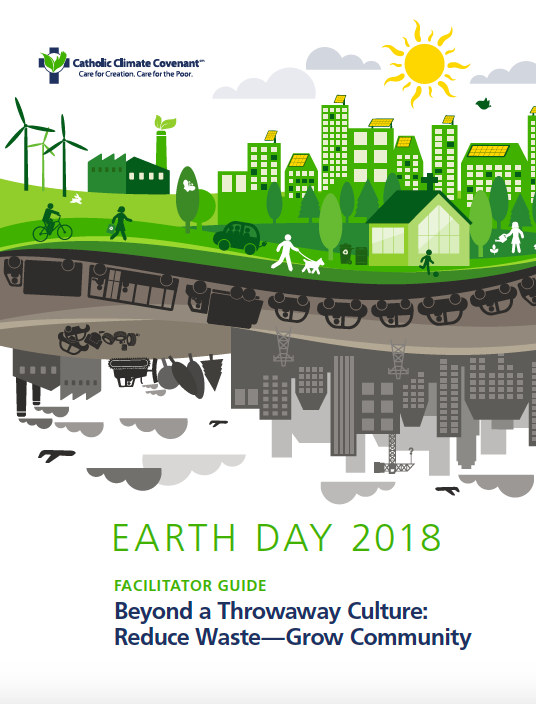
This year’s Earth Day program, “Beyond a Throwaway Culture-Reduce Waste, Grow Community” is a one-hour educational program that includes prayers, readings, actions, and a video, designed to raise awareness on how the overuse of single-use disposable plastics contributes to what Pope Francis calls “the throwaway culture.” From contributing to land and marine pollution to increasing our use of carbon-producing fuels, our reliance on single-use plastics has a devastating impact on God’s creation.

We invite you to download the program, share it with your parish, school, or religious community. Though targeted for use as part of an Earth Day celebration, the program may be used at a time that best fits your community’s schedule.

Already planning an Earth Day celebration? Don’t forget to share stories and photos with us! Consider joining the Facebook Earth Day 2018: Beyond a Throwaway Culture event to connect with others and to share your community’s projects and ideas.


Creation Justice Ministries

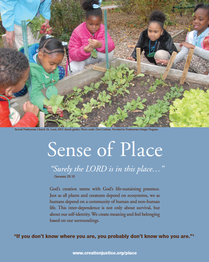
PictureEach year before Earth Day, Creation Justice Ministries offers Christian education materials to equip faith communities to protect, restore, and more rightly share God's creation.

Our 2018 theme is "Sense of Place" and offers insights about living in harmony with local ecosystems and watersheds, rightly sharing places with a diversity of peoples, and respecting the history of your place. Download the resource at www.creationjustice.org/place

Connect with others who are making plans for Earth Day Sunday by sharing in a Facebook event.


Global Catholic Climate Movement

Earth Day is Sunday, April 22. This Earth Day, Catholics around the world are joining together for a global day of action.

We are coming together with 2 simple plans:
  • include creation in your prayers or mass and
  • encourage your diocese to care for creation.
Will your community join the worldwide events on April 22? Please register your event here. From talking points and postcards to lesson plans and mass suggestions, the free toolkit has everything you need for a successful program. Please register your event now to take full advantage of all the materials.

Sunday, November 19, 2017

Take Action: Extend TPS for El Salvador, Honduras, and Haiti

 The administration has terminated the Temporary Protected Status (TPS) designation for Nicaragua, effective January 5, 2019. The administration was unable to decide whether to extend TPS for Honduras, resulting in an automatic six-month extension until July 5, 2018. However, the Department of Homeland Security (DHS) signaled the possibility that the TPS designation for Honduras might also be terminated at the end of the six-month automatic extension and the fate of TPS holders from El Salvador and Haiti are still in jeopardy.

This decision illustrates the administration’s prioritization of anti-immigrant sentiment over an honest assessment of in-country conditions. It also shows the cruelty and inhumanity of DHS to force TPSholders to continue to live with uncertainty and fear.

This decision must be met with a swift and powerful response by our elected leaders and community members. Our Senators and Representatives need to hear that their constituents stand with TPSholders and call on Congress to ensure TPS holders are protected from deportation. Please take 6 minutes to call your Members of Congress (2 minutes per Member) right now and make your voice heard!
 

Urge Your Members of Congress to Support TPS Holders and #SaveTPS!
(202) 224-3121
Please call 3x for your 2 Senators and 1 Representative
Sample Script:
“I’m your constituent from [City, State]. As a person of faith, I stand in solidarity with my immigrant neighbors and support Temporary Protected Status (TPS). I strongly condemn the administration’s termination of TPS for Nicaragua and am concerned about the future of my neighbors from Honduras. TPS is designed to protect people from being returned to harm and is extended based on country conditions. More than 300,000 of our neighbors are TPS holders. They contribute billions of dollars to our economy. Nearly 273,000 U.S. citizen children have a parent with TPS. Tearing apart families and devastating communities is immoral and wrong-headed. I urge [the Senator or Representative] to do everything she or he can to ensure that the administration reinstates TPS for Nicaragua; extends TPS for Honduras, El Salvador, and Haiti for at least another 18 months; and supports legislation that would ensure stability forTPS recipients who have lived here for many years."

DHS has yet to reach a decision on TPS for Haiti or El Salvador. Violence, weak institutions, and a lack of human rights protections in Central America, as well as food, housing, and public health crises in Haiti persist. As people of faith, we have an urgent call to stand with TPS holders and tell the administration to do everything they can to see TPS protections extended and pass a permanent legislative solution.

Here are 5 more ways you can take action!
  1. Write & Share Press Releases Condemning Reports of TPS Terminations: Press releases increase public education and raise the public profile of why TPS is important to our communities. We encourage faith organizations to take a public stance condemning Nicaragua'sTPS termination, denouncing the cruelty in only a 6-month extension for Honduras, urging the administration to extend TPS designations for all TPS countries for at least 18 months, and calling on Congress to pass a permanent solution for TPS holders. For CWS's statement, please visit: interfaithimmigration.org/TPS.
  2. Join the Prayer Chain and Share on Social Media: Record a video of yourself holding a printed, filled out #Faith4TPS sign. Upload your video to Twitter, Instagram, and Facebook with the hashtag #Faith4TPS and tag the Interfaith Immigration Coalition (@interfaithimm). Don't forget to tweet at your Members of Congress and @realDonaldTrumpClick here for sample social media posts and here for graphics.
  3. Plan #Faith4TPS Events: Host an interfaith vigil, educate your faith community, and organize other events to lift up the importance of TPS. Local actions are a great way to amplify voices ofTPS holders in the media, and don’t forget to invite your national, state, and local officials. Click here to view our Interfaith Toolkit to Defend TPS to learn more.
  4. Write for Media: Elevate the public call by publishing a letter to the editor ASAP condemning the termination of TPS for Nicaragua, and reports of possible TPS terminations for Honduras, El Salvador, and Haiti, urging the administration to extend these designations for at least 18 months, and calling on Congress to pass a permanent solution for TPS holders. Click here for sample op-eds, LTEs, and other resources on how to pitch and place media pieces.
  5. Learn and Share Resources: Visit https://docs.google.com/document/d/1pU6pyPwbbdRdIo-QzOhh71Drj0_hmHaJjnGq7WIx2T0/edit for our Interfaith "Mini-Toolkit" to learn more.

For more information on our faithful call to stand with TPS holders, please visit: interfaithimmigration.org/TPS. Please spread the word, and thank you for all your work and support!

Thanks for your continued support of our immigrant neighbors and for whatever you and your communities can do to stop the administration’s attempts to disrupt our communities, separate families, and deport our friends.

Friday, July 21, 2017

Religious Life in Peru Against Human Trafficking

In order to strengthen and support the work of the national network of Consecrated Life and Priests committed to reducing this scourge of human trafficking and respond adequately, the Fifth National Meeting of the Red Kawsay in Peru (of which we are part) was held.

During these three days of meetings, we dealt with issues of prevention, advocacy, applicability of the Anti-Trafficking Law, the migration situation in Peru, trafficking, ethics and corruption as well as a powerful theological reflection on human trafficking in the light of the icon of the Visitation.

It was a very significant time because, as explained in the Final Declaration of the Meeting, the participants were very moved by the recent events of labor exploitation seen in the fire of the Nicollini Building (Cercado de Lima). As a result, the Red Kawsay united in prayer and expressed its sorrow and condemnation of this event and all forms of trafficking in persons: “We are indignant at the normalization of these deeply rooted practices in society and we demand due process for the victims and for their families who cry out for justice," the Declaration says.

Likewise, some practices of the Network were shared in coordination with state operators that are being developed in Puno and Madre de Dios, as well as the experience of the Network ‘A Cry for Life’ in Brazil and the initiative to form Red Kawsay Bolivia.

Through reflection on the various topics discussed, as Red Kawsay we felt a strong call for a greater professionalism in the members of the Network, with a focus on awareness and advocacy, particularly for accountability and inspection from the Peruvian State as a strategy for prevention.

We are grateful for the space of meeting, prayer, learning and training.


You can read below the complete Final Declaration:

"Trafficking in persons is ... a wound in the body of Christ, and for this reason the Church together with the people of good will cry out! Let us unite efforts to help the victims."- Pope Francis

On July 6, 7 and 8, 2017, 45 participants: religious, priests and a laity from Tacna, Puno, La Libertad, Madre de Dios, Huánuco, Lambayeque, Piura, Ancash, San Martin, Ayacucho and Lima met in the retreat house of the Colegio de Jesús in Pueblo Libre to celebrate the 5th National Meeting of the Red Kawsay - "Consecrated Life for a society without human trafficking."

Still shocked by the recent events of labor exploitation seen in the tragedy of the Nicollini Building, as Red Kawsay we unite in prayer and express our sorrow and condemnation of this event and all forms of human trafficking. We are indignant at the naturalization of these deeply entrenched practices in society and we demand due process for the victims and their families who claim justice.

Starting from the Gospel of the Visitation (Luke 1:39-45) that served as an inspiring icon for the Consecrated Life of Latin America, we feel called upon and challenged to take initiatives that are more concrete and consistent with our commitment to fight against this scourge: in the recognition, defense and respect of human dignity (and one’s inalienable right to work in dignified conditions); in solidarity with the victims of human trafficking and the smuggling of migrants; and with the hope and strength that comes from God which we want to share.

In these past 7 years as the Red Kawsay we feel the grace of all we have learned, of acquiring a position within the country and civil society that recognize us as allies. At the same time, this recognition invites us to a greater professionalism, focusing our resources better on awareness and advocacy, particularly in the inspection of state actions as a prevention strategy.

As people of Faith:
  • We offer a perspective and take action from the vision of the Kingdom, to have relationships and humanizing encounters that reaffirm our call and commitment to promote the dignity of life.
  • We promote prevention actions in the different mission areas (parish, schools, groups, families, institutions and others).
  • We promote justice that dignifies the person affected by trafficking, and at the same time re-humanizes the trafficker and those surrounding him/her.
  • We focus on the creation of adequate and specialized safe spaces for accompanying the victims.
  • We contribute initiatives to local and regional governments without giving up the prophetic voice that denounces the impunity, inaction and inertia of some entities of the State linked to corruption.
  • We opt for the truth and the strengthening of a culture of peace with an emphasis on respect for life and fundamental rights.
  • We confront the naturalization of trafficking, and violence in its various forms.
  • We sensitize and raise awareness about the reality of human trafficking in the diocese through bishops, priests, religious and church institutions.
  • We will discern a careful accompaniment to the various actors, causes and effects of trafficking from coordinated and networked work.

Aware of living in new times and called to make real the presence of God in the world, we want our solidarity with the people affected by trafficking to be hopeful, contagious, and active to help bring about the Kingdom of God through the way of Jesus.

Lima, July 2017