
Showing posts with label just peace. Show all posts
Showing posts with label just peace. Show all posts
Friday, June 7, 2024
Reparation
In response to the cry of the excluded—as a member of the Base Team of the Church Axis Search Brigade, we helped receive between 800 and 1000 members of collectives of families searching for disappeared persons (on May 9 and 10) at the Servidores de la Palabra facilities in Cuautitlán, State of Mexico. The goal was to unite the 200+ collectives nationwide.


Wednesday, June 5, 2024
A daycare in the Spirit of the Gospel

Sister María Luisa Velez CCVI found inspiration to create a space of care, growth, and hope, from the sacred pages of the Gospel to the most fragile streets affected by poverty. Here we share a brief chronicle of her journey. It's a story of how the gospel of love guides each step, from the seed of the idea to the flourishing of a shared mission. The story of the Santa Fe Shelter reminds us that even in the most challenging times, the light of the Gospel can guide the way and ignite solidarity.
A Passionate Love
By Miriam Bannon CCVI
Back in 1969, when Sister María Luisa was a junior sister working as a teacher at the Miguel Angel Institute, Sister Lourdes Nava invited her to a course at ITES on liberation theology. This course broadened her horizons. If her heart had burned with the changes of Vatican II before, in the way of living and acting in the Church, now it burned even more with hope for social justice. Later in 1985, the congregation offered María Luisa another opportunity to take a five-month course in missiology in Brazil. There, she had the pleasure of meeting 40 people from different countries who all shared the same longing: to be an open and committed church. Juan Luis Segundo, Pablo Richards, Gustavo Gutiérrez, Salvador Beocio, and others were her teachers, and they spoke to her about the role of laypeople, religious sisters, and brothers inserted in the peripheries.
Encounter with the Word of God in Peripheral Communities
These courses, along with some workshops at MACC in San Antonio, led our Sister María Luisa, after finishing her period in congregational leadership from 1984 to 1990, to take a sabbatical year in South America with the purpose of learning about the experiences of CEBs (Base Ecclesial Communities) in the peripheries. For this, Sister María Luisa contacted congregations in Chile, Brazil, Peru, Bolivia, Ecuador, Colombia, Nicaragua, El Salvador, Honduras, and Guatemala. Wherever she went, she tried to stay with communities in peripheral populations. In these communities, she met the CEBs where they talked about life. They talked about a nearby God, living among them, fighting for justice. They shared about the struggles to earn money to live each day. Sister María Luisa became more and more convinced that this was what it meant to be a church. She recalls that in Chile, for example, she met a priest named Mariano Puga. Father Mariano chose to live in poverty and in the periphery. Although he was an architect before becoming a priest, he worked eight hours a day as a wall painter, and in the evening, after finishing his work, he celebrated mass with all the people in the neighborhood. After mass and fellowship, at the end of the day, between 10:00 and 11:00 p.m., he prayed together with his small community. When Sister María Luisa arrived, Father Mariano went to sleep on a bunk bed to give María Luisa his small room, which only had a bed, a chair, and a suitcase.
Completing her sabbatical year, María Luisa returned to Mexico completely convinced that the only way to make a change is through the Word of God in a peripheral neighborhood.
 Base Ecclesial Communities in the Parish of La Asunción, Santa Fe
In 1991, María Luisa established a mixed community of sisters and lay missionaries who wanted to serve in the Parish of La Asunción, Santa Fe, CDMX. After a year of arriving, the community looked for a house in the Ampliación el Pirul neighborhood in the Santa Fe ravine. There, María Luisa and I began teaching popular Bible classes in different homes. Sister María Luisa dreamed of transmitting the type of Church she had experienced in Latin America. She based her Bible classes on the writings of Carlos Mesters, Carlos Bravo, Gustavo Gutiérrez, and Leonardo Boff, among others, following Javier Saravia's methodology. She ensured that it was a participatory, open, and ecumenical reflection.
What she had experienced in the Bible study ignited the hearts in the group, and over time led the participants to form two CEB groups. These communities, by praying and seeing reality in the light of the Word of God, came to the conclusion that it was important to do something for the community. At that time, there was a lot of garbage in the streets of Santa Fe. They started a first project around garbage, making the decision to separate the garbage, but after a few months, it overwhelmed them because there was too much garbage, and they stopped separating it.
The second initiative of the base communities was about food. Through Sister María Teresa Valdez, they met the owners of Verde Valle (a company that sells seeds). They spoke with the owners and managed to buy the seeds with a 25% discount. The communities opened a store selling basic products - beans, rice, lentils, etc. Of the 25% discount, the communities only took 5% to pay for transportation and something for the person selling. This allowed people to buy with a 20% discount off the cost. They did very well in sales at first because the products were of quality. But then, after five months, Bodega Aurrera opened its store and started selling cheaper products, but not of the same quality. Sadly, the CEBs realized that it was no longer convenient to sell because people were buying from the other store.
The communities thought again about what they could do. The idea of a daycare center emerged among them because they saw it as a great need. Sister María Luisa recalls stories of moms who, because they had to go to work, turned off the gas and lights and left their children locked up. Other times they left the children with the grandmothers, but when the children grew up and started running around, the grandmothers couldn't keep up. Since the parish was sectored, the CEBs decided to conduct a survey in each of the nine zones to see what people thought about childcare while moms worked. It was unanimous. All the surveyed families agreed that a daycare center was necessary.
After confirming that it was indeed a necessity, Sister María Luisa surveyed the members of the CEBs who wanted to work in a daycare center and encouraged them to prepare. About 15 people said yes and chose to take a six-month course in popular education in childcare and preschool education. After finishing the course, Sister María Luisa insisted a lot, emphasizing that it was very important to continue studying because the daycare center had to be incorporated into the SEP (Secretary of Public Education). In addition, Sister María Luisa committed to accompany them in the search for donations to continue studying.
Their motivation always came from the Word of God, now embodied in their hearts, hands, and feet. While they prepared, they looked for a house for rent to start the daycare center. Thank God, they were lucky to find a spacious house on Paso Ancho Street, #149, in Colonia Ampliación La Mexicana, and there they started the daycare center, under the direction of Mrs. Lourdes Cruz, on October 1, 1995. They named it Estancia Infantil Vasco de Quiroga in honor of the founder of the Santa Fe Hospital Village.
They remained in the house on Paso Ancho for several years during which the communities began to think about establishing themselves as a private assistance institution so that the daycare center would stay in Santa Fe and no one could take it away. After consulting with the communities, Sister María Luisa integrated a board of trustees.
- President, herself, Sister María Luisa
- Secretary, Ms. Patricia Mañon
- Treasurer, Mrs. Aurora Alcántara
- Members, Mrs. Vivian Kolher and Mrs. María Vélez

At the same time, they began to raise funds for the purchase of a larger house for the daycare. Most of the donations were obtained through family and friends. Little by little, the money was gathered for the purchase of a spacious house that they had seen and seemed suitable on Ramón López Velarde street, in Santa Fe. Upon purchasing the house, they had to fix it and adapt it to the needs of a daycare. Despite the repairs, the cost increased. Guadalupe Vélez, the biological sister of Sister María Luisa, was the architect who helped a lot to restore the house. She reviewed the foundation to prevent it from collapsing in case of an earthquake. She had to tear down some parts of the house to ensure that everything was okay. She only charged for the labor costs, but not really for her work. Like her, other people were very generous. Mrs. Aurora Alcántara put the roof in the patio and the Miguel Angel Institute donated tables, chairs, and desks.
Eight years later, in mid-2003, when everything was arranged, the daycare moved to Ramón Lopez Velarde #7, with 15 trained people. Sister María Luisa continued to remind them that their work went beyond taking care of girls and boys, but also to continue their professional development.
LEAPS OF JOY AND CHALLENGES ALONG THE WAYMaría Luisa recounted many challenges and leaps of joy along the way.
Leaps of Joy…
The Word of God in the CEBs that led participants to commit to a strong and long-term service in the community.
People committed to providing quality care to babies, children, and also to fathers and mothers.
The support of the board, especially Mrs. Aurora Alcantara, who personally attended the daycare very frequently. In addition to guiding the teachers to redesign the spaces in the classrooms, she supported in the daily meal times for several years. Mrs. Vivian Kohler, as a board member, was concerned about the daycare's finances by sending her daughter and a trusted gentleman to review that the finances were in good condition. Mrs. María Vélez financially contributed to the needs that arose and continues to contribute to this day. Miss Patricia Mañon contributed with her pedagogical experience, working with the teachers. Many other people and institutions have also contributed time and resources - Monte de Piedad, our congregation: the Sisters of Charity of the Incarnate Word, the Hilton Foundation, and others. The present staff who continue to study. They are prepared to meet the demands of the SEP and reality to provide a better service to parents and children.
Challenges…
For many years, the staff did not want to continue preparing themselves: Only one person, Lucy Sánchez, continued studying, graduating as a teacher.
Changes in personnel management: Upon joining the SEP, the required requirements had to be met. When inspectors came, they checked even under the carpet. It was not easy to find qualified people, with the gift of integrating a team and treating teachers horizontally, keeping the study plans up to date and not missing work. Over the course of 25 years, there were eight changes in directors.
Management was difficult: There was a time when funds were not managed with due attention. It seemed that there was always a lack of money.

SECOND PART: "I am a teacher by profession and by heart," says Francisca.
TEACHER FRANCISCA GARCIA
I came to know Sister María Luisa because the daycare, initially, was on my street (Paso Ancho), practically in front of my house. Upon retiring as a teacher, María Luisa asked me to help her with the procedures to incorporate the daycare into the SEP (Secretariat of Public Education). I gladly responded because I believed in the daycare project and also wanted to lend a hand to Sister María Luisa. From there, in 2002, I started as a teacher. A year later, I was invited to be the director. Upon assuming this responsibility, I dedicated myself first to improving some practical aspects, for example, the quality of food for the children and cleanliness. In fact, every year I set myself a goal and it gives me great satisfaction to achieve it. On one occasion, realizing that motivation had decreased, my goal was to sow a better vision and a commitment from the teachers to continue studying and improving themselves. It was an uphill battle. Many left because they did not want to continue studying. Thank God, currently, all the teachers are certified. Along with the director, Mrs. Rosario Márquez Silva, and the team of teachers, we promote psychomotor development. We emphasize the adequate preparation of children to start primary school and familiarize them with the computer. We work together. There is a sense of teamwork and responsibility. We work with creativity and a good disposition.
I was also pleased to receive from 2008 to 2012, about six lay missionaries of the Incarnate Word who served for one or two years in the daycare. They assisted the teachers in educational activities with the children. They taught English and lived both with the teachers and with the children. I was impressed to see how they were becoming aware of the social and economic situation of the children.
A strong aspect of my work as director was management. Thank God, as the daycare grew, in 2015 it was decided to separate the two functions and I remained as administrator.
The key for me is to encourage co-responsibility, to link parents with the educational process. We invite them to participate in activities at the daycare and they respond. It is a great joy to meet them. In fact, one of the fathers who was at the daycare 20 years ago, now has his son with us, in 3rd grade of preschool. Currently, we have 50 children in grades:
- Nursery 1, from 1 ½ years to 2 years 5 months
- Nursery 2, from 2 ½ years to 2 years 11 months
- Preschool 1, 3 years old
- Preschool 2, 4 years old
- Preschool 3, 5 years old
We communicate with parents through bimonthly evaluations of their children's development. Additionally, we organize talks on development itself, nutrition, and health (particularly regarding vaccines).
Currently, our hours of operation are from 8:00 am to 3:00 pm. In the future, we would like to extend the hours because many parents finish work at 7:00 pm. Along with this, we would like to resume the service of caring for infants. It is a very big challenge because it would imply double shifts. Another challenge is administration itself. We have to upload the financial statements and reports to the platforms of both the IAP and the SAT. Our tuition fees are low because our raison d'être is to serve low-income families but our economic resources are few. Here is the translation:
Although we receive help from relatives and friends of Sister María Luisa, it remains a challenge to stay up to date with payments and not have debts. Our current goal is to reach 100 children. This way, we could cover expenses without having to rely on donations for the daily operation of the daycare.

PRINCIPAL ROSARIO MÁRQUEZ SILVA
I started at the daycare in August 2021. It was a very difficult year. We were emerging from Covid. We had to learn to teach online and from our homes. Sadly, at that time, my husband died of Covid, and I was hospitalized and intubated for fourteen days. Now, post-Covid, there is a new outlook. The number of boys and girls coming to the daycare is increasing; people speak very well of our services. We are already eight teachers. Teaching through projects is working well for us. We have taken training courses in active schools rather than methodical ones. Our boys and girls learn to explore and investigate. It is self-learning. In addition to education, we strive to care for nutritional value, and we have managed to resume the dining hall. We hope that more people will continue to find in our institution a safe space for growth.
I conclude with gratitude for the sacred stories that have been shared with me. Certainly, this is a story of faith, hope, and action, where the Gospel lights the way to a future brimming with possibilities.
By Miriam Bannon CCVI
Back in 1969, when Sister María Luisa was a junior sister working as a teacher at the Miguel Angel Institute, Sister Lourdes Nava invited her to a course at ITES on liberation theology. This course broadened her horizons. If her heart had burned with the changes of Vatican II before, in the way of living and acting in the Church, now it burned even more with hope for social justice. Later in 1985, the congregation offered María Luisa another opportunity to take a five-month course in missiology in Brazil. There, she had the pleasure of meeting 40 people from different countries who all shared the same longing: to be an open and committed church. Juan Luis Segundo, Pablo Richards, Gustavo Gutiérrez, Salvador Beocio, and others were her teachers, and they spoke to her about the role of laypeople, religious sisters, and brothers inserted in the peripheries.
Encounter with the Word of God in Peripheral Communities
These courses, along with some workshops at MACC in San Antonio, led our Sister María Luisa, after finishing her period in congregational leadership from 1984 to 1990, to take a sabbatical year in South America with the purpose of learning about the experiences of CEBs (Base Ecclesial Communities) in the peripheries. For this, Sister María Luisa contacted congregations in Chile, Brazil, Peru, Bolivia, Ecuador, Colombia, Nicaragua, El Salvador, Honduras, and Guatemala. Wherever she went, she tried to stay with communities in peripheral populations. In these communities, she met the CEBs where they talked about life. They talked about a nearby God, living among them, fighting for justice. They shared about the struggles to earn money to live each day. Sister María Luisa became more and more convinced that this was what it meant to be a church. She recalls that in Chile, for example, she met a priest named Mariano Puga. Father Mariano chose to live in poverty and in the periphery. Although he was an architect before becoming a priest, he worked eight hours a day as a wall painter, and in the evening, after finishing his work, he celebrated mass with all the people in the neighborhood. After mass and fellowship, at the end of the day, between 10:00 and 11:00 p.m., he prayed together with his small community. When Sister María Luisa arrived, Father Mariano went to sleep on a bunk bed to give María Luisa his small room, which only had a bed, a chair, and a suitcase.
Completing her sabbatical year, María Luisa returned to Mexico completely convinced that the only way to make a change is through the Word of God in a peripheral neighborhood.

In 1991, María Luisa established a mixed community of sisters and lay missionaries who wanted to serve in the Parish of La Asunción, Santa Fe, CDMX. After a year of arriving, the community looked for a house in the Ampliación el Pirul neighborhood in the Santa Fe ravine. There, María Luisa and I began teaching popular Bible classes in different homes. Sister María Luisa dreamed of transmitting the type of Church she had experienced in Latin America. She based her Bible classes on the writings of Carlos Mesters, Carlos Bravo, Gustavo Gutiérrez, and Leonardo Boff, among others, following Javier Saravia's methodology. She ensured that it was a participatory, open, and ecumenical reflection.
What she had experienced in the Bible study ignited the hearts in the group, and over time led the participants to form two CEB groups. These communities, by praying and seeing reality in the light of the Word of God, came to the conclusion that it was important to do something for the community. At that time, there was a lot of garbage in the streets of Santa Fe. They started a first project around garbage, making the decision to separate the garbage, but after a few months, it overwhelmed them because there was too much garbage, and they stopped separating it.
The second initiative of the base communities was about food. Through Sister María Teresa Valdez, they met the owners of Verde Valle (a company that sells seeds). They spoke with the owners and managed to buy the seeds with a 25% discount. The communities opened a store selling basic products - beans, rice, lentils, etc. Of the 25% discount, the communities only took 5% to pay for transportation and something for the person selling. This allowed people to buy with a 20% discount off the cost. They did very well in sales at first because the products were of quality. But then, after five months, Bodega Aurrera opened its store and started selling cheaper products, but not of the same quality. Sadly, the CEBs realized that it was no longer convenient to sell because people were buying from the other store.
The communities thought again about what they could do. The idea of a daycare center emerged among them because they saw it as a great need. Sister María Luisa recalls stories of moms who, because they had to go to work, turned off the gas and lights and left their children locked up. Other times they left the children with the grandmothers, but when the children grew up and started running around, the grandmothers couldn't keep up. Since the parish was sectored, the CEBs decided to conduct a survey in each of the nine zones to see what people thought about childcare while moms worked. It was unanimous. All the surveyed families agreed that a daycare center was necessary.
After confirming that it was indeed a necessity, Sister María Luisa surveyed the members of the CEBs who wanted to work in a daycare center and encouraged them to prepare. About 15 people said yes and chose to take a six-month course in popular education in childcare and preschool education. After finishing the course, Sister María Luisa insisted a lot, emphasizing that it was very important to continue studying because the daycare center had to be incorporated into the SEP (Secretary of Public Education). In addition, Sister María Luisa committed to accompany them in the search for donations to continue studying.
Their motivation always came from the Word of God, now embodied in their hearts, hands, and feet. While they prepared, they looked for a house for rent to start the daycare center. Thank God, they were lucky to find a spacious house on Paso Ancho Street, #149, in Colonia Ampliación La Mexicana, and there they started the daycare center, under the direction of Mrs. Lourdes Cruz, on October 1, 1995. They named it Estancia Infantil Vasco de Quiroga in honor of the founder of the Santa Fe Hospital Village.
They remained in the house on Paso Ancho for several years during which the communities began to think about establishing themselves as a private assistance institution so that the daycare center would stay in Santa Fe and no one could take it away. After consulting with the communities, Sister María Luisa integrated a board of trustees.
- President, herself, Sister María Luisa
- Secretary, Ms. Patricia Mañon
- Treasurer, Mrs. Aurora Alcántara
- Members, Mrs. Vivian Kolher and Mrs. María Vélez

At the same time, they began to raise funds for the purchase of a larger house for the daycare. Most of the donations were obtained through family and friends. Little by little, the money was gathered for the purchase of a spacious house that they had seen and seemed suitable on Ramón López Velarde street, in Santa Fe. Upon purchasing the house, they had to fix it and adapt it to the needs of a daycare. Despite the repairs, the cost increased. Guadalupe Vélez, the biological sister of Sister María Luisa, was the architect who helped a lot to restore the house. She reviewed the foundation to prevent it from collapsing in case of an earthquake. She had to tear down some parts of the house to ensure that everything was okay. She only charged for the labor costs, but not really for her work. Like her, other people were very generous. Mrs. Aurora Alcántara put the roof in the patio and the Miguel Angel Institute donated tables, chairs, and desks.
Eight years later, in mid-2003, when everything was arranged, the daycare moved to Ramón Lopez Velarde #7, with 15 trained people. Sister María Luisa continued to remind them that their work went beyond taking care of girls and boys, but also to continue their professional development.
LEAPS OF JOY AND CHALLENGES ALONG THE WAYMaría Luisa recounted many challenges and leaps of joy along the way.
Leaps of Joy…
The Word of God in the CEBs that led participants to commit to a strong and long-term service in the community.
People committed to providing quality care to babies, children, and also to fathers and mothers.
The support of the board, especially Mrs. Aurora Alcantara, who personally attended the daycare very frequently. In addition to guiding the teachers to redesign the spaces in the classrooms, she supported in the daily meal times for several years. Mrs. Vivian Kohler, as a board member, was concerned about the daycare's finances by sending her daughter and a trusted gentleman to review that the finances were in good condition. Mrs. María Vélez financially contributed to the needs that arose and continues to contribute to this day. Miss Patricia Mañon contributed with her pedagogical experience, working with the teachers. Many other people and institutions have also contributed time and resources - Monte de Piedad, our congregation: the Sisters of Charity of the Incarnate Word, the Hilton Foundation, and others. The present staff who continue to study. They are prepared to meet the demands of the SEP and reality to provide a better service to parents and children.
The pillar that has been Ms. Francisca García, widely known and respected in the Santa Fe community. Thanks to her tenacity as an administrator and director, the daycare has continued with a maximum level of attention, a respectful environment, a pleasant, clean, and welcoming place. In addition, she has been a key person for the unity and spirit of the staff.
Challenges…
For many years, the staff did not want to continue preparing themselves: Only one person, Lucy Sánchez, continued studying, graduating as a teacher.
Changes in personnel management: Upon joining the SEP, the required requirements had to be met. When inspectors came, they checked even under the carpet. It was not easy to find qualified people, with the gift of integrating a team and treating teachers horizontally, keeping the study plans up to date and not missing work. Over the course of 25 years, there were eight changes in directors.
Management was difficult: There was a time when funds were not managed with due attention. It seemed that there was always a lack of money.

SECOND PART: "I am a teacher by profession and by heart," says Francisca.
TEACHER FRANCISCA GARCIA
I came to know Sister María Luisa because the daycare, initially, was on my street (Paso Ancho), practically in front of my house. Upon retiring as a teacher, María Luisa asked me to help her with the procedures to incorporate the daycare into the SEP (Secretariat of Public Education). I gladly responded because I believed in the daycare project and also wanted to lend a hand to Sister María Luisa. From there, in 2002, I started as a teacher. A year later, I was invited to be the director. Upon assuming this responsibility, I dedicated myself first to improving some practical aspects, for example, the quality of food for the children and cleanliness. In fact, every year I set myself a goal and it gives me great satisfaction to achieve it. On one occasion, realizing that motivation had decreased, my goal was to sow a better vision and a commitment from the teachers to continue studying and improving themselves. It was an uphill battle. Many left because they did not want to continue studying. Thank God, currently, all the teachers are certified. Along with the director, Mrs. Rosario Márquez Silva, and the team of teachers, we promote psychomotor development. We emphasize the adequate preparation of children to start primary school and familiarize them with the computer. We work together. There is a sense of teamwork and responsibility. We work with creativity and a good disposition.
I was also pleased to receive from 2008 to 2012, about six lay missionaries of the Incarnate Word who served for one or two years in the daycare. They assisted the teachers in educational activities with the children. They taught English and lived both with the teachers and with the children. I was impressed to see how they were becoming aware of the social and economic situation of the children.
A strong aspect of my work as director was management. Thank God, as the daycare grew, in 2015 it was decided to separate the two functions and I remained as administrator.
The key for me is to encourage co-responsibility, to link parents with the educational process. We invite them to participate in activities at the daycare and they respond. It is a great joy to meet them. In fact, one of the fathers who was at the daycare 20 years ago, now has his son with us, in 3rd grade of preschool. Currently, we have 50 children in grades:
- Nursery 1, from 1 ½ years to 2 years 5 months
- Nursery 2, from 2 ½ years to 2 years 11 months
- Preschool 1, 3 years old
- Preschool 2, 4 years old
- Preschool 3, 5 years old
We communicate with parents through bimonthly evaluations of their children's development. Additionally, we organize talks on development itself, nutrition, and health (particularly regarding vaccines).
Currently, our hours of operation are from 8:00 am to 3:00 pm. In the future, we would like to extend the hours because many parents finish work at 7:00 pm. Along with this, we would like to resume the service of caring for infants. It is a very big challenge because it would imply double shifts. Another challenge is administration itself. We have to upload the financial statements and reports to the platforms of both the IAP and the SAT. Our tuition fees are low because our raison d'être is to serve low-income families but our economic resources are few. Here is the translation:
Although we receive help from relatives and friends of Sister María Luisa, it remains a challenge to stay up to date with payments and not have debts. Our current goal is to reach 100 children. This way, we could cover expenses without having to rely on donations for the daily operation of the daycare.
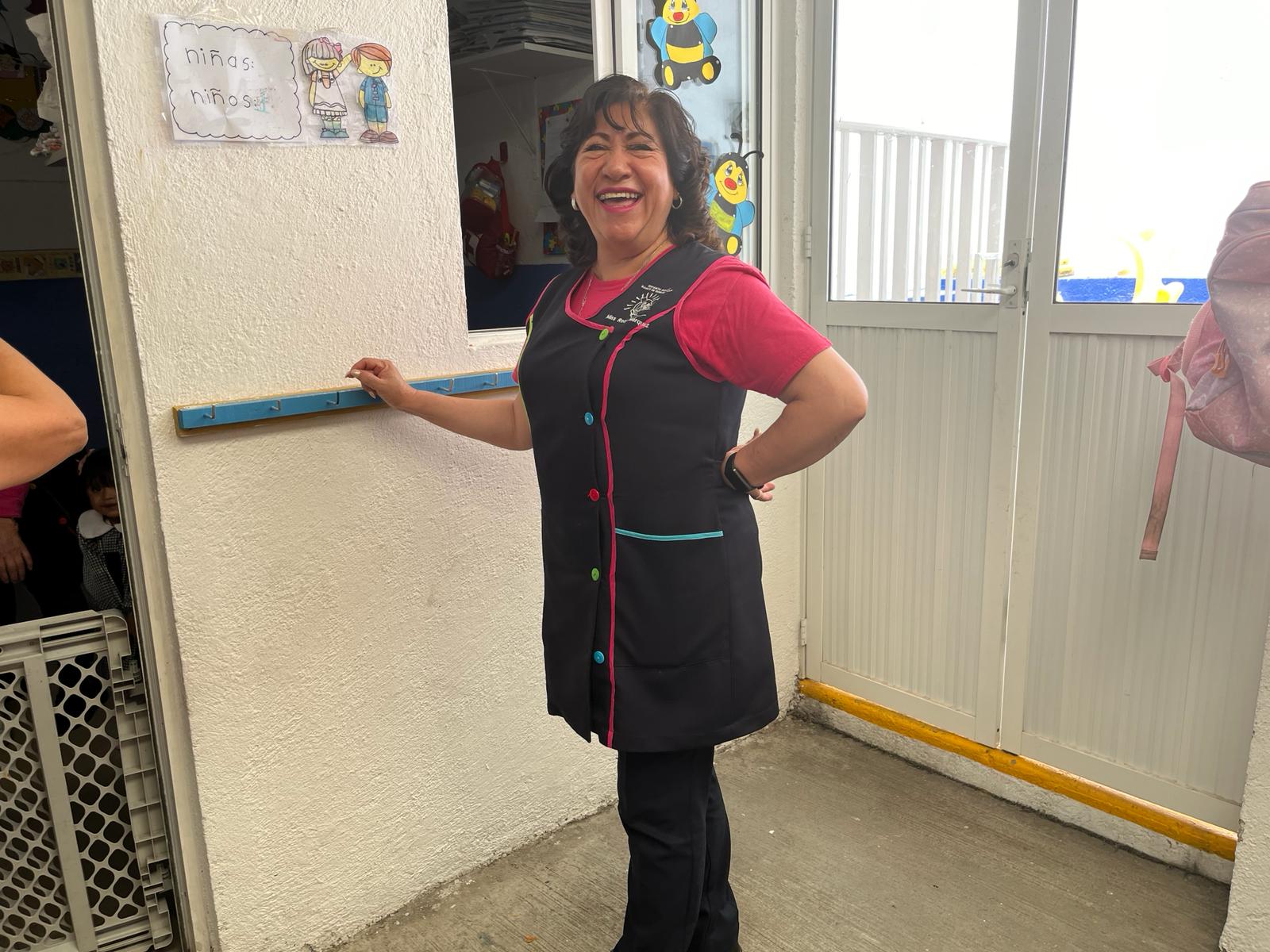
I started at the daycare in August 2021. It was a very difficult year. We were emerging from Covid. We had to learn to teach online and from our homes. Sadly, at that time, my husband died of Covid, and I was hospitalized and intubated for fourteen days. Now, post-Covid, there is a new outlook. The number of boys and girls coming to the daycare is increasing; people speak very well of our services. We are already eight teachers. Teaching through projects is working well for us. We have taken training courses in active schools rather than methodical ones. Our boys and girls learn to explore and investigate. It is self-learning. In addition to education, we strive to care for nutritional value, and we have managed to resume the dining hall. We hope that more people will continue to find in our institution a safe space for growth.
I conclude with gratitude for the sacred stories that have been shared with me. Certainly, this is a story of faith, hope, and action, where the Gospel lights the way to a future brimming with possibilities.
Weaving Change

Sister María Luisa Gamboa arrived in Tampamolón, in the southeastern region of the State of Huasteca (Mexico), in 2003, as a pastoral response to indigenous communities. Hospital Muguerza invited and supported our sisters in this ministry. With the aim of promoting human dignity, María Luisa began by visiting communities in eight municipalities, close to each other, to meet the people and assess their needs. During her visits, she was struck by the poverty and vulnerability of women. Women used to embroider napkins, but despite their beauty, they sold poorly. So Sister María Luisa suggested they consider making clothing in addition to napkins. Since the women wanted an additional income in the household, they found the idea appealing. To launch this project, Sister María Luisa asked for help from her mother, who was skilled in sewing. Maria Louisa mother gladly made patterns of different sizes using newspaper. Then María Luisa bought fabric and thread, and with these, the women began to learn to cut fabric for blouses. Everything had to be done by hand as they didn't have sewing machines.

How to Sell the Merchandise?
One thing is the production of clothing, another is the sale. To sell the products, women send representatives from their communities periodically to take their products to selling places in the city. Everyone cooperates in advance with transportation, food, and lodging expenses. Each garment carries the name of the person who made the product and the price of the garment. Upon return, they distribute the profits from the sales.
Achievements
At one point, the women were invited to participate in a Successful Projects competition at the national level organized by FONART (National Fund for the Promotion of Crafts). After going through the different stages: regional, district, and state, they reached the final stage, the National one, in the city of León, Guanajuato. They didn't win first place, but they were considered to attend every year, for a month, with all expenses paid (lodging, transportation, food), and most importantly, to have a space to sell their products at the National Potosina Fair (FENAPO) - one of the most important fairs in the country. They continue to participate to this day. This speaks to the quality their products have achieved.

From Huasteca to Mezquital Valley
About fifteen years later, around 2016, having established this cottage industry in Tampamolón, María Luisa and Mary chose to move to Chilcuautla, Hidalgo, to the Mezquital Valley to work with women from the Hñahñu or Otomí communities. The Mezquital Valley was once considered the poorest area in the country. In fact, Mexico City's sewage is discharged there. However, thanks to state government, investment from Mexicans returning from the United States, and support from Germany, an irrigation system was installed using canals that irrigate farmlands. Mexican families who returned to the country invested in nurseries and greenhouses, and with drip irrigation, they began to grow lettuce, tomatoes, broccoli, squash, cauliflower, and tomatoes. This has greatly improved the region's economy.
The small industry was gradually growing...
Sisters María Luisa and Mary, having visited the Hñahñu communities and realizing that women's need was to have their own income, encouraged them to diversify their products. The sisters shared their learning on making blouses, children's dresses, skirts, shirts, bags, purses, etc., with the women. Additionally, with the financial support of the Hilton Foundation and Christus Health, the sisters managed to buy sewing machines, chairs, and tables that are of great use to the entire community.
Looking to the Future
To this day, the project remains strong in both locations, Tampamolón and Chilcuautla. Once a year, the sisters return to the Huasteca, and there they meet with the coordinators, and everyone is trained in new models. This way, the sisters continue to support and accompany the 6 groups of women in that community.
In addition to accompanying the artisan women, Sisters María Luisa and Mary also participate with the entire local faith community in four areas of social pastoral care: labor, penitentiary, social commitment, and ecological. In 2022, they obtained funds from the Hilton Foundation to support 36 families in the conservation of maguey, a very important plant for their daily work. To protect the maguey plants from animals, the foundation supported with 74 rolls of cyclonic mesh, each roll being 50 meters long. With this help, families can continue working with maguey fiber and preserve the use of the Waist Loom, an ancestral technique with which they make the ayate and other artisanal garments.


Contemplating the passion and commitment of our sisters in their accompaniment of women, I experience a deep sense of pride in what our Congregation is achieving through Mary and María Luisa. Their unwavering faith, generosity, and dedication embody the spirit of the Gospel. Our beloved María Luisa and Mary are not only alleviating social challenges in two indigenous communities but are also cultivating transformative change that enriches society as a whole. Their ministry is an inspiration; a testimony to the power of love, creativity, and solidarity.
Written by Sister Miriam Banon CCVI
Sunday, May 31, 2020
We stand with you!
National Black Sisters' Conference: Official Statement
US Bishops statement: http://www.usccb.org/news/2020/20-83.cfm
LCWR statement: https://lcwr.org/media/news/lcwr-condemns-killing-george-floyd
LCWR statement: https://lcwr.org/media/news/lcwr-condemns-killing-george-floyd
Other resources:
Open Wide Our Hearts: http://www.usccb.org/…/open-wide-our-hearts-bulletin-insert…
Combatting Racism: http://www.usccb.org/racism
Together against brutality: News
“We call for an END to the systemic racism that allows this culture of corruption to go unchecked and our lives to be taken” See the Demands: https://actionnetwork.org/forms/2005_email_blm_defund
Podcasts about racial justice: https://hope-hard-pills.simplecast.com
Combatting Racism: http://www.usccb.org/racism
Together against brutality: News
“We call for an END to the systemic racism that allows this culture of corruption to go unchecked and our lives to be taken” See the Demands: https://actionnetwork.org/forms/2005_email_blm_defund
Podcasts about racial justice: https://hope-hard-pills.simplecast.com
Speech from a Racial justice activist: https://www.facebook.com/535475596/posts/10163706458825597/?d=n
 |
| From Michael O'Neill McGrath, OSFS |
Monday, May 20, 2019
Rejecting the Mindset of the Forever War
The Incarnate Word Congregation has committed itself to exploring the Catholic Nonviolence Initiative. Let us consider and discuss this article:
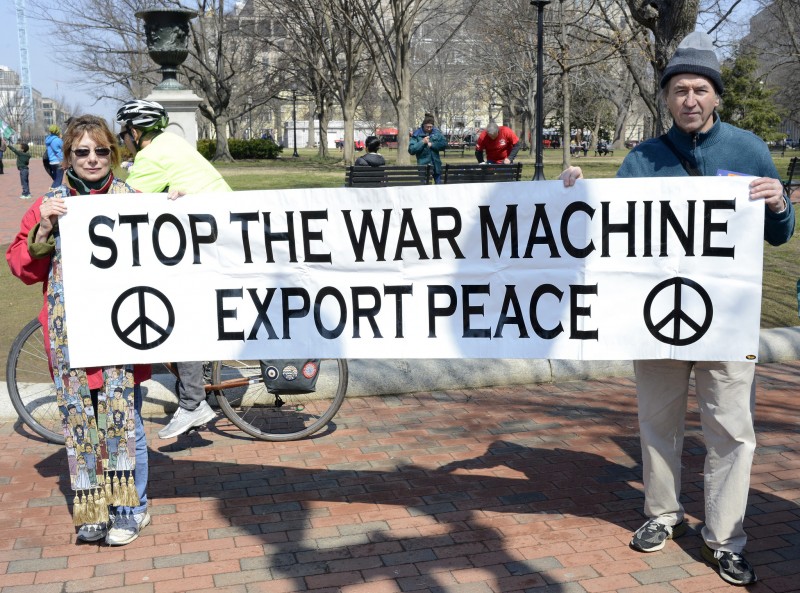 "The Forever War is not just in the Middle East. It is in Korea, where US troops still stand to post along the DMZ. It is in Vietnam, where hundreds of thousands of children have been born with spina bifida, neural tube problems, missing limbs, missing vertebrae, autoimmune disorders and more, four decades after the US finished hosing that nation down with Agent Orange. And yes, the Forever War is also in Iraq, which practically glows at night from all the depleted uranium the US has detonated there since 1991.
This is why we find ourselves today talking about torture the way other people talk about their sandwich order, and why powerful voices see fit to accuse torture survivors of treason. We have been thoroughly debased by all this war, all this violence, all this death for so many years. The most popular video games come with body counts. Neighbors with massive arsenals are the norm, and massacres flicker by like dandelion seeds.
We are a crumbling nation not just in a moral sense, but in a literal one. The trillions of dollars spent on the Forever War have turned our economy into a shaky shell game, and deprived us of the opportunity to make education, infrastructure, genuine health care and artistic achievement the cornerstones of our culture. When capitalism sits at the table with democracy, sooner or later all the plates are empty save for a golden few. The United States did not invent the concept of using war to plunder the treasury. It simply perfected the practice."
"The Forever War is not just in the Middle East. It is in Korea, where US troops still stand to post along the DMZ. It is in Vietnam, where hundreds of thousands of children have been born with spina bifida, neural tube problems, missing limbs, missing vertebrae, autoimmune disorders and more, four decades after the US finished hosing that nation down with Agent Orange. And yes, the Forever War is also in Iraq, which practically glows at night from all the depleted uranium the US has detonated there since 1991.This is why we find ourselves today talking about torture the way other people talk about their sandwich order, and why powerful voices see fit to accuse torture survivors of treason. We have been thoroughly debased by all this war, all this violence, all this death for so many years. The most popular video games come with body counts. Neighbors with massive arsenals are the norm, and massacres flicker by like dandelion seeds.
We are a crumbling nation not just in a moral sense, but in a literal one. The trillions of dollars spent on the Forever War have turned our economy into a shaky shell game, and deprived us of the opportunity to make education, infrastructure, genuine health care and artistic achievement the cornerstones of our culture. When capitalism sits at the table with democracy, sooner or later all the plates are empty save for a golden few. The United States did not invent the concept of using war to plunder the treasury. It simply perfected the practice."
Tuesday, April 9, 2019
Ongoing Pax Christi Efforts for Peace
On February 26, 2019 the Incarnate Word JPIC Office with the University of the Incarnate Word Religious Studies Department hosted a student art and writing contest on the “Peace of Christ” and sponsored a presentation by Marie Dennis, the co-vice president of Pax Christi International, who spoke about Creative Nonviolence a new Paradigm for Peace. The presentation was live streamed and can be watched in both English and Spanish.
On April 4-5, the Vatican's Dicastery for Promoting Integral Human Development and Pax Christi International's Catholic Nonviolence Initiative organised a workshop on the theme, "Path of Nonviolence: Towards a Culture of Peace" in Rome.

On April 4-5, the Vatican's Dicastery for Promoting Integral Human Development and Pax Christi International's Catholic Nonviolence Initiative organised a workshop on the theme, "Path of Nonviolence: Towards a Culture of Peace" in Rome.
With a consideration and understanding of current situations of conflict and violence, participants engaged in dialogue about the roots of violence, the hope for peace and reconciliation, and reflected on paths to a conversion to nonviolence. They noted that nonviolence is not only a method but a way of life, a way to protect and care for the conditions of life for today and tomorrow.
“Our conversations on nonviolence and peace filled our hearts and minds with a consideration of the dignity of each person – young people, women and men, people who are impoverished, citizens and leaders,” said Mons. Bruno Marie Duffé, Secretary of the Dicastery. “Nonviolence and peace call us to a conversion to receive and to give, to gather and to hope.”
“Pax Christi International deeply appreciates the support and participation of the Dicastery in this workshop, which has been a significant and positive step in the work of the Catholic Nonviolence Initiative,” said Marie Dennis, Co-president of Pax Christi International. “We are touched by the interventions from all the participants, who reiterated the importance of nonviolence rooted in respect, patience and spiritual strength.” Continue reading
“Our conversations on nonviolence and peace filled our hearts and minds with a consideration of the dignity of each person – young people, women and men, people who are impoverished, citizens and leaders,” said Mons. Bruno Marie Duffé, Secretary of the Dicastery. “Nonviolence and peace call us to a conversion to receive and to give, to gather and to hope.”
“Pax Christi International deeply appreciates the support and participation of the Dicastery in this workshop, which has been a significant and positive step in the work of the Catholic Nonviolence Initiative,” said Marie Dennis, Co-president of Pax Christi International. “We are touched by the interventions from all the participants, who reiterated the importance of nonviolence rooted in respect, patience and spiritual strength.” Continue reading
Sunday, May 6, 2018
John Dear Book Tour - St. Louis

John Dear gave a powerful and moving talk, mixing together biblical exegesis, scientific facts, humor, faith, and hope. The title of the book comes from a reflection on the 3rd Beatitude "Blessed are the meek, for they will inherit the earth" (Mt 5:5). Dear, drawing on reflections by Thomas Merton, translates the ancient understanding of "meek" to be our modern day equivalent of "nonviolent" in the sense of King/Ghandian nonviolence. It is those who live a life of committed nonviolence who will be at one with the earth. He also reflected on the term "blessed" and translated the original word to more accurately mean, "awake or get up, and go forth." So these are calls to action. Awake and go forth, living nonviolence with all of creation, and you shall live in harmony with the earth.
 John Dear has proven himself over and over again throughout the decades to be a dedicated champion of peace and nonviolence. He challenged those in attendance to get involved in more grassroots organizing because it will take a large scale nonviolent grassroots movement to truly change the course we are on right now which is destroying the planet. We need concerted effort to end all wars, and the United States is the largest supplier of the arms trade around the world. We have been engaged in perpetual war for decades, feeding what President Dwight D. Eisenhower called the "Military Industrial Complex." For the survival of the plant and all of creation, we must shift from a war and violence based economy, to a peace and flourishing of creation based economy.
 Dear praised the encyclical "Laudato Si" by Pope Francis which has inspired a renewed focus and commitment to an integral ecology that honors our interconnectedness with all of creation. He also talked about the work being done in Rome to bring together major leaders of nonviolent movements from around the world to share stories, ideas, practices, and foster a stronger commitment to peace and nonviolence throughout the Catholic Church. In 2016 after the first such meeting they issued a Appeal to the Catholic Church to Recommit to the centrality of Gospel Nonviolence which we as a Congregation signed onto in 2017, along with hundreds of other religious congregations and Catholic organizations. The call now is for the Pope to issue an encyclical specifically on Just Peace and Nonviolence. Dear encouraged attendees to advocate for this encyclical as well.
Overall it was an inspiring and challenging evening with John Dear, learning about the connection between nonviolence and care of creation, and holding on to the hope that together we really can make a difference in the world. If you would like to learn more about the work that John Dear is doing check out Pace e Bene, and you can sign up to receive e-mail updates on the ongoing work for a more peaceful and nonviolent world.
Wednesday, November 15, 2017
Pray-Study-Act on Nuclear Disarmament
|

|
This past weekend the conference titled, "Perspectives for a World Free from Nuclear Weapons and for Integral Disarmament," was held at the Vatican. This is the largest international conference on nuclear disarmament since the Nuclear Ban Treaty was adopted this summer.
Out of this conference came Pope Francis's condemnation of nuclear weapons. He said, "Weapons of mass destruction, particularly nuclear weapons, create nothing but a false sense of security. They cannot constitute the basis for peaceful coexistence between members of the human family."
Prayer for the Vatican conference
Creator God, We thank your Holy Spirit for inspiring and guiding those who met this weekend in Rome, including the Pax Christi delegation.
Your world is precious but human folly threatens its very existence.
We pray for those whose lives have been destroyed by nuclear weapons and nuclear testing.
We pray for those denied the essentials of life when money is squandered on nuclear weapons production.
We pray that our Church will speak to the world with clarity and wisdom and work with world leaders to ban the development, possession and use of nuclear weapons.
With Pope Francis, we commit ourselves to work for a world without nuclear weapons.
We pray in hope for a world built on just relations and cooperation between people who wish to live in peaceful co-existence.
Amen
Provided by Pax Christi International
Study
Good resources on the Vatican conference and the Nuclear Ban Treaty:
Pope condemns possession of nuclear weapons in shift from church's acceptance of deterrence, National Catholic Reporter, 11-10-17
Action
Yesterday, the first congressional hearing on nuclear weapons since 1976 took place. They are reevaluating the US nuclear weapons process, specifically the protocol surrounding the president's ability to use them. Advocate to Senate Foreign Relations Committee that we need stricter protocols in place.
Share Pax Christi International's information about the Vatican's nuclear weapons conference on social media and to your communities.
|
Friday, September 22, 2017
Our Commitment to Peace

Violence in its many and varied forms surrounds us. This violence can manifest as physical, emotional, psychological and/or spiritual harm. Some of the most blatant forms of physical and psychological violence include perpetual warfare and exorbitant military spending, feminization of poverty, a throw away culture, and intolerance of difference. In light of this reality, 'Nonviolence and Just Peace' was born, a worldwide initiative that reaffirms the centrality of active nonviolence in the message of Jesus, in the life and praxis of the Catholic Church; and in our vocation to heal and reconcile both people and the planet.
Our Congregational Commitment for Peace is our response to the initiative launched at the Conference on Nonviolence and Just Peace, held in Rome April 11-13, 2016 by the Conference of Major Superiors, the Leadership Conference of Women Religious and other Catholic organizations.
After communal discernment and conversation our Congregation (the Sisters of Charity of the Incarnate Word) signed on to the "Appeal to the Catholic Church to Recommit to the Centrality of Gospel Nonviolence" pledging to promote the understanding and practices of active nonviolence on the road to just peace, with the desire to be authentic disciples of Jesus, challenged and inspired by the stories of hope and courage.
"In our mission to incarnate the compassionate love of God, caring for the Body of Christ that suffers in the world today, we feel called to transform our own lives, our communities, our countries and our Congregation with actions that lead us to create and support a culture of peace and non-violence".
September 21, 2017
 As the Office of Justice, Peace and Integrity of Creation, we thank all the Sisters who have helped us to reflect, pray and respond daily to the call of the Incarnate Word at this time. Our task is challenging but we trust in God who calls us to be artisans of the active and creative nonviolence of Jesus. Because nonviolence practiced with determination and consistency has produced impressive results.
As the Office of Justice, Peace and Integrity of Creation, we thank all the Sisters who have helped us to reflect, pray and respond daily to the call of the Incarnate Word at this time. Our task is challenging but we trust in God who calls us to be artisans of the active and creative nonviolence of Jesus. Because nonviolence practiced with determination and consistency has produced impressive results.Monday, August 14, 2017
Tell President Trump and Congress - We Need Talks, not War, with North Korea
The Marianist Social Justice Collaborative sent out the following action to support dialogue not war with North Korea. Please follow the link to their website below to send a message to your representatives, senators, and the President.
 On August 9th, 72
years ago, the United States dropped an atomic bomb on the Japanese city of
Nagasaki - just three days after dropping one on the city of Hiroshima. It is
estimated that over 150,000 people were killed over those three days.
On August 9th, 72
years ago, the United States dropped an atomic bomb on the Japanese city of
Nagasaki - just three days after dropping one on the city of Hiroshima. It is
estimated that over 150,000 people were killed over those three days.
Now we have a U.S. president vowing to meet threats from
North Korea "with fire and fury like the world has never seen."
On August 1st, U.S.
Secretary of State Rex Tillerson said during a briefing with the press,
"We are trying to convey to the North Koreans: 'We are not your enemy, we
are not your threat.'" Tillerson added that the United States hopes that
"at some point," North Korea will understand and sit down for a
dialogue.
The time for dialogue is now.

Join with our friends at the Maryknoll Office of Global
Concerns by clicking here to let President Trump and Congress know that we need
talks, not war, with North Korea.
You can read more
about the situation in this excellent short background article, "Korea:Moving from Crisis to Peace" by Columban missionary priest Pat Cunningham,
SSC, of Seoul, South Korea.
Here is the text of the letter:
"As a person of faith, I am alarmed by the inflammatory rhetoric by the leaders of the United States and North Korea and the increasing threats of hostile acts and nuclear war. I urgently call upon President Trump to tone down his inflammatory rhetoric.
Furthermore, the movement of U.S. military assets to the Korean peninsula and region, including aircraft carriers and nuclear submarines, bring the world closer to the possibility of hostile acts and violence. Steps must be taken immediately to avoid the possibility of a cataclysmic nuclear war and to promote peaceful coexistence.
There are 11 million people on the Korean peninsula who will immediately suffer injury or death if our leaders do not pursue dialogue and diplomacy instead of military strikes. Belligerent threats and hostile acts are not the answer to the political tensions between the U.S. and North Korea.
On August 1, Secretary Tillerson said, “We are trying to convey to the North Koreans: ‘We are not your enemy, we are not your threat.’” Tillerson added that the United States hopes that “at some point,” North Korea will understand and sit down for a dialogue. The time for such dialogue is now.
It is essential that bilateral dialogue take place, that aggressive language be discarded, and that paths to peace be pursued.
Thank you."
Sincerely,
(insert name here)
Friday, August 11, 2017
Just War? Enough Already.
Originally posted in Commonweal By Gerald W. Schlabach May 31, 2017
 A year ago I participated in the Nonviolence and Just Peace
Conference, an historic event organized by Pax Christi International and
co-sponsored by the Vatican’s Pontifical Council for Justice and Peace in Rome.
At its close, the conference issued an appeal to the Catholic Church, urging
that it “re-commit to the centrality of Gospel nonviolence.” The document
reflected the consensus of eighty-some attendees from more than thirty
countries—lay people, theologians, religious, and priests, including six
bishops—that the church must abandon its reliance on “just-war” theory. By
dedicating his 2017 World Day of Peace message to the theme, “Nonviolence: A
Style of Politics for Peace,” Pope Francis has signaled that church leadership
is listening.
A year ago I participated in the Nonviolence and Just Peace
Conference, an historic event organized by Pax Christi International and
co-sponsored by the Vatican’s Pontifical Council for Justice and Peace in Rome.
At its close, the conference issued an appeal to the Catholic Church, urging
that it “re-commit to the centrality of Gospel nonviolence.” The document
reflected the consensus of eighty-some attendees from more than thirty
countries—lay people, theologians, religious, and priests, including six
bishops—that the church must abandon its reliance on “just-war” theory. By
dedicating his 2017 World Day of Peace message to the theme, “Nonviolence: A
Style of Politics for Peace,” Pope Francis has signaled that church leadership
is listening.
What is so wrong with the just-war theory? The answer lies
in the way it overlooks and even undermines alternative approaches. The
critique that emerged at the meeting was that while many Christians have come
to assume that Jesus’ nonviolent teachings are impractical in the face of
violence, they know little about the practice, power, or effectiveness of those
teachings. When Pope John Paul II looked back on the 1989 revolution that
brought down the Soviet empire, he did not credit Ronald Reagan or Mikhail Gorbachev,
but resolute nonviolent action by ordinary people. And rightly so.
Political-science researchers Maria Stephan (a participant at the Rome
conference) and Erica Chenoweth have extensively surveyed conflicts around the
world since 1900 and found that nonviolent resistance campaigns have been twice
as successful as violent struggles.
Why have we relied on militarism and so often ignored the
power of nonviolence? Arguably, the church’s centuries-old focus on “just war”
bears great responsibility. In this view, just-war teaching has distracted
Catholics from learning, developing, and practicing strategic nonviolence. At
times it has excused them from even trying.
As an alternative, the conference called upon the Catholic
Church to shift to a “Just Peace” framework for guiding its responses to war,
violence, and injustice. Based in Gospel nonviolence, such an approach means
much more than refraining from violence; in the words of the conference’s
appeal, it offers a positive and proactive “vision and an ethic to build peace
as well as to prevent, defuse, and to heal the damage of violent conflict,”
even as it provides “specific criteria, virtues, and practices to guide our
actions.” The conference’s request and great hope was that Pope Francis would
issue an encyclical to call the church back to Jesus’ teachings and to
underscore the power of active nonviolence.
Monday, May 1, 2017
U.S. Catholics: Write your bishop to encourage his support of active nonviolence
“Instruments
of reconciliation” is a new national campaign to amplify active nonviolence in
the U.S. Catholic Church. Catholics in other parts of the world might adapt the
information for their local situations.
 Catholics
in the United States are asked to choose one of three dates during May to share
their hope for greater teaching and commitment to active nonviolence with their
bishop and to invite him to affirm active nonviolence as the “nucleus of the
Christian revolution” by 1) sharing and speaking about Pope Francis’ World Day of
Peace message broadly within their diocese, seminaries, and other ministries
and 2) concretely committing to an initiative to scale-up practices of active
nonviolence.
Catholics
in the United States are asked to choose one of three dates during May to share
their hope for greater teaching and commitment to active nonviolence with their
bishop and to invite him to affirm active nonviolence as the “nucleus of the
Christian revolution” by 1) sharing and speaking about Pope Francis’ World Day of
Peace message broadly within their diocese, seminaries, and other ministries
and 2) concretely committing to an initiative to scale-up practices of active
nonviolence.As Pope Benedict wrote, “For Christians, nonviolence is not merely tactical behavior but a person’s way of being, the attitude of one who is so convinced of God’s love and power that he or she is not afraid to tackle evil with the weapons of love and truth alone. Love of one’s enemy constitutes the nucleus of the ‘Christian revolution.’”
In a time when violence continues to dominate our families, our neighborhoods, and our cities – and violence is increasingly becoming the way our country deals with conflict – we want our bishops to know there are voices for active nonviolence within his diocese. We want to encourage them to embrace Pope Francis’ call to active nonviolence. We want to support our bishops in their efforts, like Pope Francis, who pledged the assistance of the church in “every effort to build peace through active and creative nonviolence.” Some dioceses – such as the Archdiocese of Chicago – are already experimenting with a commitment to a culture of nonviolence and practical steps to greater active nonviolence to address tensions and crime within the diocese. Pope Francis wrote them a letter of encouragement.
We believe a concerted effort during the month of May will have a positive impact on our bishops and U.S. church. May is traditionally “Mary’s month” and Mary is the “Queen of Peace.” The bishops themselves will be meeting over the summer. In May we expect the bishops of the United States of America to receive more than 10,000 letters encouraging them to bold teaching and practice of active nonviolence—and committing ourselves to do the same. Here are some suggested significant dates in May to contact your bishop:
- May 3 is the anniversary of “The challenge of peace: God’s promise and our response” (1983), the U.S. bishops’ pastoral letter.
- May 9 is the birthday of Daniel Berrigan (b. 1921) and Sophie Scholl (b. 1921).
- May 21 is the feast of Austrian conscientious objector and martyr Franz Jägerstätter who was beatified by Pope Benedict XVI in 2007.
See here for more details, sample letter, and to report your action.
Saturday, December 31, 2016
Wednesday, December 14, 2016
Prayer Service for World Day of Peace – 2017
 Violence in its many and varied forms surrounds us in our world today. We are called to transform our own lives, our communities, and our country through nonviolence and just peace. On behalf of Justice, Peace, and Integrity of Creation, we encourage you to take time for reflection and prayer to help us respond to the call of the Incarnate Word at this time.
Print version: http://bit.do/cWsuv
Setting:
Create a small altar in the center of your group
with symbols of peace from your culture, one large candle lit in the center,
and smaller unlit candles around the larger one.
Leader: Every day, we
hear of issues—such as war, terrorism, or social violence—that affect us and
our brothers and sisters around the world. The problems can seem so complex
that they can leave us paralyzed, overwhelmed, or even numb. We may wonder,
“What can I possibly do?”
Reader
1: In his
message for the 50th World Day of Peace, celebrated on January 1, 2017, Pope
Francis urges us to overcome such challenges by replacing cautiousness with
courage and cynicism with hope. This year Pope Francis has asked Catholics to
focus on Christian nonviolence as a style of politics for peace. He says in his opening statement, “I wish
peace to every man, woman and child, and I pray that the image and likeness of
God in each person will enable us to acknowledge one another as sacred gifts
endowed with immense dignity. Especially in situations of conflict, let us
respect this, our “deepest dignity”, and make active nonviolence our way of
life.”
Reader
2: In our
families, schools, and institutions, we must learn the things that make for
peace. There are effective Christian ways to counter war, terrorism, and social
and domestic violence that can be accomplished without resorting to violence or
military options. We must reach out to engage in positive encounters with our
neighbors, in civil dialogue for the common good, and building skills to
address these problems in meaningful ways.
Working together, we can creatively build “cultures of peace” and our
churches can become places of peacemaking in our communities.
Scripture
Reading: John 14: 26-27
“But the Advocate, the Holy Spirit, whom
the Father will send in my name, will teach you all things and will remind you
of everything I have told you. Peace I leave with you; my peace I give to you.
I do not give to you as the world gives. Do not let your hearts be troubled; do
not be afraid.”
Questions
for Reflection and Sharing:
- What can you do to affirm the
centrality of active nonviolence in the message of Jesus, the life of the
Catholic Church, and to the calling to be part of the healing and reconciling
of both people and our earth?
- How might the Holy Spirit be
calling our faith community to be active and creative peacemakers?
Witnesses
for peace and nonviolence
Leader: Loving Creator and giver of all life, We thank you for the many
people who have gone before us:
Reader 2 For those who have lived out Jesus’ example of love
Reader 1 For those who have worked tirelessly to make sure that all people
are treated with dignity
Reader 2 For those who have taught us how to pray
Reader 1 For those who have shown us how to forgive
Reader 2 For those who helped us to cross boundaries
Reader 1 For those who have tried to live your way of nonviolence
Reader 2 For those who have lived out your kingdom of justice, love and
peace
Reader 1 We name them now before you…
(People can be invited to
come forward to light a candle and, if they wish, name out loud a person who
has been an example of peacemaking for them.)
Leader: We know that we do not go alone, for the path is brightened by
those who have gone before us. May our lives also be a shining example to
others. We ask the Incarnate Word to give us courage, strength and wisdom to be
artisans of peace and nonviolence. When we are afraid, help us to remember your
words, ‘Peace I leave with you, my peace I give to you.’
Closing
Prayer
PRAYER FOR CONVERSION TO GOSPEL
NONVIOLENCE:
Blessed are the peacemakers, you said, O
Lord, for they shall be called children of God. We ask you, Lord, to forgive us
for the times we’ve caused division or misunderstanding in our communities. We
know that communion is not achieved through violence, but through constant
conversion. We ask the grace to not speak ill, not criticize, not to be sowers
of strife, so that peace can reign in our hearts. From this conversion of the
heart, Lord, lead us to a conversion in actions. First in our hearts, then in
our world incarnate the power of gospel nonviolence. Give us the imagination to
overcome all forms of violence with creative nonviolence. Revive in our
church’s theology of peace the nonviolent message of Jesus, that once again our
churches may be centers of learning for nonviolence and just peace, centers of
conversion from violence to peace, and from loneliness to joy. Amen
Subscribe to:
Posts (Atom)